

Avoid the Innovation Trap: Learn from the Rise and Fall of Past Empires.
Golden Hook & Introduction
SECTION
Nova: Everyone says AI is unprecedented, a completely new frontier. But what if the biggest challenges we face today in tech, in society, even in our careers, are just ancient history repeating itself with shinier tools?
Atlas: Whoa, that's a bold statement, Nova. It feels like every other day there's a new AI breakthrough, a new ethical dilemma, a new job market shift. It's easy to feel like we're navigating completely uncharted waters.
Nova: Absolutely, Atlas. The speed is dizzying, no doubt. But the of human behavior, societal structures, and our responses to disruption? Those are incredibly consistent. We're talking about avoiding what we've called 'The Innovation Trap,' and learning from the rise and fall of past empires.
Atlas: Okay, so you're saying that instead of panicking about the 'newness' of AI, we should actually be looking back? That's counterintuitive, but compelling. What kind of historical lens are we talking about here?
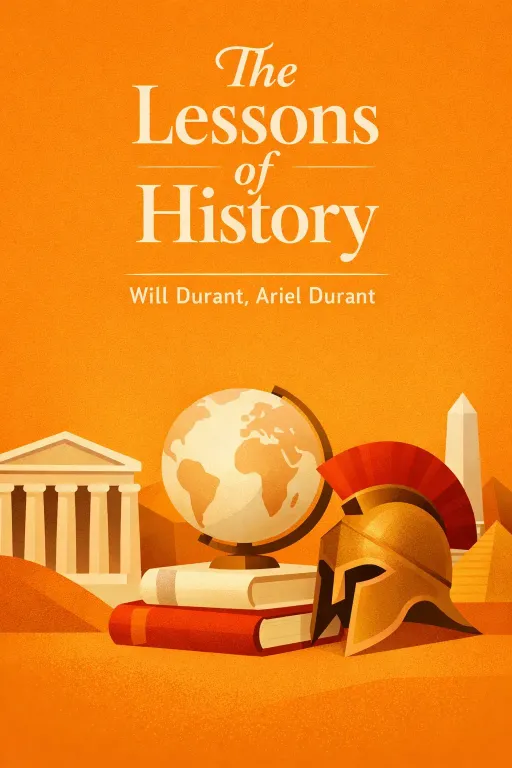
Nova: Exactly! Today, we're diving into insights drawn from monumental works like Will and Ariel Durant's 'The Lessons of History.' Their work distills centuries of human experience into key observations about governance, economics, and human nature. It's a testament to how enduring human patterns are, despite technological shifts. Think of it as a grand historical playbook.
Atlas: A historical playbook for AI innovators? I'm intrigued. So, how do these ancient echoes manifest in our current innovation landscape? Where do we even begin to see these patterns playing out?
The Cyclical Nature of Innovation and Societal Decline
SECTION
Nova: Let's start with the cyclical nature of innovation itself. We often see a burst of ingenuity, a new technology or system emerges, and it brings immense benefits. But inevitably, if not managed wisely, it leads to wealth concentration, social stratification, and eventually, societal decline.
Atlas: That makes me wonder about the dot-com bubble, or even the current AI gold rush. Are you suggesting that the incredible growth and rapid accumulation of wealth we're seeing in the tech sector, particularly with AI, is just a modern iteration of something we've seen before?
Nova: Precisely. Take the Roman Empire. Their innovations in infrastructure, governance, and military strategy allowed for unprecedented expansion and prosperity. But over time, that very success led to vast land ownership by a few, a growing divide between rich and poor, and a heavy reliance on external resources and slave labor. This created internal social friction and instability, weakening the empire from within, even as it appeared strong externally.
Atlas: It's like the initial innovation, say, better roads or a new farming technique, creates this boom, but then the fail to adapt to the consequences of that boom. So, in the AI context, what's our 'wealth concentration' equivalent? Is it data? Compute power?
Nova: That's a sharp observation, Atlas. Today, the 'land' or 'resources' are arguably data, algorithms, and computing power. The companies and individuals who control these assets accumulate immense power and wealth. And just like Rome, if that power becomes too concentrated, if the benefits aren't broadly distributed, you start to see social unrest, calls for regulation, and a sense of disenfranchisement for those left behind.
Atlas: But wait, looking at this from a tech innovator's perspective, isn't the scale of AI's disruption fundamentally different? We're not just talking about better roads; we're talking about systems that can redefine intelligence itself. Is there a point where history's playbook becomes… too old?
Nova: That's a critical question, and it's where the insights become most valuable. While the are new, the remains constant. How societies respond to disruptive power, manage resources, deal with inequality, and adapt to change – these are timeless challenges. The Durants found that human nature, despite its outward changes, remains 'stubbornly the same.' The lessons aren't about the specific technology, but about our collective wisdom – or lack thereof – in handling its implications.
Environmental and Societal Resilience in the Face of Collapse
SECTION
Atlas: So, if innovation and wealth can create these cycles, what about the actual foundations – the environment and society itself? I imagine a lot of our listeners who are focused on sustainable growth might be asking, are we seeing similar pressures today from AI development, not just economically, but environmentally and ethically?
Nova: Absolutely. This leads us to the second core idea, which is beautifully explored in Jared Diamond's 'Collapse.' He examines why some societies thrive while others fail, often highlighting the critical importance of environmental management, climate change, and societal responses to external pressures. It’s a sobering look at how even advanced civilizations can unravel.
Atlas: That gives me chills. So, what's an example of a society that literally collapsed because they ignored these foundational elements?
Nova: A classic case Diamond analyzes is the Norse settlement in Greenland. For centuries, they thrived by applying their European farming and livestock practices to a marginal environment. But they refused to adapt. They wouldn't learn from the Inuit, who had perfected sustainable hunting and fishing in the Arctic. The Norse clung to their European identity, overgrazed their land, deforested for iron smelting and building, and ignored the changing climate. When the 'Little Ice Age' hit, their rigid cultural adherence and environmental mismanagement led directly to their extinction in Greenland.
Atlas: Wow. So it wasn't just the climate change, but their to it – or lack thereof – that sealed their fate. That's a powerful lesson. When I think about AI, its energy consumption, the rare earth minerals needed for hardware, the sheer scale of its computational demands… it makes me wonder if we're creating our own version of 'overgrazing' or 'deforestation' in the digital realm.
Nova: Precisely the parallel we need to consider. The 'Tiny Step' from our discussion asks us to reflect on a current AI challenge and consider how a past civilization might have approached it. For the Norse, their challenge was resource scarcity and environmental shift. Their outcome was collapse because they lacked adaptive capacity and foresight. For us, with AI, the challenge isn't just efficiency but also the ethical 'footprint' – how do we manage this powerful technology sustainably, ensuring it doesn't deplete our planet or exacerbate societal divides?
Atlas: That's a crucial point for the 'Ethical Explorer' in all of us. It’s not just about building the next big thing; it's about building it with wisdom. It's about asking if our innovations are truly sustainable in the long run, not just financially, but environmentally and socially.
Nova: Exactly. History shows us that those societies that were resilient, that adapted and innovated not just technologically but also socially and environmentally, were the ones that endured. It's about integrated thinking, seeing the bigger picture beyond the immediate innovation.
Synthesis & Takeaways
SECTION
Nova: So, what we're really seeing is that the 'innovation trap' isn't about innovating too much, but innovating. It's thinking our challenges are entirely new, when in fact, the patterns of human response to power, wealth, and environmental pressure are ancient.
Atlas: In other words, the AI wave isn't just a technological marvel; it's a profound human challenge. And for the 'Resilient Strategist' and 'Ethical Explorer' out there, this historical playbook offers more than warnings—it offers a blueprint for sustainable growth and purpose. It's about moving beyond just reacting to change, and actively shaping our future with wisdom.
Nova: You've hit on the core of it, Atlas. This isn't about predicting the future, but about understanding the timeless forces that shape it. By looking back, we gain the foresight to build a future that avoids the mistakes of the past, ensuring our AI innovations lead to endurance, not collapse.
Atlas: That's actually really inspiring. It means we have agency, even in the face of such rapid change. So, for everyone listening, reflect on a current challenge in your AI project. How might a past civilization have approached a similar problem, and what was their outcome? What can you learn from their 'historical playbook' today?
Nova: A powerful question to carry forward. Thanks for joining us for this deep dive into history's lessons for today's innovators.
Atlas: It's been incredibly insightful, Nova.
Nova: This is Aibrary. Congratulations on your growth!