

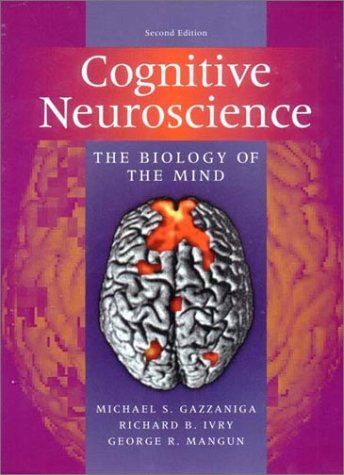
Cognitive neuroscience
The Biology of the Mind
Introduction
Nova: Imagine this: a patient sits in a lab, staring at a dot on a screen. A picture of a snow scene flashes to the left side of his visual field. A chicken claw flashes to the right. Then he's asked to point to matching pictures. His right hand points to a chicken, his left hand points to a shovel. And when the researcher asks why he chose the shovel, the patient without missing a beat says: "You need a shovel to clean out the chicken shed." That patient wasn't crazy. He was a split-brain patient. And the scientist behind that experiment, Michael Gazzaniga, used moments exactly like that to build an entire field of science.
Nova: That's exactly where we're going. Michael Gazzaniga didn't just run those wild experiments. He wrote the textbook. Literally. Cognitive Neuroscience: The Biology of the Mind is the gold-standard undergraduate textbook in the field. It's now in its fifth edition, co-authored with Richard Ivry and George Mangun, and it has shaped how a generation of students understands the brain. But here's the thing: you can't understand this book without understanding the man who wrote it, and the experiments that made him the father of cognitive neuroscience.
Nova: It is. And he earned it. In the late 1970s, Gazzaniga and his colleague George Miller were sitting in a taxi in New York City when they coined the term "cognitive neuroscience." They literally named a field that didn't exist yet. Then Gazzaniga founded the Journal of Cognitive Neuroscience, the Cognitive Neuroscience Society, the first PhD program in the field, and the Summer Institute that trained an entire generation of researchers.
Nova: Exactly. And in the next few minutes, we're going to dive into what makes this book so essential, the groundbreaking split-brain research behind it, the famous left-brain interpreter theory, and the huge philosophical questions Gazzaniga tackles about consciousness and free will. Ready to have your brain examined?
How Gazzaniga Built Cognitive Neuroscience
The Father of a Field and His Masterwork
Nova: Let's start with the book itself. Cognitive Neuroscience: The Biology of the Mind is published by W. W. Norton and spans fourteen dense, beautifully illustrated chapters. It goes from the history of the field, through the structure of the nervous system, all the way to consciousness. And here's a fun fact: Gazzaniga's co-authors are heavyweights in their own right. Richard Ivry at Berkeley and George Mangun at UC Davis are both giants in the field.
Nova: It's elegantly structured. Chapter one is a brief history, from phrenology and Broca's area to modern neuroimaging. Then you get the nuts and bolts: neurons, synaptic transmission, brain anatomy. Chapter three covers methods, everything from EEG to fMRI to computational neuroscience. Then the book really takes off into the meat of cognition. Chapter four on hemispheric specialization is where Gazzaniga's own research shines brightest. Then sensation and perception, object recognition, attention, action, memory, emotion, language, cognitive control, social cognition, and finally, consciousness.
Nova: That's the genius of it. The fifth edition, published in 2019, was reorganized to move more seamlessly from micro to macro. The publisher calls it "universally recognized as the gold-standard text for undergraduate students." But what's really striking is that the sixth edition of The Cognitive Neurosciences, which is the sourcebook for researchers published by MIT Press, features nearly 200 scientists. Gazzaniga edits that series, which comes out every five years and represents a stock-taking of the entire field.
Nova: It is, and it started with a remarkable process. Every five years since 1993, Gazzaniga invites about eight leaders in each sub-specialty for an intense three-week meeting of self-examination. They write chapters, debate, and the result is this massive volume that defines the state of the art. That's alongside the textbook, which serves a completely different audience: the undergraduate just entering the field.
Nova: Right. In 1978, Gazzaniga and George Miller got a small grant from the Sloan Foundation. With it, Gazzaniga established the Cognitive Neuroscience Institute at Cornell. Later, at Dartmouth, he founded the first cognitive neuroscience degree-granting program in the United States. He launched the Journal of Cognitive Neuroscience and served as its first editor-in-chief until 2003. He started the Summer Institute in Cognitive Neuroscience, a two-week intensive program that brought together graduate students and postdocs with leaders in the field. And in 1993, he co-founded the Cognitive Neuroscience Society with Steve Pinker, Daniel Schacter, and others.
Two Hemispheres, Two Minds?
The Split-Brain Revolution
Nova: The split-brain story starts in the early 1960s at Caltech, where Gazzaniga was a PhD student under Roger Sperry, who later won the Nobel Prize in 1981. The setup was this: patients with severe, intractable epilepsy sometimes had their corpus callosum surgically severed. That's the bundle of about 200 million nerve fibers connecting the left and right hemispheres. The idea was to stop seizures from spreading across the brain. And it worked. But it also created a natural experiment that changed neuroscience forever.
Nova: Exactly. And Gazzaniga designed a clever apparatus to test them independently. Here's the key: visual information from the right visual field goes to the left hemisphere, and information from the left visual field goes to the right hemisphere. By flashing an image for just 200 milliseconds, faster than the eye can move, he could send information to one hemisphere only.
Nova: The results were stunning. If you flashed a picture of a cup to the right visual field, the left hemisphere, which controls speech in most people, could name it: "It's a cup." But if you flashed that same picture to the left visual field, the patient would say, "I didn't see anything." But then, if you asked them to reach behind a screen with their left hand, controlled by the right hemisphere, and pick out the object they just saw, they could do it.
Nova: That's exactly right. The right hemisphere is largely mute. It can understand language to some degree, but it can't produce speech. Gazzaniga's first patient, W. J., was a World War II paratrooper. Before surgery, he was having up to seven grand mal seizures a day, each requiring a full day to recover. After his corpus callosum and anterior commissure were severed, the seizures stopped. He said he felt no different. But in the lab, Gazzaniga could demonstrate that W. J.'s two hemispheres were now isolated islands of awareness.
Nova: That became the provocative question. And it's still debated today. A 2020 review paper in the journal Brain laid out the current state of the debate. The authors pointed out that split-brain patients behave in a "socially ordinary" manner outside the lab. Their families don't report two personalities. And certain processes, like action control, seem to remain unified. The question of whether consciousness is truly split remains unresolved. But here's the more important contribution: these patients revealed that the brain is not a single unified processor. It's a collection of specialized modules.
Nova: That's Gazzaniga's core insight. And it leads directly to his most famous theoretical contribution: the left-brain interpreter.
Your Brain's Storytelling Machine
The Left-Brain Interpreter
Nova: Let's return to that experiment I mentioned at the top. A split-brain patient sees a snow scene in the left visual field, which goes to the right hemisphere, and a chicken claw in the right visual field, going to the left hemisphere. When asked to choose matching images, the right hand, controlled by the left brain, points to a chicken. The left hand, controlled by the right brain, points to a shovel. Then Gazzaniga asks: "Why did you pick those?"
Nova: Right. So it says, "Oh, that's simple. The chicken claw goes with the chicken." Then the patient looks down and sees his left hand pointing to a shovel. He has no idea why, because the left hemisphere didn't see the snow scene. But does he say "I don't know"? No. Without missing a beat, he says, "And you need a shovel to clean out the chicken shed."
Nova: And that's the interpreter. Gazzaniga and his student Joseph LeDoux developed this concept in the 1970s. The left hemisphere has a module whose job is to make sense of incoming information, to find patterns, to construct coherent narratives, even when it doesn't have all the data. The interpreter is the part of your brain that tells the story of your life, and it will confabulate when necessary to maintain coherence.
Nova: Absolutely. Gazzaniga says the interpreter is "only as good as the information it gets." It receives the results of computations from hundreds of modules, but it doesn't know about the modules themselves. It doesn't know how they work. It just takes the output and weaves it into a story. This has huge implications. It means that when you explain why you did something, your explanation might be a post-hoc rationalization rather than the real cause.
Nova: Exactly. The amygdala triggers the fear response automatically, faster than conscious awareness. Your conscious brain registers the jump and the snake, infers causality, and you believe you made a decision. Gazzaniga argues that much of our conscious reasoning is this kind of after-the-fact storytelling.
Emergence, Consciousness, and the Modular Mind
Who's in Charge? Free Will and the Decentralized Brain
Nova: That's precisely the question Gazzaniga tackled in his 2011 book, Who's in Charge? Free Will and the Science of the Brain, which grew out of his Gifford Lectures at the University of Edinburgh. His answer is provocative: the brain is not a single decision-maker. It's a decentralized system with thousands of specialized modules operating in parallel, most of them below conscious awareness. There is no CEO in the brain.
Nova: Through a principle called emergence. Gazzaniga's favorite analogy is traffic. If you look at a single car part, like a brake pad, you cannot predict that the 405 freeway in Los Angeles will be jammed at 5:15 PM on a Friday. You can't even predict that the phenomenon of traffic exists from looking at a cam shaft. Traffic emerges from the interaction of millions of cars, drivers, weather, road design, and time. Similarly, consciousness and unified experience emerge from the interaction of countless neural modules, none of which individually is conscious.
Nova: That's a nice way to put it. And Gazzaniga argues that this has direct implications for free will. Most neuroscientists who study this topic lean toward determinism: the idea that our actions are fully caused by prior physical states of the brain. But Gazzaniga takes a different position. He says that while individual neurons follow deterministic physical laws, at the level of the whole person interacting with the social world, a new kind of causality emerges. Responsibility exists at the level of persons in society, not at the level of neurons.
Nova: Right. Gazzaniga served on the President's Council on Bioethics from 2002 to 2009, and in 2007 he became director of the Law and Neuroscience Project, funded by the MacArthur Foundation. This was the first systematic effort to explore how neuroscience should inform the legal system. His conclusion: just because the brain is a physical system doesn't mean we throw out personal responsibility. Responsibility is a social construct, and it operates at the level where humans interact.
Nova: That's his most recent book-length treatment of the big question. Gazzaniga argues that consciousness isn't some mysterious add-on. It's what the brain does. The title says it all: consciousness is an instinct, something that evolved because it helped organisms survive. He draws an analogy to how physicists think about matter. In the 19th century, nobody knew how matter generated heat. Today we understand thermodynamics as emerging from particle interactions. Similarly, Gazzaniga believes consciousness emerges from the modular, parallel architecture of the brain, and understanding it is a scientific problem, not a mystical one.
Nova: That's the beauty of Gazzaniga's career. Everything connects. The textbook, Cognitive Neuroscience: The Biology of the Mind, is the gateway. It's where students first encounter these ideas: that the brain is modular, that consciousness is distributed, that the left hemisphere is a relentless storyteller, and that understanding the biology of the mind might be the most important scientific challenge of our time.
Conclusion
Nova: So what should our listeners take away from all this? First, Michael Gazzaniga didn't just contribute to cognitive neuroscience. He created the architecture of the field: the name, the journal, the society, the PhD programs, the summer institutes, and yes, the textbook that has educated tens of thousands of students around the world. Cognitive Neuroscience: The Biology of the Mind, now in its fifth edition, remains the standard introduction to a field that Gazzaniga himself midwifed.
Nova: Third, this has huge implications for how we think about free will and responsibility. Gazzaniga argues that determinism at the neuronal level doesn't eliminate responsibility at the social level. Different levels of organization have different laws, and the person interacting in society is as real as the neuron firing in the brain. Consciousness and free will emerge from complexity.
Nova: Michael Gazzaniga is now 86 years old, professor emeritus at UC Santa Barbara, and still editing for the Proceedings of the National Academy of Sciences. He recently said in an interview that he's working on yet another book, trying to give a fresh perspective on split-brain research for a new generation. After six decades, he's still asking the big questions. And that's what makes him not just the father of a field, but one of the great scientific storytellers of our time.
Nova: Beautifully said. This is Aibrary. Congratulations on your growth!