

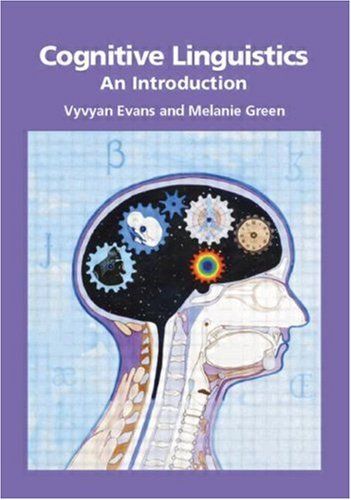
** Mapping the Mind: How Language Shapes Our Ultimate Reality
Golden Hook & Introduction
SECTION
Albert Einstein: Imagine you are riding on a beam of light, looking at a clock. To you, time seems perfectly straightforward, a constant tick-tock guiding the universe. But what if I told you that the way we talk about time, and indeed the way we think about everything from love to quantum physics, is not an objective reflection of the universe, but a construct of our physical bodies and the language we use to navigate them? Today, we are diving into Vyvyan Evans's groundbreaking book, Cognitive Linguistics, to explore how our minds map reality. We will tackle this from three distinct angles. First, we will look at how language is not just a tool for communication, but the very architecture of our thought. Second, we will explore the concept of embodied cognition, the idea that our physical bodies dictate our abstract concepts. And finally, we will synthesize these ideas to ask what this means for the ultimate truth of human learning and education. Joining me today is Dr. Zen, a brilliant educational researcher who spent over fifteen years studying how we acquire knowledge. Welcome, Zen.
Zen: Thank you, Albert. It is an absolute pleasure to be here. As someone who has spent a career looking at how people learn, I find cognitive linguistics to be one of the most exciting frontiers. It challenges the traditional view that language is just a passive mirror of the world. Instead, it shows that our conceptual systems are actively built through our physical interactions with our environment. For an educator or a researcher, understanding this is like finding the source code of human thought.
Albert Einstein: The source code, I love that. You know, in physics, we always look for the simplest, most elegant laws to explain complex phenomena. In cognitive linguistics, it seems the elegant law is that our minds are fundamentally metaphorical. We do not just use metaphors to write poetry; we use them to think.
Zen: Exactly. Evans argues that our conceptual system is structured by these deep, underlying conceptual metaphors. We map a concrete source domain, something we can physically touch or experience, onto an abstract target domain, like time, or ideas, or even the mind itself.
Albert Einstein: Yes, like saying time is money. We spend time, we waste time, we save time. It is as if time is a physical currency we keep in our pockets.
Zen: Precisely, Albert. And because we use that metaphor, we actually experience time as a limited resource. It shapes our behavior, our anxiety, and our societal structures. It is not just a way of speaking; it is a way of being.
Deep Dive into Core Topic 1
SECTION
Albert Einstein: Let us look closer at this idea of conceptual metaphors. In his book, Evans talks about how these mappings are systematic. It is not just a random comparison. It is a highly structured projection from one domain to another. For instance, think about how we talk about arguments. We say, he attacked my point, or her criticisms were right on target, or I demolished his argument. We are mapping the physical domain of war onto the intellectual domain of conversation.
Zen: That is a classic example from the literature, Albert, and it has massive implications for education. If a student conceptualizes an argument as war, their goal in a classroom discussion is to win, to defend their territory, and to destroy the opponent's position. But what if we changed the metaphor? What if we conceptualized an argument as a collaborative journey, or a dance? Suddenly, the goal is not to defeat the other person, but to move gracefully together or reach a new destination. The entire cognitive and emotional framework of the learning experience shifts.
Albert Einstein: A dance of ideas. That is beautiful. It reminds me of how we struggle to conceptualize things in physics that we cannot see, like gravity or curved spacetime. We have to use metaphors. We talk about spacetime as a fabric that is bent by heavy objects, like a bowling ball on a trampoline. It is a physical analogy that helps our minds grasp the mathematics. But we must be careful, right? The metaphor is not the ultimate truth itself; it is a bridge to it.
Zen: That is a crucial distinction, Albert. As an INTJ, I am always looking for the underlying systems and the limits of those systems. Cognitive linguistics teaches us that while metaphors are essential for thought, they also constrain thought. They highlight certain aspects of a concept while hiding others. If we only view learning through the metaphor of acquisition, as in, the student is a container and the teacher pours knowledge into them, we miss the active, constructive nature of learning. We treat the mind as a warehouse rather than an ecosystem.
Albert Einstein: A warehouse versus an ecosystem. Yes, the container metaphor is very powerful but very limiting. I always felt that school was trying to pack too many facts into my container, when what I really wanted was to wonder, to look at the stars and ask why.
Zen: And that wonder is actually rooted in our physical existence. Evans details how cognitive linguistics emerged as a reaction against the formal, Chomskyan view that language is an abstract, mathematical system of rules divorced from human experience. Instead, cognitive linguistics says language is usage-based. It grows out of our daily lives, our social interactions, and our physical bodies.
Albert Einstein: This usage-based approach is fascinating. It means that language is dynamic, constantly evolving as we interact with our world. It is like a path through a forest. The path is not designed by a master architect in advance; it is created by the feet of the people who walk it. The more people walk a certain way, the deeper the path becomes.
Zen: That is a perfect analogy, Albert. In educational research, we see this in how language and concepts develop in children. They do not learn abstract grammar rules first and then apply them. They learn specific, concrete constructions in context. They hear, where is the ball, or put it on the table, and they gradually abstract patterns from those concrete experiences. The grammar emerges from the usage, not the other way around.
Albert Einstein: It is the same in science. We do not start with the grand equations. We start with the concrete observations, the anomalies, the physical sensations of the world, and we slowly build the mathematical language to describe them. But tell me, Zen, how does this connect to our physical bodies? How does the physical shape of a human being influence how we think about abstract things like justice or truth?
Deep Dive into Core Topic 2
SECTION
Zen: This brings us to the second major pillar of cognitive linguistics: embodied cognition. Evans explains that our conceptual categories are grounded in our bodily experience. We are upright, bipedal creatures with a front and a back, living in a world with gravity. This simple physical reality shapes our entire conceptual system. For example, think about the metaphor, happy is up, sad is down.
Albert Einstein: Ah, yes. We say, I am feeling up today, or my spirits rose, or I am feeling down, depressed. Why do we do that?
Zen: Because of our physical bodies. When we are happy and healthy, we stand up straight. When we are sad, sick, or dead, we droop or lie down. Our physical posture is projected onto our emotional states. This is not arbitrary. It is a direct consequence of having a body in a gravitational field.
Albert Einstein: That is marvelous. If we were intelligent jellyfish floating in a deep ocean with no sense of up or down, our language for happiness and sadness would be completely different. Perhaps we would talk about expansion and contraction, or warmth and cold.
Zen: Absolutely. Our very concept of reality is human-centric because it is filtered through our human sensory-motor system. This is what cognitive linguists call experiential realism. The ultimate truth we can access is always mediated by our biological hardware. For an educator, this is a profound realization. It means that abstract concepts must be grounded in physical, concrete experiences if they are to be truly understood.
Albert Einstein: This is why thought experiments are so powerful. When I was trying to understand relativity, I did not just look at equations. I imagined falling off a roof, or being inside an elevator accelerating through space. I used my physical intuition, my bodily sense of motion and gravity, to explore the universe. I was embodying the physics.
Zen: Yes, and that is exactly how deep learning happens. In modern educational design, we are moving away from passive lecturing toward embodied learning. We use manipulatives in mathematics, physical simulations in science, and role-playing in humanities. We are literally helping students use their bodies to build their minds. If you want a child to understand fractions, do not just write numbers on a board. Have them cut a physical pie, or walk a number line. They need to feel the distance, the division.
Albert Einstein: It makes complete sense. The mind is not a separate entity floating above the body like a ghost in a machine. The mind is the body in action. But this raises a fascinating question about the ultimate truth. If our knowledge is entirely shaped by our human embodiment and our linguistic metaphors, is there an objective truth out there, or are we trapped in a subjective bubble of our own making?
Zen: That is the ultimate question, isn't it? Evans addresses this by showing that cognitive linguistics does not lead to a radical, anything-goes relativism. Instead, it suggests a middle ground. We all share a common human biology and we all inhabit the same physical earth. Therefore, our conceptual systems, while metaphorical, are constrained by the real world. Our metaphors must work. They must help us navigate gravity, find food, and cooperate with others. If a metaphor is completely disconnected from physical reality, it will fail.
Albert Einstein: Yes, the universe has a way of talking back to us. If my theories about gravity were wrong, the planets would not obey them. The equations must match the observations. So, while our language is a human construct, it is constantly being tested against the hard edges of reality. It is a dialogue between the mind and the cosmos.
Zen: Beautifully put, Albert. It is a dialogue. And in that dialogue, language is the medium. It is the interface. As researchers, when we look at how different cultures categorize the world, we see incredible diversity, but we also see deep universal patterns. These universals come from our shared embodiment, while the diversity comes from the different ways cultures choose to elaborate on those basic physical experiences.
Synthesis & Takeaways
SECTION
Albert Einstein: We have journeyed from the structure of metaphors to the physical grounding of our thoughts. It seems to me that the ultimate truth of cognitive linguistics is that we are creators of meaning. We do not just discover the world; we actively interpret it through the lens of our physical and linguistic heritage. Zen, as we wrap up our conversation, how do we apply this to our lives, and especially to how we teach and learn?
Zen: I think the most powerful takeaway is the need for conceptual awareness. We must become conscious of the metaphors we live by. If you are an educator, ask yourself: what metaphors am I using to describe my students and my subject? Am I treating my classroom as a factory, where I produce standardized units of output, or as a garden, where I cultivate unique living things? The metaphors we choose dictate our methods, our assessments, and our relationships.
Albert Einstein: Yes, and for the individual learner, it is about embracing the physical, intuitive side of understanding. Do not be afraid to use your imagination, to create physical analogies, to play with concepts. The intellect alone is a dry tool; it needs the wetness of experience, the warmth of intuition, to truly come alive.
Zen: Exactly. We must design learning environments that honor the whole human being, body and mind. We need to give students the space to build their own conceptual bridges, rather than just forcing them to memorize ours. That is how we foster true creativity and deep, systemic thinking.
Albert Einstein: A wonderful place to conclude. To our listeners, we leave you with this question to ponder: what are the hidden metaphors shaping your daily life, your work, and your relationships? Are they opening doors to new understanding, or are they keeping you locked in an old way of thinking? Perhaps it is time to step out of the container and join the dance. Thank you, Zen, for this deeply stimulating conversation.
Zen: Thank you, Albert. It was an honor to explore these ideas with you.