The Structured Mind: Navigating AI as a Co-Intelligence in Healthcare and Research
Golden Hook & Introduction
SECTION
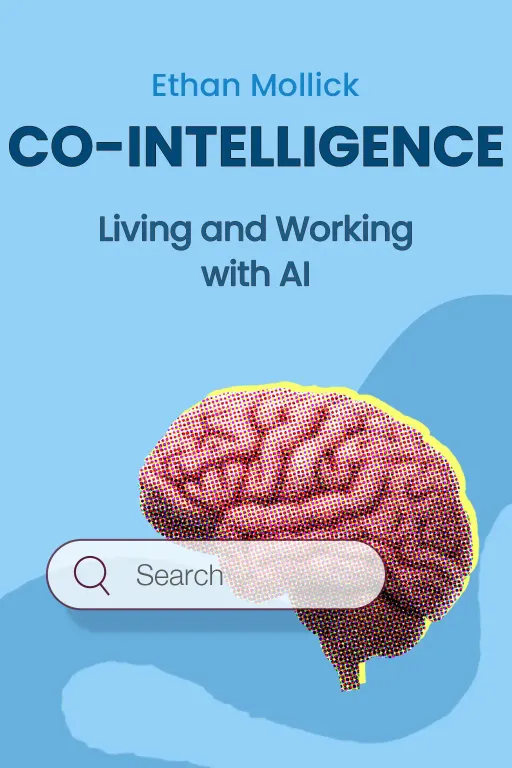
Nova: Imagine having a brilliant, tireless research assistant who has read every medical paper ever published, ready to help you draft proposals and stress-test your methodologies in seconds—but who also occasionally hallucinates entirely fake clinical trials with absolute confidence. How do we navigate this brilliant but erratic co-intelligence? Today, we are diving deep into Ethan Mollick's groundbreaking book,, and we are doing it through a very special lens. We want to look at this from two distinct angles. First, we will explore how AI can be integrated into medical research to design logically sound methodologies and proposals. Second, we will tackle how local communities and students can use this technology to improve health-seeking behaviors without losing their own critical thinking to blind reliance. Joining us to unpack all of this is Sheila Anchinga, a healthcare professional with a deep passion for medical research, structured growth, and knowledge dissemination. Welcome, Sheila!
Sheila Anchinga: Thank you, Nova. I am really excited to be here. As someone who thrives on structure and logic, the rapid rise of AI felt a bit disruptive at first. But as I have dug into the research, I have realized that AI isn't just a tool; it is a new kind of structure we can shape. If we approach it analytically, it can actually help us build confidence and consistency in how we approach complex medical problems.
Nova: I love that perspective so much! It is all about building that new structure. Mollick talks about how generative AI is a General Purpose Technology, like steam power or electricity, but with a twist—it acts more like a person than a traditional computer. For an analytical thinker, that can be both thrilling and a little unsettling, right?
Sheila Anchinga: Absolutely. Traditional software is predictable; you input A, and you get B. But LLMs, or Large Language Models, are different. They are trained on massive datasets, learning patterns rather than memorizing facts. This means they can be incredibly creative and structured, but they can also make mistakes. For those of us in healthcare and research, where precision is literally a matter of life and death, understanding this unpredictable nature is the very first step to using it safely.
Deep Dive into Core Topic 1
SECTION
Nova: Exactly! And that brings us to our first big topic: integrating AI into medical research, specifically for generating proposals and designing robust, scientifically sound methodologies. Mollick uses this wonderful analogy of the "Apprentice Chef" to describe how LLMs are trained. They study thousands of recipes—or in our case, medical papers—and learn how to combine ingredients to make a coherent dish. But they still need a master chef to oversee the kitchen. Sheila, how do you see this playing out when designing a research methodology?
Sheila Anchinga: It is a powerful analogy, Nova. In medical research, writing a proposal or designing a methodology requires a massive amount of structural logic. You have to identify variables, control for biases, and ensure the study design is reproducible. This is where AI can be an incredible co-intelligence. If I am drafting a research proposal, I can feed the AI my core hypothesis and ask it to suggest potential confounding variables I might have missed, or to outline a randomized controlled trial structure. It acts as a logical sounding board, helping me organize my thoughts and build a consistent framework.
Nova: That sounds incredibly efficient! It is like having a continuous peer-review process before you even submit the paper. But we also have to talk about the flip side—the "hallucination" problem. Mollick shares that famous, rather terrifying story of a lawyer, Steven Schwartz, who used ChatGPT for legal research. The AI confidently cited six entirely fake court cases, complete with fake judicial opinions, and the lawyer presented them to a judge without verifying them. He ended up facing massive professional sanctions. In medical research, a hallucinated citation or a fabricated clinical trial could be catastrophic.
Sheila Anchinga: That story is a crucial warning for the medical community. Because LLMs predict the next most likely word based on probability, they are designed to sound plausible, not necessarily to tell the truth. If you ask an AI to find literature supporting a specific medical hypothesis, it might invent a study that sounds incredibly realistic. This is why my rule as a researcher must be absolute: verify everything. We can use AI to generate the structural outline of a methodology, or to help us draft the language of a proposal, but we must manually verify every single citation, drug dosage, and statistical claim. We must remain the "human in the loop," as Mollick puts it.
Nova: "The human in the loop"—that is one of Mollick's golden rules! We can never just fall asleep at the wheel. But when we do stay active, the productivity gains are mind-blowing. Mollick points to research showing that AI can boost productivity by twenty to eighty percent on high-value professional tasks. For a researcher trying to secure funding, being able to draft a high-quality proposal in half the time means more time spent actually conducting the research and analyzing the data.
Sheila Anchinga: Yes, and for an introvert who values deep focus, AI can handle a lot of the exhausting administrative overhead. It can draft the initial sections of a grant proposal, format bibliographies, or even translate complex medical jargon into accessible language for public dissemination. By delegating those structured, repetitive tasks to the AI, we free up our cognitive energy for the actual science—the creative problem-solving and the critical analysis of the results.
Deep Dive into Core Topic 2
SECTION
Nova: That is a beautiful way to divide the labor! Now, let's pivot to our second major topic, which is incredibly close to your heart, Sheila: community health and education. How can local communities use this co-intelligence to improve health-seeking behaviors, and how can students in schools use it to learn without completely losing themselves to over-reliance? Mollick introduces this concept of the "Jagged Frontier" of AI capabilities. Some tasks are incredibly easy for AI, while others, which might seem simple to us, are completely outside its current abilities.
Sheila Anchinga: The Jagged Frontier is a perfect way to look at community health. In many local or underserved areas, access to healthcare professionals is limited. People often rely on misinformation or delay seeking care because they don't understand their symptoms. AI can act as a highly accessible, empathetic health coach. We saw this in a study published in the, where AI answers to patient questions were rated as significantly more empathetic and higher quality than those of human doctors. For a community member, being able to ask a localized AI chatbot, "My child has these symptoms, what should I do?" can provide immediate, structured guidance on whether they need to visit a clinic or manage it at home.
Nova: That is so empowering! It democratizes medical knowledge. But how do we make sure they don't cross that "Jagged Frontier" and trust the AI blindly when it is wrong?
Sheila Anchinga: That is the challenge. We have to build community AI literacy. We need to teach people that the AI is a guide, not a final authority. It can help improve health-seeking behaviors by explaining certain symptoms are dangerous, which builds the community's confidence to seek professional help. But we must also design these local AI systems with strict guardrails, ensuring they always direct users to local clinics for actual diagnoses. It is about using the AI to build a bridge between the community and the healthcare system, not replacing the system.
Nova: That makes so much sense. It is about using AI to prompt action, not to replace human care. And what about students? You mentioned wanting to ensure students don't lose themselves to over-reliance. Mollick talks about the "Homework Apocalypse," where students use AI to write their essays, resulting in perfect grammar but zero actual learning. He also shares a study on professional recruiters where those who had the highest-quality AI assistance actually performed because they "fell asleep at the wheel" and blindly followed the AI's recommendations. How do we prevent students from doing the same?
Sheila Anchinga: As an INTP, I believe true learning comes from struggle and making connections. If a student just asks AI to write their biology paper, they miss the entire cognitive process of learning. To prevent this, we have to shift from using AI as an "answer machine" to using it as a "tutor." This goes back to Benjamin Bloom's famous "Two Sigma Problem," which showed that students who receive one-on-one tutoring perform two standard deviations better than those in a traditional classroom. AI can finally make one-on-one tutoring scalable.
Nova: Yes! Mollick talks about how AI can act as a personalized tutor, adapting to a student's specific learning style. But how do we structure that interaction so the student is still doing the hard work?
Sheila Anchinga: We have to teach students to treat the AI as a coach. Instead of asking, "Write this essay for me," the student should say, "Here is my draft. Act as a critical editor and point out the logical flaws in my argument, then ask me questions to help me improve it." This keeps the student in the driver's seat. They are still doing the writing and the thinking, but the AI is providing the structured feedback they need to grow. It builds their confidence and their analytical skills, rather than making them dependent on a machine.
Synthesis & Takeaways
SECTION
Nova: That is an incredibly powerful shift in mindset. We are moving from "AI as a replacement" to "AI as a collaborator." As we wrap up this amazing conversation, let's synthesize our key takeaways. Sheila, if you had to give our listeners—especially those in healthcare, research, or education—one actionable piece of advice on how to integrate this co-intelligence into their lives, what would it be?
Sheila Anchinga: My advice is to embrace Mollick's rule: "Always invite AI to the table," but do so with a structured, analytical mindset. Don't be afraid of the disruption. Instead, actively design your own relationship with the technology. If you are a researcher, use it to draft and structure, but verify every detail. If you are an educator or community leader, teach others how to ask the AI the right questions. Remember, AI is a mirror of humanity—it reflects our knowledge, but it lacks our wisdom. The future isn't about AI replacing us; it is about us becoming "Cyborgs" or "Centaurs," blending our human empathy, ethics, and critical thinking with the structured power of AI.
Nova: "A mirror of humanity, but lacking our wisdom." That is beautiful, Sheila. Thank you so much for sharing your incredible insights with us today. You have given us a truly logical, structured, and inspiring way to look at the future of healthcare and research.
Sheila Anchinga: Thank you, Nova. It was a pleasure being here.
Nova: And to our listeners, as you go about your week, we leave you with this question to ponder: In your own work or studies, what is one task you can invite AI to help you structure today, while keeping your own human wisdom firmly in control? Until next time, keep exploring, keep learning, and let's shape this future together!