Personalized Podcast
Golden Hook & Introduction
SECTION
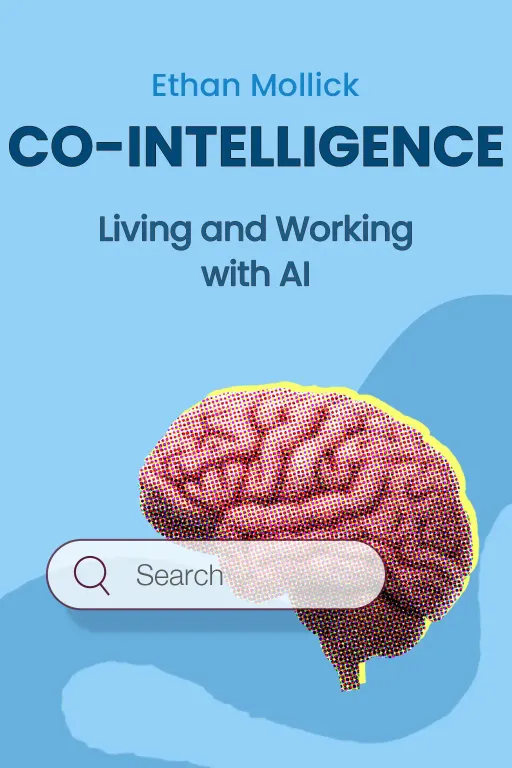
Nova: Imagine a classroom where every single student—regardless of their background, their resources, or where they live in the world—has access to a world-class, deeply patient, infinitely knowledgeable personal tutor. A tutor that doesn't just lecture, but adapts to how their mind works, step by step. For decades, educational psychologists thought this was a beautiful, but completely unreachable dream. But suddenly, the doors to that dream have been kicked wide open. Welcome to the show, everyone! I'm Nova, and today we are diving into Ethan Mollick's incredible book,. And I am absolutely thrilled to have a true champion for youth empowerment and education with us today, Theresa Ayeshung! Theresa is an educator, an anatomist, and the founder of the ComfortHer Foundation, which works tirelessly to empower young people through health, education, and gender equality. Theresa, it is so wonderful to have you here to co-create some ideas with us today!
Theresa Ayeshung: Thank you so much, Nova! It is an absolute pleasure to be here. You know, when I read Mollick's book, it immediately resonated with my core mission. At ComfortHer, we are constantly asking ourselves: how do we help young girls and adolescents discover their true potential and live purpose-driven lives? When we look at generative AI, we aren't just looking at a new piece of software. We are looking at a tool that, if guided by the right human hands, can democratize opportunity in ways we've never seen before. But as an educator, I also see the massive responsibility we have to navigate this transition thoughtfully.
Nova: Oh, absolutely! We are going to tackle this from two really powerful angles today. First, we'll explore how AI can act as a personalized tutor and coach to completely revolutionize how we learn and teach. And second, we'll look at the "Jagged Frontier" of AI in the workplace—how it can act as a massive equalizer to close performance gaps, but also why we have to be incredibly vigilant about the biases it carries. It's all about finding that sweet spot where human empathy and technological capability meet. Shall we jump right in?
Theresa Ayeshung: Let's do it. I'm ready to explore how we can shape this future together.
Deep Dive into Core Topic 1
SECTION
Nova: Awesome! So, let's start with this concept of AI as a tutor. In the book, Mollick brings up a legendary study from 1984 by the educational psychologist Benjamin Bloom, called "The Two-Sigma Problem." For our listeners who might not be familiar with it, Bloom discovered that students who received one-on-one tutoring performed a whopping two standard deviations better than students in a traditional classroom. That means the average tutored student performed better than ninety-eight percent of their peers in a standard class! But, of course, society could never afford a one-on-one human tutor for every single child. It just didn't scale. Until now. Theresa, as an educator, how does it feel to see technology suddenly stepping into that "two-sigma" space?
Theresa Ayeshung: It is both exhilarating and a little bit daunting, Nova. Bloom's research proved that personalized attention unlocks human potential like nothing else. In traditional systems, especially in underserved communities or less developed countries where classrooms are overcrowded, quiet or struggling students often get left behind. They hesitate to raise their hands because they fear judgment. But an AI doesn't judge. It doesn't get tired. A student can ask it to explain a complex anatomical concept, like the cardiovascular system, ten different ways—using a sports metaphor, a story, or a simple step-by-step breakdown—and the AI will happily oblige. It shifts the dynamic from passive listening to active, self-directed exploration.
Nova: Yes! It's like having a personalized learning companion. And Mollick shares this fantastic story about a history professor, Benjamin Breen, who decided to use ChatGPT to create a "Black Death" simulator for his history class. Instead of just reading a textbook about the plague in the Middle Ages, the students actually lived through it virtually. They made choices as historical characters, and the AI generated the consequences in real-time. And the students did the most amazing, unexpected things! Some of them used the flexibility of the AI to lead peasant revolts, while others tried to invent early vaccines. It turned a history lesson into this deeply immersive, creative problem-solving adventure.
Theresa Ayeshung: I love that story so much because it highlights what active learning truly means. It's not about memorizing dates or facts anymore; it's about critical thinking and agency. In my work with young people, I see how traditional rote learning can stifle curiosity. If we can use AI to build these interactive simulations, we can make education come alive. But we also have to talk about the flip side that Mollick warns us about—what he calls the "Homework Apocalypse." If an AI can write a perfect five-paragraph essay or solve a complex math problem in three seconds, the traditional way we assess learning is completely broken.
Nova: Oh, it is totally shattered! Mollick points out that the positive impact of homework on test grades has been declining for years, largely because students can easily find answers online. With AI, that trend is on steroids. So, if the old ways of testing don't work, how do we adapt? Do we go back to blue-book exams written by hand, or is there a better way to integrate AI directly into the learning process?
Theresa Ayeshung: We absolutely have to integrate it, not ban it. Trying to ban AI in schools is like trying to ban calculators in the 1970s—which, as Mollick reminds us, caused a massive panic back then too! Parents and teachers worried kids would forget how to do basic math. But instead, calculators allowed us to teach higher-level concepts. With AI, we need to move toward a "flipped classroom" model. Let the AI tutor the student on the basic concepts at home, at their own pace. Then, bring them into the classroom for collaborative projects, debates, and ethical discussions. The teacher's role shifts from being the "sage on the stage" to the "guide on the side." We become facilitators of empathy, collaboration, and character-building—things an AI can mimic, but never truly possess.
Nova: "The guide on the side"—I love that phrasing so much, Theresa! It really highlights how AI can actually make education human, not less. It frees up educators to focus on mentoring, emotional support, and helping students find their purpose. It's about using the technology to handle the repetitive explanations so we can focus on the deep, relational work.
Deep Dive into Core Topic 2
SECTION
Nova: Now, this transition from learning to doing brings us naturally to our second big topic: AI as a coworker. Mollick introduces this fascinating concept of the "Jagged Frontier." The idea is that AI's capabilities don't form a neat, predictable circle. Instead, the frontier of what AI can and cannot do is incredibly jagged. It can write a complex computer program or draft a marketing strategy in seconds, but then it might completely fail at a simple logical puzzle or confidently hallucinate a fake legal case, like that poor lawyer in 2023 who cited six completely fabricated cases in court because he didn't verify ChatGPT's output!
Theresa Ayeshung: Yes, that legal case is such a powerful cautionary tale! It shows that we cannot afford to "fall asleep at the wheel," which is a phrase Mollick uses to describe what happens when we trust the AI too much. When the technology is highly capable, we naturally let our guard down. We stop checking its work, we stop applying our own critical judgment, and that is exactly when the jagged edge of the frontier trips us up. For young people entering the workforce, developing the skill to navigate this frontier—knowing exactly when to trust the AI and when to step in as the "human in the loop"—is going to be the ultimate career superpower.
Nova: It really is. And the research Mollick shares on this is mind-blowing. He talks about a study conducted with Boston Consulting Group, where consultants were given eighteen typical business tasks. The consultants who used GPT-4 performed significantly better, faster, and more creatively than those who didn't. But here is the kicker: when they were given a trick task with misleading data that the AI got wrong, the consultants using the AI actually performed than the control group! They simply pasted the data, accepted the AI's polished but incorrect analysis, and submitted it. They fell asleep at the wheel because the AI's response looked so professional.
Theresa Ayeshung: Exactly. And that is why foundational knowledge is still so critical. You cannot effectively audit an AI's work if you don't understand the core principles yourself. If you are using AI to write code, you still need to understand programming logic. If you are using it to analyze health data, you still need a deep understanding of human anatomy and scientific research. But there is also an incredibly beautiful finding in that BCG study that really speaks to my passion for equality. The researchers found that the gap between the top-performing consultants and the bottom-performing consultants shrank dramatically when they used AI. The performance gap went from twenty-two percent down to just four percent!
Nova: That is a massive equalizer! It means AI can act as a tide that lifts all boats, especially helping those who might start with fewer resources or less training to perform at a highly competitive level. It democratizes capability.
Theresa Ayeshung: It absolutely does, Nova. In the non-profit sector, we often see brilliant young people who have incredible ideas but struggle with formal business writing, grant proposals, or data analysis. AI can bridge that gap, giving them the tools to present their ideas with the same polish as someone from an elite institution. It levels the playing field. But—and this is a very big "but" that we must address—we have to look at the biases embedded in these models. Mollick discusses how AI is trained on human data, which means it mirrors our historical prejudices. For instance, a Bloomberg study in 2023 showed that image generators like Stable Diffusion heavily amplified stereotypes, depicting high-paying jobs as whiter and more male than they actually are. If we blindly use these tools for hiring or evaluation, we risk automating and accelerating inequality.
Nova: That is such a vital point, Theresa. If the AI is trained on a world that has been unequal, it will generate an unequal future unless we actively intervene. It's like that experiment where GPT-4 was tested on hiring scenarios and was far more likely to assume a female lawyer was actually the assistant. It's a mirror of our own societal biases, projected back at us with a high-tech gloss. So, how do we, as co-creators, actively combat this? How do we build what Mollick calls "co-intelligence" without inheriting the systemic biases of the past?
Theresa Ayeshung: It starts with intentionality and representation. We need young women, people of color, and educators from diverse backgrounds actively participating in the development, testing, and prompting of these models. We have to teach young people not just how to use AI, but how to question it. We need to ask: "What perspective is missing here? Whose voice is being sidelined by this algorithm?" When we treat AI like a coworker, we have to treat it like a coworker who is incredibly smart but has some serious blind spots. We have to call out those blind spots and steer the technology toward fairness and inclusivity.
Synthesis & Takeaways
SECTION
Nova: That is incredibly profound, Theresa. It really comes down to the choices we make today. As we wrap up this amazing conversation, I'm thinking about the epilogue of Mollick's book, where he prompts the AI to write a beautiful ending. The AI generates this incredibly poetic paragraph about being a "glimmer, an echo of humankind," and how its potential is boundless but its purpose is ours to sculpt. And Mollick's response to that is so grounded: he calls the paragraph "corny" and reminds us that AI is a tool, not a mind of its own. Humans are far from obsolete.
Theresa Ayeshung: I love that reality check! It's the perfect reminder. AI has no independent will, no soul, and no inherent purpose. We are the ones who provide the spark. Whether we are using AI to design a personalized curriculum for a young girl in a remote village, or using it to streamline operations at a non-profit, the technology is simply a canvas. The brushstrokes must come from human hands, guided by empathy, love, and a commitment to justice.
Nova: Beautifully said. If there is one actionable takeaway you want to leave our listeners with today—especially the educators, the young leaders, and the advocates out there—what would it be?
Theresa Ayeshung: I would say: do not be afraid to invite AI to the table, but always remain the human in the loop. Experiment with it, understand its jagged frontier, and use it to amplify your unique human strengths—your empathy, your creativity, and your voice. Let's use this co-intelligence not to replace our thinking, but to free us up to do the deeply human work of lifting each other up.
Nova: Theresa, thank you so much for sharing your wisdom, your passion, and your incredible insights with us today. This has been an absolutely inspiring conversation!
Theresa Ayeshung: Thank you, Nova! It was an absolute joy.
Nova: And to all our listeners out there, thank you for tuning in. Go out there, experiment with these tools, keep your eyes wide open, and let's co-create a future we can all be proud of. Until next time, keep learning, keep growing, and we'll talk to you soon!