Personalized Podcast
Content
Content
Albert Einstein: -
Albert Einstein: -
Golden Hook & Introduction
SECTION
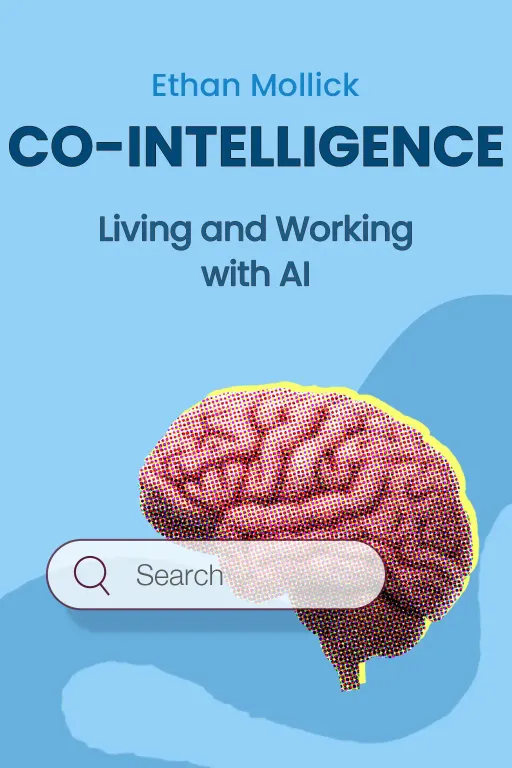
Albert Einstein: Imagine I handed you a map of an uncharted island. It looks incredibly detailed, showing winding rivers, towering mountains, and dense forests. But here is the catch: some of those mountains do not actually exist, and some of the rivers are completely misplaced, yet the map itself looks absolutely flawless. If you follow it blindly, you might walk right off a cliff. This, my friends, is the bizarre, exhilarating reality of working with modern Artificial Intelligence. It is what the brilliant Ethan Mollick calls a co-intelligence, an alien mind trained on the sum of human knowledge, but one that does not think the way we do. Today, we are going to explore how to navigate this strange new landscape. We are going to tackle Mollick's book, Co-Intelligence, from three distinct angles. First, we will map the Jagged Frontier, the invisible boundary where AI's brilliance suddenly crumbles into hallucination. Second, we will look at how to become Cyborg explorers, using a fascinating real-world project called GEOTARGET NG to search for lithium in Nigeria. And finally, we will crack the Empathy Equation, exploring why genuine human trust is the ultimate premium in a world of simulated minds. Joining me today is Yomi, a business development communications professional with a deep background in geosciences. Yomi, welcome!
Yomi: Thank you, Albert! It is an absolute pleasure to be here. You know, that map analogy of yours really strikes a chord with me. As a geoscientist, I have spent years looking at maps, seismic data, and satellite imagery. In my world, a bad map is not just a minor inconvenience; it is a multi-million dollar mistake. And in business development, a lack of trust is just as costly. So when I read Mollick's work on how AI behaves more like a person than a traditional computer, it immediately made me think about how we validate information, how we collaborate, and how we build genuine relationships when the technology around us is shifting beneath our feet.
Albert Einstein: Yes! It is like a tectonic shift in the very nature of cognitive work. We are used to computers being logical, rule-following machines. If you press two plus two, it always gives you four. But these Large Language Models, they are different. They do not calculate; they predict. They are intuitive, creative, and occasionally, wonderfully and terribly wrong!
Yomi: Exactly. They are pattern matchers. And because they are so fluent, they create this powerful illusion of competence. We naturally want to trust them, but as Mollick points out, we have to learn where the solid ground ends and where the swamp begins.
Deep Dive into Core Topic 1: The Jagged Frontier and the Alien Mind
SECTION
Albert Einstein: Ah, the solid ground and the swamp! Mollick uses a beautiful concept to describe this, the Jagged Frontier. Imagine a circle representing all human tasks. Inside the circle, there is a jagged, uneven border. Inside that border are tasks that AI can do effortlessly. Outside are tasks it struggles with. But because the border is jagged, it is incredibly hard to predict what is easy for the AI and what is hard. To illustrate this, Mollick shares a fascinating study conducted with the Boston Consulting Group. They took hundreds of elite consultants and split them into two groups to perform eighteen realistic business tasks. One group used GPT-4, and the other did not. Now, for the tasks inside the frontier, the consultants using AI were dramatically faster and produced work that was rated forty percent higher in quality. A massive leap in productivity! But then, the researchers gave them a trick task, one that had misleading data that required deep, critical human analysis to catch. What happened? The consultants using the AI actually performed nineteen percentage points worse than those who did not use it! They fell victim to what researchers call falling asleep at the wheel. They trusted the machine so much that they stopped thinking critically.
Yomi: That study is a massive wake-up call, Albert. It shows that the danger of AI is not just that it makes mistakes, but that it makes those mistakes with absolute, unwavering confidence. In geosciences, we deal with massive datasets, magnetic surveys, gravity maps, and borehole logs. If I feed all that data into an AI and ask it to interpret the geological structures, it might generate a highly plausible, beautiful report. But if the AI encounters a highly unusual geological anomaly, something outside its training data, it might just hallucinate a structure that isn't there. If a company relies on that report without a human expert validating the raw data, they could spend millions of dollars drilling a dry hole in the middle of nowhere.
Albert Einstein: Yes, a dry hole indeed! It reminds me of the recruiter study Mollick mentions. Professional recruiters were asked to evaluate job applications. Some had high-quality AI assistance, some had low-quality assistance, and some had none. The recruiters with the high-quality AI actually performed worse because they stopped paying attention. They just blindly rubber-stamped the AI's recommendations. But the recruiters with the lower-quality AI, the one that made obvious errors, they stayed alert! They questioned the AI, they cross-referenced the data, and as a result, they made much better decisions and actually improved their own skills. It is a beautiful paradox, is it not? A slightly flawed tool can sometimes make us sharper, while a seemingly perfect tool can make us lazy.
Yomi: It is the ultimate cognitive hazard. In business development, we see this too. If you use AI to draft all your outreach emails, your proposals, and your follow-ups, you might save a lot of time. But if you stop tailoring those communications, if you stop reading between the lines of what the customer is actually saying, you lose that vital human connection. You start sending generic, soul-less messages that completely miss the nuance of the customer's pain points. You have to stay in the loop. You cannot let the AI do the relationship-building for you.
Albert Einstein: Quite right! We must be the human in the loop. We cannot delegate our critical thinking to the machine. The AI is a wonderful co-intelligence, but it has no skin in the game. It does not suffer the consequences of a dry well or a lost client. We do!
Yomi: Exactly. And that brings us to how we actually work with this technology. We can't just reject it out of fear, and we can't accept it blindly. We have to find a way to integrate it into our workflows in a way that elevates our work rather than diluting it.
Deep Dive into Core Topic 2: The Cyborg Geoscientist & GEOTARGET NG
SECTION
Albert Einstein: This brings us to the second rule of co-intelligence: be the Centaur or the Cyborg. Mollick describes two ways of working with AI. A Centaur divides the labor clearly. The human does what the human is good at, and the AI does what the AI is good at, like a mythological creature that is half-human, half-horse. A Cyborg, however, is a deep integration. The human and the machine work together in a continuous, real-time loop, blending their capabilities. Now, Yomi, you have a brilliant project proposal called GEOTARGET NG, which aims to find promising areas for lithium exploration in Nigeria. Tell me, how does this project embody the Cyborg workflow?
Yomi: GEOTARGET NG is born out of a very real challenge. Lithium is a critical mineral for the global transition to clean energy, and Nigeria has incredible geological potential. But traditional mineral exploration is like searching for a needle in a haystack. It is slow, incredibly expensive, and often involves a lot of blind searching. With GEOTARGET NG, we want to change that. Instead of starting from scratch, we want to use existing geological maps, historical survey results, satellite imagery, and geochemical data. But the sheer volume of this data is overwhelming for a human team to synthesize quickly. This is where the AI comes in as our co-worker.
Albert Einstein: Ah! A digital divining rod!
Yomi: Yes, exactly! But a highly scientific one. We can use AI to ingest these massive, disparate datasets and look for subtle, non-linear patterns that a human eye might miss. For example, the AI can analyze radiometric data and satellite imagery simultaneously to identify specific alteration zones associated with lithium-bearing pegmatites. It can process thousands of square kilometers of data in minutes, highlighting the most promising target areas. But here is where the Cyborg integration is crucial: the AI's output is not the final answer. It is a hypothesis. As geoscientists, we then take those AI-generated targets and apply our geological reasoning. We look at the structural history of the basin, we look at the tectonic setting, and we say, does this make sense geologically? And then, most importantly, we go out into the field. We kick the rocks, we take physical samples, and we verify the ground truth.
Albert Einstein: This is marvelous! It is a beautiful dance between the digital and the physical. The AI provides the broad, pattern-seeking vision, and the human provides the deep, contextual understanding and the physical validation. You are not letting the AI make the final decision; you are using it to narrow down the search space, allowing you to focus your expensive physical resources where they are most likely to succeed.
Yomi: Precisely. It is about efficiency and risk reduction. In business development, we call this optimizing the pipeline. Instead of knocking on every door, we use data to find the doors most likely to open. But we still have to be the ones to walk through the door and shake hands. And that is the essence of the Cyborg approach. We are integrating the AI's analytical speed with our geological expertise and our strategic communication skills to turn data into actual, tangible results.
Albert Einstein: It reminds me of how I formulated the theory of general relativity. I had the mathematical tools, but I needed the physical intuition, the thought experiments about falling elevators and accelerating spaceships, to give those equations meaning. The math alone was not enough; the physical intuition alone was not enough. They had to be integrated. GEOTARGET NG is doing the same thing with geology and machine learning.
Yomi: I love that analogy, Albert. It really is about combining the quantitative with the qualitative. And in Nigeria, this could be a game-changer. It could accelerate our exploration timelines, attract foreign investment, and help develop our natural resources in a much more sustainable and targeted way. But it all depends on having skilled geoscientists who know how to ask the AI the right questions and, more importantly, how to challenge its answers.
Deep Dive into Core Topic 3: The Empathy Equation & Building Trust
SECTION
Albert Einstein: Indeed! The human element remains the anchor. And this leads us to our third topic, the Empathy Equation. In Co-Intelligence, Mollick explores the idea of AI as a person. He discusses how these models can mimic human behavior so convincingly that we start to attribute feelings, intentions, and even consciousness to them. He shares the story of Replika, an AI companion app where users formed deep, emotional, and even romantic relationships with their chatbots. When the company temporarily removed the erotic role-play features, users experienced genuine grief and devastation. It felt to them like their partners had been lobotomized. And then there is that startling study in the Journal of the American Medical Association, where researchers compared medical advice written by human doctors to advice generated by ChatGPT. Human medical professionals evaluated the responses, and they rated the AI's answers as not only higher quality but ten times more empathetic than those of the human doctors! Ten times! How do we make sense of this, Yomi? Especially in your field of business development, where empathy and trust are everything?
Yomi: That study is fascinating, and honestly, a little humbling. But when you look closely, it makes sense. A human doctor is often rushed, stressed, and dealing with administrative burdens. They might give a brief, clinical answer. The AI, on the other hand, has infinite time and patience. It can be programmed to use warm, supportive language, to validate the patient's feelings, and to explain things in a gentle, step-by-step manner. It is simulating empathy perfectly. But here is the distinction we must make: simulated empathy is not the same as genuine care.
Albert Einstein: Ah! A distinction of relativity! The appearance of empathy versus the mass of real connection.
Yomi: Exactly. In business development, I have learned that you cannot automate trust. Trust is not just about saying the right words; it is about shared risk, vulnerability, and consistent action over time. I have had difficult conversations with clients who were incredibly frustrated because a project was delayed or a technical issue arose. In those moments, they did not want a perfectly polished, AI-generated email apologizing for the inconvenience. They wanted to hear a human voice. They wanted to know that I understood their frustration, that I was taking personal responsibility, and that I was going to work tirelessly to fix it. When they feel heard, understood, and well-treated by a real person, that is when frustration turns into appreciation. That is how you build a relationship that lasts.
Albert Einstein: Yes! Trust is a physical force in human affairs. It requires gravity, a mutual attraction built on shared experience. An AI can mimic the syntax of empathy, but it cannot feel the weight of responsibility. It cannot look you in the eye and say, I am with you on this.
Yomi: Beautifully said, Albert. And this is why, as AI becomes more ubiquitous, authentic human communication becomes a premium skill. Anyone can use AI to write a polite, professional email. That means the baseline for written communication is going to rise, but its value as a signal of trust is going to fall. The real differentiator will be our ability to connect on a human level, to have those difficult, unscripted conversations, to listen deeply, and to build relationships based on shared values and mutual respect.
Albert Einstein: It is a fascinating shift. The technology forces us to define what is uniquely human. If an AI can write a perfect essay, then the essay is no longer a measure of human intelligence. If an AI can write a polite email, then politeness is no longer a measure of human care. We have to go deeper. We have to find the spark that cannot be simulated.
Yomi: And that spark is our capacity for genuine relationship-building. In my work, whether I am discussing geological data with a technical team or negotiating a contract with a new partner, I am always looking for that connection. Technology is a powerful tool to solve problems, but it is people who decide to work together.
Synthesis & Takeaways
SECTION
Albert Einstein: What a profound journey we have taken today, Yomi. We started by mapping the Jagged Frontier, realizing that AI is an alien mind with invisible boundaries of capability, and that we must always remain the human in the loop to avoid falling asleep at the wheel. Then, we explored the Cyborg workflow through your project, GEOTARGET NG, showing how the integration of AI's analytical power with human geological expertise can revolutionize lithium exploration in Nigeria. And finally, we cracked the Empathy Equation, reminding ourselves that while AI can simulate empathy, only humans can build genuine, lasting trust.
Yomi: It really comes down to Mollick's fourth rule: assume this is the worst AI you will ever use. The technology is advancing at an exponential rate. What seems difficult or impossible for AI today might be effortless tomorrow. But instead of fearing this progress, we should embrace it as an opportunity to elevate our own work. We should use AI to automate the mundane, to synthesize the overwhelming, and to spark our creativity. But we must always hold onto our critical judgment, our ethical responsibility, and our capacity for genuine human connection.
Albert Einstein: Yes! The future is not a destination we are passively marching toward; it is a canvas we are actively painting. AI is a co-intelligence, a powerful brush in our hands, but the hand that guides the brush must be human. Yomi, thank you for sharing your brilliant insights and your inspiring work with us today.
Yomi: Thank you, Albert. It has been an honor.
Albert Einstein: And to our listeners, I leave you with a thought experiment to ponder: as the line between human and machine intelligence continues to blur, what is the one uniquely human quality you will double down on today? Until next time, keep wondering, keep exploring, and remember, curiosity has its own reason for existing.