The Co-Active Cradle: Coaching Secrets for Building a Resilient New Family
Golden Hook & Introduction
SECTION
Nova: Aleck, as you're preparing for your new baby, you're probably getting all sorts of advice on strollers and sleep schedules. But what if the most important preparation isn't about the 'what,' but the 'how'? How you and your partner will function as a team when the pressure is on?
aleck: That's exactly right, Nova. You get so focused on the logistics, the gear, the nursery... you almost forget that you're about to enter into the most intense, high-stakes partnership of your life. The 'how' is everything, but it's the part nobody gives you a manual for.
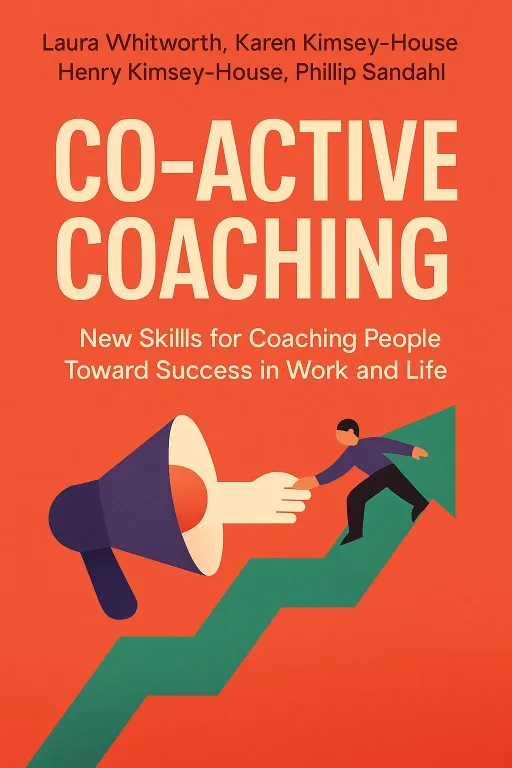
Nova: Well, today we might have found the closest thing to it. We're diving into a book you might not expect to find in the parenting section, "Co-Active Coaching," and we're going to extract its most powerful tools for new parents. It's less of a business book and more of a relationship operating manual.
aleck: I'm intrigued. An operating manual is exactly what I'm looking for.
Nova: We'll tackle this from two powerful perspectives. First, we'll explore how to build your 'Family Constitution' using the concept of a Designed Alliance. Then, we'll discuss a game-changing skill for any new parent: mastering the Three Levels of Listening to navigate stress and connect more deeply.
aleck: Okay, I'm ready. Let's build this thing.
Deep Dive into Core Topic 1: The 'Designed Alliance': Your Family's Constitution
SECTION
Nova: Fantastic. Let's start with that first idea, the 'Designed Alliance.' The book's core message is that coaching isn't just a methodology; it's fundamentally a relationship. And the same is true for a family, right? So the question becomes, how do you design that relationship on purpose, instead of just letting it happen to you?
aleck: That's a huge shift in perspective. We think about designing a nursery, but not designing the partnership itself. So what does that look like?
Nova: The book calls it creating a 'designed alliance.' It's a conscious, deliberate agreement between two people about how they want to work together. And to explain it, the authors use this incredible analogy of a rock climber. Are you ready for this?
aleck: I am. Lay it on me.
Nova: Okay, so imagine you're on a sheer cliff face—which, let's be honest, can feel like the first few months of parenthood! You're the climber, you're exhausted, you're maybe a little scared, and you're trying to find your next handhold. The book says the coach—or in this case, your partner—isn't there to climb for you. They're not there to shout instructions. They are the belay team.
aleck: The belay team... the ones holding the rope.
Nova: Exactly! Their entire job is to hold the rope, to manage the slack, and to make sure that if you slip, you don't fall. They create what the book calls a 'safe and courageous space.' It's a space where you have the courage to take risks, to maybe fail at something, but to know, fundamentally, that you are safe. You won't be dropped.
aleck: Wow. That's a powerful image. It completely reframes the dynamic. It's not about two separate people trying to solve a problem, like a crying baby. It's a single team with different, equally important roles. One person is in the thick of it, on the cliff face, and the other is providing that foundational support.
Nova: You've got it. And just think about the psychological impact. The book says, "Powerful coaching is not about being a powerful coach; it is about the power the client experiences." In a family, it's not about being a perfect parent; it's about the power your partner feels because they know you're holding their rope.
aleck: I can see how just knowing the 'belay team' is there would give you the courage to try again with feeding at 3 AM, or to handle a toddler's tantrum in the grocery store. It changes the internal monologue from 'I'm failing at this' to 'This is hard, but we're in this together. I'm safe.'
Nova: Yes! And the 'designed alliance' is about having the conversation about this. You sit down and you design how you'll be that belay team for each other. The book suggests asking questions like: When you're stressed and overwhelmed, what does support look like for you? Do you want me to offer solutions, or do you just want me to listen and bring you a cup of coffee? How will we handle disagreements when we're both sleep-deprived?
aleck: So it's like creating a shared user manual for each other under pressure. It's not about having all the answers, but about agreeing on the process. It's like asking, 'What's our family's policy for when we're at our wit's end?' or 'How do we make sure we celebrate the small wins, like just surviving a Tuesday?'
Nova: You're building your family culture, one conversation at a time. It’s your family’s constitution. And having those conversations effectively, especially when things are tough, brings us right to our second big idea, which is a total communication superpower.
Deep Dive into Core Topic 2: Beyond Hearing: The Three Levels of Parental Listening
SECTION
aleck: Okay, I'm ready for a superpower. The 'designed alliance' is the 'what,' so this must be the 'how.'
Nova: Precisely. The book introduces a concept that is so simple but so profound: the three levels of listening. And I think for new parents, this is a lifesaver.
aleck: Three levels. I thought there was just... listening.
Nova: That's what we all think! But the book breaks it down. Level I is 'Internal Listening.' This is when you're hearing words, but the focus is entirely on you. The baby's crying, and your internal monologue is, 'Am I a bad parent? What did that book say I should do? My mother-in-law is totally judging me right now.' It's all about 'I, me, my.' The sound is coming in, but it's just bouncing off your own thoughts and anxieties.
aleck: I can already feel myself living in Level I for the first six months, at least. That sounds exhausting, and not very helpful to anyone else.
Nova: It is! And that's why we need Level II, which is 'Focused Listening.' Here, you consciously shut down your own internal noise. You put your agenda, your fears, your solutions aside, and you focus with a laser-like intensity on the other person. You're listening to your partner's words, their tone, their body language. You are trying to climb inside world and understand what it's like for them in that moment.
aleck: So if my partner says, 'I'm just so tired,' instead of my Level I response being 'Me too, I only got two hours of sleep,' my Level II response would be to just listen and maybe ask, 'What kind of tired is it? Tell me more.'
Nova: Exactly! You're seeking to understand, not to respond. But then... there's Level III. This is the superpower. The book calls it 'Global Listening.' At this level, you're not just listening to the words or even just focusing on the other person. You are sensing the. You're listening with your intuition.
aleck: Global listening... what does that feel like?
Nova: It's when you hear your partner's sigh from the other room and you just know it was a 'this is impossible' sigh, not just a tired sigh. You notice the tension in the air before anyone says a word. The book gives an example of a coach listening to a client talk about work stress, but the coach the real, unspoken issue is a feeling of being trapped. That's Level III.
aleck: Wow. Okay, so that's the parental sixth sense people talk about. It's not some mystical gift you're born with. The book is saying it's a you can actually develop. It's a form of intelligence.
Nova: It's a form of intelligence! And think about it with a baby. A baby can't use words. So Level I and even Level II listening have their limits. You can't just focus on their 'words.' Level III is how you truly communicate. You're listening to their whole being, not just their sounds. You might hear a cry and your intuition, your global listening, tells you 'that's not a hunger cry, that's a loneliness cry,' or 'that's a cry of discomfort.'
aleck: That's a profound shift. It means you have to be present enough to quiet your own internal noise and then expand your awareness beyond just the obvious sounds to the entire emotional landscape. That's... a huge challenge when you're sleep-deprived, but I can see how it would be the key to everything. It's the difference between reacting to a noise and responding to a need.
Nova: You've hit the nail on the head. It's about responding to the need. And the book says, "Everything in coaching hinges on listening." I think we can safely say everything in parenting hinges on listening, too.
Synthesis & Takeaways
SECTION
aleck: This is all connecting in a really powerful way. It's not just two separate ideas. The 'Designed Alliance' is the strong container you build for your family, and the 'Three Levels of Listening' are the tools you use to communicate and connect within that container.
Nova: That's such a great way to put it! You build the safe space, and then you practice a kind of deep, empathetic listening that makes that space feel truly alive and supportive. It's about moving from being reactive parents to being, well, co-active parents.
aleck: Exactly. You're not just reacting to crises as they pop up. You're actively, consciously, and collaboratively building the relationship system that can handle those crises when they inevitably arrive. It feels so much more empowering.
Nova: It is. It's about taking charge of the one thing you truly can control: the quality of your relationship. So, for you, aleck, and for everyone listening who is in a partnership, whether you're expecting a child or just navigating life together, maybe the most valuable takeaway today is to start that design process.
aleck: With a simple conversation.
Nova: With a simple conversation. Perhaps the most powerful question you can ask your partner tonight is one inspired by that rock-climbing analogy: 'How can we be a better belay team for each other?' That single question could be the start of your own co-active family.
aleck: I'm going to ask that tonight. Thank you, Nova. This has given me a completely new framework to think about what's ahead.
Nova: It was my pleasure, aleck. It's going to be an amazing climb.