

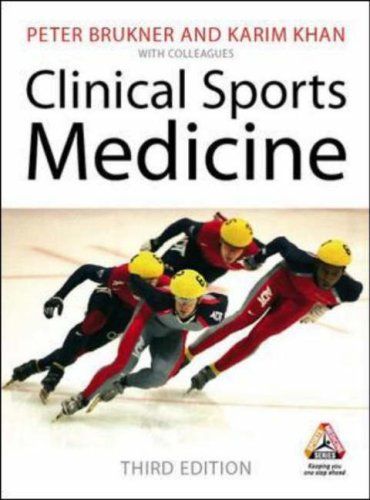
Clinical sports medicine
Introduction
Nova: If you walk into any physiotherapy clinic or sports medicine department in the world, there is one book you are almost guaranteed to see on the shelf. It is thick, it is heavy, and it is usually covered in sticky notes. We are talking about Clinical Sports Medicine by Peter Brukner and Karim Khan.
Nova: It really is. In the medical community, it is often referred to as the Bible of Sports Medicine. It has been around since 1993, and it has completely transformed how we think about treating athletes. But what is fascinating is that it is not just for the pros anymore. It has evolved into this massive guide for how exercise can actually be used as a primary medicine for everyone.
Nova: Exactly. Today we are diving into why this specific text, especially the latest editions, is considered the ultimate authority. We will look at the philosophy of the authors, Peter Brukner and Karim Khan, and how they moved the needle from just treating injuries to managing the whole human being through movement.
Key Insight 1
The Architects of the Bible
Nova: To understand the book, you have to understand the men behind it. Peter Brukner is a legend in the field. He has been the team doctor for the Australian national cricket team, Liverpool Football Club, and the Socceroos. He even has a background in obstetrics and gynecology, which is where that D. R. C. O. G. credential in his name comes from.
Nova: It shows his range! And then you have Karim Khan, who is a professor and a world-renowned researcher. Together, they realized back in the early nineties that sports medicine was too fragmented. Surgeons talked to surgeons, physios talked to physios, and the poor athlete was stuck in the middle.
Nova: Precisely. They pioneered what they call the multidisciplinary approach. Before this book, if you had a sore ankle, you might just get an X-ray and a rest order. Brukner and Khan argued that you need the doctor, the physical therapist, the podiatrist, and the coach all working together. They were among the first to put that philosophy into a structured clinical manual.
Nova: It was the practicality. Most textbooks are very theoretical. Brukner and Khan wrote this for the person in the clinic who has a patient sitting in front of them right now. It is symptom-oriented. Instead of a chapter just on the ACL, they have chapters on things like acute knee pain. It starts with what the patient feels, not just what the textbook says.
Key Insight 2
The Symptom-Oriented Framework
Nova: That symptom-oriented approach is actually the secret sauce of the book. One of the most famous parts of Clinical Sports Medicine is how they handle the clinical assessment. They emphasize that the history of the injury—what the patient tells you—is about eighty percent of the diagnosis.
Nova: That is exactly the point they make! They are very vocal about the fact that scans can be misleading. You can have a perfectly healthy-looking MRI and be in agonizing pain, or you can have a scan that looks like a car wreck but feel fine. Brukner and Khan teach clinicians to treat the patient, not the scan.
Nova: It is more of a systematic framework. They use these incredible flowcharts and tables that help a clinician rule things out. For example, if you have groin pain—which is a notoriously difficult area to diagnose—the book breaks it down into specific clinical entities. Is it adductor-related? Iliopsoas-related? Inguinal-related?
Nova: Exactly. And they include these clinical pearls, which are basically little nuggets of wisdom from their decades of experience. Things like, if a patient can point to the exact spot where it hurts with one finger, it is likely a different issue than if they use their whole hand to describe a vague ache.
Nova: And they do not shy away from the controversial stuff either. They talk about when surgery is actually necessary versus when it is just a quick fix that might cause more problems down the road. They are very big on evidence-based practice, meaning they only recommend what the latest science actually supports.
Key Insight 3
Exercise as Medicine
Nova: Now, if you look at the fifth and sixth editions, something major changed. The book got so big they had to split it into two volumes. Volume one is all about injuries, but volume two is titled The Medicine of Exercise.
Nova: It is for everyone. This is where Brukner and Khan really showed their visionary side. They realized that physical inactivity is one of the biggest health crises in the world. So, they dedicated an entire volume to how exercise can treat chronic diseases like diabetes, heart disease, and even depression.
Nova: Precisely. They argue that if exercise were a pill, it would be the most widely prescribed and effective drug in history. Volume two covers the physiology of how movement changes our cells, how it affects the brain, and how to safely get people with serious medical conditions moving again.
Nova: That is exactly their argument. They want to take the high-level care that elite athletes get—the focus on nutrition, recovery, and biomechanics—and apply it to the general public. Why should an Olympic sprinter get better rehab than a grandmother who wants to walk to the park?
Nova: Definitely. It has become a staple for GPs. The book even covers things like exercise in extreme environments, like heat or high altitude, and specific populations like the elderly, pregnant women, and children. It is incredibly comprehensive.
Key Insight 4
The Evolution of Treatment
Nova: One of the coolest things about following the different editions of this book is seeing how medical advice has flipped over the years. For example, remember the old R. I. C. E. protocol for injuries? Rest, Ice, Compression, Elevation?
Nova: Well, Brukner and Khan were among the leaders in moving away from that. In the newer editions, they talk about the P. E. A. C. E. and L. O. V. E. protocol. It emphasizes that complete rest is actually often bad for an injury. You need optimal loading—meaning you need to move the tissue to help it heal.
Nova: Not entirely out, but the focus has shifted to movement. They explain the science of mechanotransduction, which is a fancy way of saying that our cells respond to physical pressure by building stronger tissue. If you just rest, the tissue stays weak.
Nova: And they apply that to everything. They have massive sections on tendon injuries, like Achilles tendonitis. They used to think it was inflammation, so they called it tendonitis. Now we know it is often more about the tendon structure breaking down, so they call it tendinopathy. The book explains why anti-inflammatories might not be the best choice and why specific heavy lifting exercises are actually the cure.
Nova: They are. They have a huge team of contributors now—hundreds of experts from around the world. It is a massive collaborative effort. They even have a companion website with videos of clinical examinations so you can see exactly how to perform the tests they describe in the text.
Conclusion
Nova: We have covered a lot of ground today, from the multidisciplinary philosophy of Brukner and Khan to the revolutionary idea that exercise is a literal medicine for the masses. Clinical Sports Medicine is more than just a textbook; it is a roadmap for how we can all live more active, resilient lives.
Nova: It is worth the read, even if you just dip into the chapters that apply to your own life. Whether you are a professional athlete, a weekend warrior, or just someone trying to stay healthy, the insights in this book are universal. It reminds us that our bodies are designed to move, and when they break, the best way back is often through the very thing we were designed to do.
Nova: Absolutely. Thank you for joining us on this deep dive into a true medical masterpiece. This is Aibrary. Congratulations on your growth!