

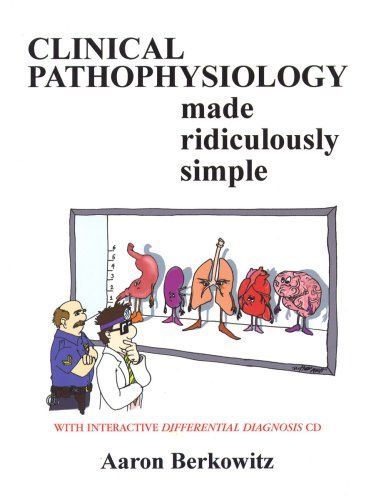
Clinical Pathophysiology Made Ridiculously Simple
Introduction
Nova: Imagine you are a second-year medical student. You are sitting in a library surrounded by textbooks that are thick enough to be used as doorstops. You have to memorize thousands of pages of biochemical pathways, drug names, and rare genetic mutations. It feels like you are trying to drink from a firehose, and honestly, most of it feels like a giant, disconnected pile of facts. Then, you find this slim, unassuming book with a title that sounds almost like a joke: Clinical Pathophysiology Made Ridiculously Simple.
Atlas: It sounds like one of those For Dummies books, right? Like, is this actually for medical professionals or just people who want to sound smart at dinner parties? Because pathophysiology is basically the study of how the body breaks down. That does not exactly sound simple.
Nova: That is exactly the point. The author, Dr. Aaron Berkowitz, realized that the way we teach medicine is often backwards. We ask students to memorize the symptoms of a disease before they truly understand the mechanism of the disease. This book is a cult classic because it does the opposite. It strips away the jargon and focuses on the core logic of how our organs actually work—and why they fail.
Atlas: So it is like the cheat code for med school? I have heard people talk about this book in hushed tones, like it is some kind of secret weapon for the boards. But I have always wondered, can you really make something as complex as the human heart or the kidneys ridiculously simple without losing the actual science?
Nova: That is the magic of Berkowitz's approach. He does not simplify by leaving things out; he simplifies by finding the underlying patterns. Today, we are diving into why this book changed the game for medical education and how its lessons apply to anyone trying to understand the incredible machine that is the human body.
Atlas: I am ready. Let us see if we can actually make sense of the chaos inside of us.
Key Insight 1
Mechanisms Over Memorization
Nova: To understand why this book is so different, you have to look at the man behind it. Dr. Aaron Berkowitz is not just a textbook author. He is a neurologist, a professor at UCSF, and he spent years working in Haiti, providing neurological care in a place where resources are incredibly scarce. When you are teaching medicine in a setting where you do not have a million-dollar MRI machine on every corner, you have to be able to think on your feet. You have to understand the first principles.
Atlas: That makes a lot of sense. If you do not have the fancy tech to tell you what is wrong, you have to rely on your brain and your understanding of how the body is supposed to function. It is like being a mechanic in the middle of the desert versus a mechanic in a high-tech dealership.
Nova: Exactly. Berkowitz's philosophy is built on one major pillar: Mechanisms over Memorization. In most medical schools, you might be told that a certain disease causes a specific type of swelling in the legs. You memorize that fact for the test. But Berkowitz asks: Why does the fluid go to the legs? What is happening at the level of the blood vessels and the heart that forces that fluid out of the pipes and into the tissues?
Atlas: So he is basically saying that if you understand the plumbing, you do not have to memorize where the leaks will be. You can just predict them.
Nova: Precisely. He argues that the human body is essentially a series of interconnected systems that follow basic laws of physics and chemistry. If you understand those laws, the symptoms of a disease become inevitable conclusions rather than random facts. It is the difference between memorizing the answers to a math test and actually learning how to do the algebra.
Atlas: I love that. But I have to ask, is medicine really that logical? I always thought it was full of weird exceptions and things that just happen because biology is messy.
Nova: Biology is definitely messy, but Berkowitz shows that the messiness usually follows a pattern. He uses this approach to bridge the gap between basic science—like what you learn in a biology lab—and clinical medicine, which is what you see at the bedside of a patient. He wants students to stop seeing pathophysiology as a hurdle to clear and start seeing it as the story of the patient.
Atlas: It sounds like he is trying to give students a mental map. Instead of just giving them a list of directions, he is showing them the whole landscape so they can find their own way if they get lost.
Nova: That is a perfect analogy. And he does this with a very specific tone. He is not lecturing you from a podium. He is like that brilliant older brother who sits you down and says, Look, don't overthink this. It is just a pump and some pipes. Let's look at what happens when the pump gets tired.
Atlas: Which brings us to the actual systems. I want to know how he actually breaks this down. How do you make the heart ridiculously simple?
Key Insight 2
The Heart as a Four-Part Machine
Nova: Okay, let's talk about the cardiovascular system. In a standard textbook, you would get hundreds of pages on hemodynamics, pressure-volume loops, and complex equations. Berkowitz takes a different route. He tells you to think of the heart as having only four main components that can go wrong.
Atlas: Only four? That seems... bold. What are they?
Nova: First, you have the muscle. That is the pump itself. If the muscle is weak, it cannot push the blood forward. That is heart failure. Second, you have the valves. Think of these as the doors between the rooms of the heart. If the doors are stuck shut, the blood cannot get through. If they are leaky, the blood flows backwards.
Atlas: Okay, so we have the pump and the doors. What are the other two?
Nova: Third is the electrical system. This is the wiring that tells the muscle when to squeeze. If the wiring is frayed or misfiring, the heart beats too fast, too slow, or just chaotically. And finally, you have the plumbing—the coronary arteries that supply the heart muscle itself with blood. If those pipes get clogged, the pump loses its power source. That is a heart attack.
Atlas: Wow. When you put it that way, it is actually hard to forget. Weak pump, bad doors, faulty wiring, or clogged fuel lines. That covers almost everything I have ever heard about heart disease.
Nova: It really does. And then he takes it a step further. He explains that when the heart fails, the blood has to go somewhere. If the left side of the heart isn't pumping well, the blood backs up into the lungs. That is why people with heart failure get short of breath—they are literally drowning from the inside because the fluid is backing up into their air sacs.
Atlas: Wait, so that is why doctors listen to the lungs when they suspect a heart problem? I always thought they were just being thorough, but it is actually because the lungs are the first place the backup happens.
Nova: Exactly. And if the right side of the heart fails, the blood backs up into the rest of the body. That is why you see swollen ankles or a congested liver. It is all just a matter of where the traffic jam is happening. Berkowitz uses these simple visual models to explain things that usually require complex diagrams.
Atlas: It is so much more intuitive than just memorizing a list of symptoms for right-sided versus left-sided heart failure. You just visualize the flow of traffic. If the bridge is out, the cars pile up behind it.
Nova: And he applies this same logic to the electrical system. Instead of making you memorize every single arrhythmia, he explains the concept of re-entry. Imagine a racetrack where a car gets stuck in a loop and just keeps going around and around instead of finishing the lap. That is what happens in many fast heart rhythms. The electrical signal gets trapped in a circle, and the heart just keeps firing over and over.
Atlas: That is a great image. It makes the whole thing feel less like a mystery and more like a mechanical problem you can actually solve. Does he do the same thing for the lungs?
Key Insight 3
The Sieve and the Sponge
Nova: He absolutely does. For the lungs and the kidneys, he uses analogies that are just as sticky. For the pulmonary system, he focuses on the idea of the V/Q mismatch. Now, in med school, that term usually makes students' eyes glaze over. It stands for Ventilation and Perfusion.
Atlas: Yeah, you lost me already. Ventilation and what?
Nova: Think of it this way: To get oxygen into your blood, you need two things. You need air to reach the air sacs—that is ventilation. And you need blood to reach the vessels surrounding those sacs—that is perfusion. Berkowitz says it is like a matching game. If you have air but no blood, or blood but no air, you are not getting oxygen.
Atlas: So it is like a dating app for molecules. If the oxygen and the blood don't meet up at the same place at the same time, no magic happens.
Nova: That is actually a great way to put it. He explains that almost every lung problem is just a failure of that matching game. If you have pneumonia, the air sacs are full of fluid, so the air can't get in. Ventilation is down. If you have a blood clot in the lung, the air is getting in fine, but the blood can't get to it. Perfusion is down. Either way, the patient is short of breath.
Atlas: It is so simple it almost feels like cheating. What about the kidneys? I have heard the renal system is the hardest part of medical school.
Nova: The kidneys are notoriously difficult because they involve so much chemistry—electrolytes, pH balance, fluid levels. But Berkowitz simplifies the kidney by calling it a sieve. Its job is to filter the blood, keep the good stuff, and throw away the trash.
Atlas: Okay, I can visualize a sieve. But how does he explain the complicated stuff, like how the kidney controls blood pressure?
Nova: He frames it as a volume problem. The kidney is like a bouncer at a club. It decides how much salt and water are allowed to stay in the blood. If the kidney keeps too much salt, the water follows the salt, the blood volume goes up, and the pressure in the pipes increases. If the kidney lets too much out, the pressure drops.
Atlas: So the kidney is basically the thermostat for the body's fluid levels. If it breaks, the whole system either overflows or dries up.
Nova: Exactly. And he uses this to explain why people with kidney failure have such a wide range of symptoms. If the filter is broken, the trash—like urea and potassium—starts building up in the blood. That trash then poisons other systems. High potassium can stop the heart. High urea can make you confused or make your skin itch. It is all connected back to that one broken sieve.
Atlas: It is interesting how he keeps bringing it back to these physical, everyday objects. A pump, a sieve, a racetrack. It makes the body feel less like an abstract concept and more like something you could actually build in your garage.
Nova: That is the goal. He wants to remove the intimidation factor. He even tackles the acid-base balance, which is the bane of every medical student's existence. He explains it as a tug-of-war between the lungs and the kidneys. The lungs handle the fast changes by breathing out CO2, which is acidic, and the kidneys handle the slow changes by peeing out acid or keeping bicarbonate. If one side loses the tug-of-war, the body's pH goes out of whack.
Atlas: A tug-of-war. Man, I wish I had this book when I was taking high school biology. It makes so much more sense than just memorizing the pH scale.
Key Insight 4
The Clinical Bridge
Nova: One of the most valuable parts of the book is how it teaches clinical reasoning. It is one thing to understand how an organ works, but it is another thing entirely to see a patient with five different symptoms and figure out which organ is the culprit. Berkowitz uses what he calls Clinical Pearls to help with this.
Atlas: What exactly is a clinical pearl? It sounds like something a wise old doctor would say while stroking their beard.
Nova: That is pretty much what it is. It is a small, concentrated bit of wisdom that helps you make a diagnosis. For example, one of his pearls is about the difference between a problem in the lungs and a problem in the heart when a patient is short of breath. He points out that if a patient can't breathe while lying flat but feels better when they prop themselves up with three pillows, that is almost always a heart problem, not a lung problem.
Atlas: Wait, why? Why does the number of pillows matter?
Nova: Because of gravity. When you lie flat, the fluid that was sitting in your legs because of gravity suddenly redistributes throughout your body. If your heart is weak, it can't handle that extra volume, and the fluid backs up into your lungs. Propping yourself up keeps the fluid down in your lower body, away from your air sacs.
Atlas: That is brilliant. It is a physical explanation for a specific behavior. It is not just a random fact; it is a consequence of physics.
Nova: Exactly. And the book is full of these. He also talks about how to use lab results logically. Instead of just looking at a number and saying it is high or low, he teaches you to ask: What is the body trying to achieve by making this number high? If a patient is dehydrated, their kidneys will hold onto as much water as possible, making their urine very concentrated. If the urine is dilute but the patient is dehydrated, you know the problem is the kidney itself—it has lost the ability to concentrate.
Atlas: So the body is always trying to compensate. It is always trying to fix the problem, and the symptoms we see are often just the body's attempt to stay alive.
Nova: That is a profound insight, and it is exactly what Berkowitz wants students to see. Pathophysiology isn't just a list of things going wrong; it is the study of the body's struggle to maintain balance, or homeostasis. When you see it that way, you start to have more empathy for the patient. You are not just treating a disease; you are helping a body that is working really hard to save itself.
Atlas: It also seems like this approach would make you a much better communicator as a doctor. If you can explain to a patient that their heart is like a tired pump and their lungs are backing up like a sink, they are going to understand their treatment so much better than if you use words like pulmonary edema or congestive heart failure.
Nova: You hit the nail on the head. Berkowitz's work in Haiti really emphasized this. When you are working across cultures and languages, you have to be able to explain complex ideas simply. Simplicity isn't just for students; it is for everyone. It is the ultimate sign of mastery. If you can't explain it simply, you don't understand it well enough.
Conclusion
Nova: As we wrap up our look at Clinical Pathophysiology Made Ridiculously Simple, it is clear that Dr. Aaron Berkowitz has given the medical world something much more than a study guide. He has provided a framework for thinking that values clarity over complexity and understanding over rote memorization.
Atlas: It is really inspiring to see that even in a field as intimidating as medicine, there is room for simplicity. It makes me realize that no matter what we are learning—whether it is coding, or finance, or biology—the goal should always be to find those core mechanisms. If you understand the pump and the pipes, you can figure out the rest.
Nova: And that is a lesson that applies far beyond the walls of a hospital. The world is full of complex systems, but they are all built on fundamental principles. Berkowitz's book is a reminder that we shouldn't be afraid to strip away the jargon and ask the simple questions. Why is this happening? What is the underlying logic? Usually, the answer is more elegant than we expect.
Atlas: I think I am going to look at my own body a little differently now. It is not just a collection of parts; it is this incredible, logical, hard-working machine that is constantly performing a balancing act just to keep me going.
Nova: It really is a miracle of engineering. If you are a student, a healthcare professional, or just someone who wants to understand the why behind the how, this book is an absolute treasure. It proves that medicine doesn't have to be a mystery. It can be, well, ridiculously simple.
Atlas: I love it. Thanks for walking me through the plumbing, Nova.
Nova: Any time, Atlas. This is Aibrary. Congratulations on your growth!