

Hire Your College
Content
Content
Narrator: Introduction
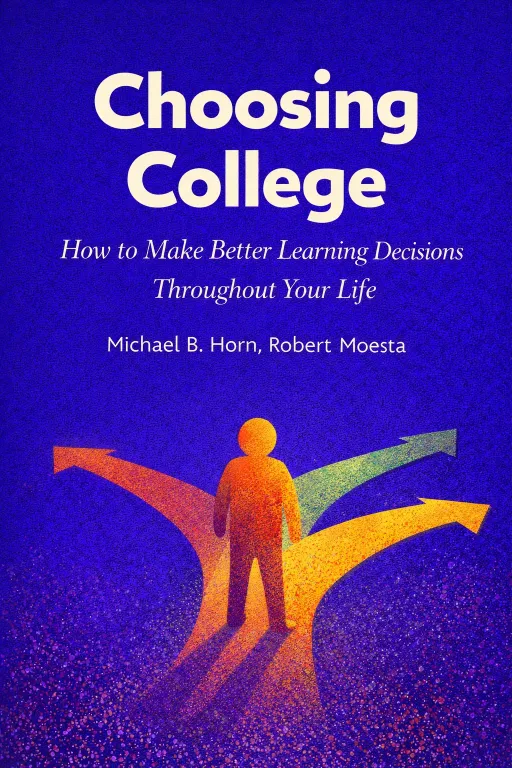
Austin Louis was a student at Babson College, a top-ranked school for entrepreneurship. By all external measures, he was on the perfect path to success. Yet, in his second year, he dropped out. His reason was simple but profound: he didn't feel like he was learning anything. He realized he was there to please his parents, trapped in what he called a "dull, uninspired life." Why would a student at a prestigious, expensive institution feel so disconnected? What was the school failing to provide? This puzzle sits at the heart of a massive, unspoken crisis in education, a crisis that Michael B. Horn and Bob Moesta explore in their book, "Choosing College: How to Make Better Learning Decisions Throughout Your Life." They argue that we have been asking the wrong questions. The most important question isn't "where" to go to college, but "why."
Key Insights
Key Insight 1: The Broken Compass of College Choice
The landscape of choosing a college has become a high-stakes, high-anxiety world. More people are applying to more schools than ever before, driven by the societal narrative that a degree is the only ticket to a good job. Yet, for a huge number of people, this promise falls flat. The book points out that even for those who graduate, college isn't always a good investment. Many find themselves with significant debt and a degree that doesn't lead to the career they envisioned, resulting in widespread dissatisfaction. The traditional tools used to navigate this landscape, like college rankings and generic advice, are often unhelpful. They focus on institutional prestige, test scores, and amenities, but they fail to address the fundamental reason a person is seeking education in the first place. The system is built on a flawed assumption that all students are pursuing the same goal, when in reality, their motivations are deeply personal and varied. This mismatch between what students need and what the system measures is why so many, like Austin Louis, feel lost even in the "best" schools.
Key Insight 2: What Job Are You Hiring College For?
To fix this broken system, the authors introduce a powerful framework from the world of business innovation called the "Jobs to Be Done" theory. Co-developed by author Bob Moesta and the late Clayton Christensen, the theory posits that people don't just buy products or services; they "hire" them to make progress in their lives. They have a "job" that needs doing. The classic example is the milkshake. A fast-food chain wanted to improve milkshake sales and asked customers what they wanted: thicker, sweeter, more flavors? Nothing worked. When researchers instead asked what "job" customers were hiring the milkshake for, they discovered that many morning customers were buying it for a long, boring commute. The milkshake was a one-handed, clean, and slow-to-consume companion that staved off hunger until lunch. The competition wasn't other milkshakes; it was bananas, bagels, and donuts. "Choosing College" applies this same lens to education. Students don't choose a school based on a checklist of features. They "hire" a school to do a specific job in their life. Understanding that job is the key to making a successful choice.
Key Insight 3: The Five Motivations Driving Every Student
Through extensive interviews, the authors identified five distinct "Jobs to Be Done" that explain why people pursue postsecondary education. These jobs are not about demographics; they are about the circumstances and the progress a person is trying to make. The five jobs are:
- Help Me Get into My Best School: Here, the focus is on prestige and the classic college experience. The goal is admission itself, often without a clear plan for what comes after. 2. Help Me Do What’s Expected of Me: These students attend college to fulfill family or societal expectations, often lacking personal drive or excitement for the path. 3. Help Me Get Away: For these individuals, education is an escape route from a negative situation at home, a dead-end job, or a bad relationship. 4. Help Me Step It Up: This job is about career advancement. These learners are seeking specific skills or credentials to get a better job, a promotion, or a salary increase. 5. Help Me Extend Myself: This is about personal growth and intellectual challenge. These learners are often stable in their lives and are driven by a clear vision to learn something new for its own sake or to make a lasting impact.
To see how this works, imagine five students all majoring in math. The student hiring college to "Get into My Best School" wants a math degree from Yale. The one "Doing What's Expected" is there because their mom said they were good at math. The student trying to "Get Away" sees a math degree as a ticket out of their current life. The "Step It Up" student wants to become a data analyst and sees math as the path to a high-paying role. And finally, the "Extend Myself" student is there because of a deep, intrinsic curiosity about mathematics itself. They are all in the same major, but they need vastly different experiences to be successful.
Key Insight 4: Why Universities Fail by Trying to Be Everything
The "Jobs to Be Done" framework reveals a critical flaw in the design of most colleges and universities. As Clayton Christensen writes in the foreword, institutions have evolved to be places that "seek to do everything for everyone." They try to be a top-tier research institution, a vibrant social hub, a vocational training center, and a place for personal enrichment all at once. As a result, they don't do any single job particularly well, and they become incredibly complex and expensive. The book points to data showing that from 1987 to 2012, the number of nonacademic administrative employees at universities more than doubled, far outpacing the growth of students or faculty. This administrative bloat is a direct result of trying to manage the complexity of being all things to all people. By failing to focus on a specific "Job" they are best equipped to do, institutions create a one-size-fits-none experience that frustrates students and drives up costs for everyone.
Key Insight 5: Redesigning Education from the Ground Up
The book's final and most powerful message is a call to action for both learners and educators. For learners, the advice is to first understand your "Job" and then embrace non-linear paths to fulfill it. The story of Naomi is a perfect example. She initially went to college to "get away" but dropped out. She then took an extended gap year, working at Taco Bell, a vet clinic, and a chiropractor's office. Through these real-world experiences, she learned what she did and didn't want, eventually discovering a passion for nursing. She then enrolled in a local university with a clear purpose and succeeded. Her story shows that a purposeful gap year or work experience can be far more valuable than rushing into a decision.
For educators, the authors propose a radical redesign based on mastery. They tell the story of an American engineer visiting two car plants. At a Detroit plant, he was told to install a seat in 58 seconds. Time was fixed, but the result was variable; he failed repeatedly. This is like our current education system, where students spend a fixed semester in a class and emerge with variable A, C, or F grades. At a Toyota plant, however, he had to master step one before moving to step two. Time was variable, but the result was fixed: he could do the job perfectly every time. The book argues that schools must adopt this Toyota model, focusing on mastery and outcomes rather than time spent in a seat. This means raising standards, ensuring students have the prerequisite knowledge, and creating a system where learning, not just teaching, is the goal.
Conclusion
The single most important takeaway from "Choosing College" is that education is a two-sided matchmaking process. It is not about a student's struggle to get into the "best" school; it is about finding the right fit between the progress a student needs to make and the experience an institution is designed to provide. A school can be excellent, but if it's not built to do the "Job" a student is hiring it for, the match will fail.
This reframes the entire conversation. It challenges us to move beyond the superficial obsession with rankings and prestige. Before asking "Where should I go to college?" or "What should I major in?", we must first ask a more fundamental question: "What progress am I trying to make in my life right now?" Answering that question honestly is the first and most critical step toward making a truly good learning decision.