

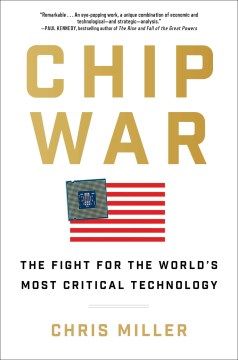
Chip War
The Fight for the World's Most Critical Technology
Introduction: The Invisible Weapon
Introduction: The Invisible Weapon
Nova: Welcome to the show. Imagine a single component so vital that its absence can halt the production of eight million cars in a single year, costing one economy alone an estimated 240 billion dollars. That’s not oil, that’s not gold. That is the semiconductor chip.
Nova: : That staggering figure really puts the recent supply chain chaos into perspective. I remember hearing about empty dealership lots, but I never connected it to something so small and fundamental.
Nova: Exactly. And that’s the central, electrifying thesis of Chris Miller’s phenomenal book, Chip War: The Fight for the World's Most Critical Technology. Miller argues that the story of the microchip is not just a story of Silicon Valley innovation; it’s the defining story of 21st-century global power, military strategy, and geopolitical conflict.
Nova: : So, we’re talking about the new oil, but maybe even more potent? Miller suggests it’s more than just an economic commodity, right? It’s the bedrock of modern military might.
Nova: Precisely. He frames it as a techno-nationalist struggle. We’ve spent decades assuming the chip industry was a purely free-market success story, but Miller meticulously peels back the layers to show how governments—the US, Japan, the Netherlands, and now China—have been pouring subsidies, setting policies, and waging quiet wars to control every single step of the process.
Nova: : It sounds like a thriller disguised as an economic history textbook. What’s the first major revelation we need to unpack? Where does this invisible empire begin?
Nova: We have to start at the beginning, with the invention that changed everything, and how the US built an empire on it, only to slowly, perhaps accidentally, give away the crown jewels. Let's dive into the accidental empire that built the modern world.
Key Insight 1: The US-Built Foundation
The Accidental Empire: From Transistor to Global Fragmentation
Nova: The story doesn't start in Silicon Valley, but at Bell Labs in 1947 with the invention of the transistor by Bardeen and Brattain. This was a government-funded, defense-driven breakthrough. The transistor replaced vacuum tubes, making everything smaller, faster, and more reliable.
Nova: : That’s the foundation. But when did it become the integrated circuit, the chip we think of today? I always associate that with the 1960s boom.
Nova: You’re close. The real leap was the Integrated Circuit, or IC, invented independently by Jack Kilby at Texas Instruments and Robert Noyce at Fairchild Semiconductor in 1958 and 1959. Noyce, of course, went on to co-found Intel. This invention allowed thousands of components to be etched onto a single piece of silicon. Miller emphasizes that the US government, particularly the Department of Defense through programs like the Minuteman missile guidance system, was the initial, massive, guaranteed customer.
Nova: : So, the US government essentially bankrolled the R&D for the entire digital age? That’s a massive industrial policy success story, even if they didn't call it that at the time.
Nova: Absolutely. Miller calls it a series of strategic government bets. But here’s where the fragmentation begins. By the 1980s, the US decided that manufacturing these incredibly complex chips was too expensive domestically. They started outsourcing the actual fabrication to focus on design—the high-margin, intellectual property side.
Nova: : That sounds like classic American business logic: focus on what you’re best at and let others handle the dirty work. Who did they outsource to?
Nova: Primarily Japan initially, and later, crucially, Taiwan and South Korea. This decision, driven by short-term cost-cutting, created the hyper-specialized, globally interdependent supply chain we have today. Miller points out that the US effectively ceded control over the physical manufacturing process, retaining control over the design software and the core intellectual property.
Nova: : So, the US became the architect, but other nations became the master builders. What was the consequence of that handover? Did the US lose its edge entirely?
Nova: Not entirely, but it created a massive vulnerability. The US still dominates the design software—the Electronic Design Automation tools—and the critical intellectual property. But when you look at the physical production of the most advanced chips, the US share of manufacturing capacity has plummeted. It’s a house built on sand, where the foundation is in someone else’s hands.
Nova: : It’s fascinating how a decision made decades ago, purely for quarterly earnings, now dictates national security policy. It sounds like the next stage of the story has to be about the one company that managed to keep its manufacturing dominance, the one place everyone needs to go.
Nova: That leads us perfectly to the heart of the modern industry, the place that holds the keys to the kingdom. We need to talk about Taiwan and the incredible story of TSMC.
Key Insight 2: The World's Most Important Company
The Taiwan Nexus: TSMC and the Single Point of Failure
Nova: If the transistor was the spark, Taiwan Semiconductor Manufacturing Company, or TSMC, is the current that powers the entire modern world. Miller dedicates significant attention to how TSMC, founded in 1987, pioneered the pure-play foundry model.
Nova: : What does 'pure-play foundry' actually mean in this context? It sounds like a specialized term.
Nova: It means they only manufacture chips designed by others. They don't design their own competing products like Intel or Samsung used to. This made them the indispensable partner for every major tech company—Apple, Nvidia, AMD. They became the ultimate neutral manufacturer, trusted by everyone.
Nova: : And that neutrality is now the source of immense geopolitical tension, because they are geographically located in the most contested spot on the map.
Nova: Precisely. TSMC currently manufactures over 90% of the world's most advanced logic chips—those below 10 nanometers. These are the chips that power AI training, the latest smartphones, and advanced military hardware. Miller paints a stark picture: if TSMC’s fabrication plants in Taiwan were disrupted, the global economy and military capabilities would grind to a halt almost overnight.
Nova: : It’s almost unbelievable that the entire global digital infrastructure rests on one island, controlled by one company. What’s the scale of their technological lead?
Nova: It’s immense. They are consistently one or two generations ahead of their nearest competitors, like Samsung and Intel. This lead isn't just about size; it’s about process maturity, yield rates, and sheer experience. They have perfected the art of making these microscopic structures reliably.
Nova: : So, if the US wants to maintain its technological edge over China, it absolutely needs TSMC to keep producing at this level, and it needs them to be safe.
Nova: Correct. And this is where the US strategy gets complicated. They want TSMC to build fabs in the US—which they are doing, thanks to the CHIPS Act—but Miller suggests that replicating the entire ecosystem, the specialized workforce, the local supplier network, and the decades of accumulated tacit knowledge, is nearly impossible.
Nova: : It’s like trying to move a mature rainforest to a new location. You can move the trees, but you can’t instantly recreate the soil and the microbial life that makes it thrive.
Nova: That’s a perfect analogy. The ecosystem matters more than the building. And this reliance on Taiwan is why the geopolitical maneuvering around the Taiwan Strait is so intense. It’s not just about sovereignty; it’s about controlling the world’s most critical manufacturing bottleneck. But even TSMC can’t build the most advanced chips without one specific piece of equipment, which brings us to the Dutch monopoly.
Key Insight 3: The Hidden Gatekeeper
The ASML Choke Point: The Monopoly on Light
Nova: If TSMC is the master builder, then ASML, a Dutch company, is the one who sells the master blueprint and the only tool capable of reading it. ASML holds a complete monopoly on Extreme Ultraviolet, or EUV, lithography machines.
Nova: : Lithography—that’s the process of using light to etch the circuits onto the silicon wafer, right? Why is EUV so special?
Nova: It’s the difference between drawing with a thick marker and drawing with a laser pointer. EUV uses light with an extremely short wavelength—13.5 nanometers—which allows manufacturers like TSMC to print features smaller than 7 nanometers. Without ASML’s EUV machines, you simply cannot produce the cutting-edge chips that power AI and modern defense systems.
Nova: : A complete monopoly on the single most complex piece of machinery in the world. That sounds like a national security asset for the Netherlands, whether they want it or not.
Nova: Exactly. And that’s where the US pressure comes in. Because the US controls key components and software used in the ASML machines—things like specialized optics and design software—Washington has been able to strong-arm the Dutch government into blocking sales of the most advanced EUV machines to China since 2019.
Nova: : So, the US is leveraging its control over the design tools to enforce its geopolitical strategy through a Dutch company. It’s a web of dependencies.
Nova: It is a perfect illustration of Miller’s point: the supply chain is not globalized by choice, but by necessity, and that necessity creates leverage points. ASML’s machines are so complex that they require over 100,000 components from hundreds of suppliers across the globe, but the final assembly and the critical EUV light source are controlled by a handful of entities, with ASML at the apex.
Nova: : What happens if China decides to pour unlimited resources into trying to build its own EUV machine? Can they catch up?
Nova: Miller is skeptical. He notes that the complexity is staggering. It took ASML decades and billions in state and private investment to perfect EUV. China has made progress on older Deep Ultraviolet, or DUV, technology, which is sufficient for less advanced chips, but closing the EUV gap is a monumental task. It’s a technological moat built over 40 years.
Nova: : So, the US strategy seems to be: keep the choke points—design software, ASML machines, and TSMC’s advanced nodes—tightly controlled, effectively strangling China’s access to the future of computing.
Nova: That is the core of the current conflict. It’s a war fought not with missiles, but with export licenses and machine delivery schedules. This brings us to the broader economic fallout and the aggressive response from Beijing.
Key Insight 4: The Race for Self-Sufficiency
The Techno-Nationalist Response
Nova: The US export controls, particularly those implemented under the Biden administration, are designed to prevent China from acquiring the tools necessary for advanced AI and military modernization. But this aggressive posture has a predictable reaction: intense nationalistic investment in self-sufficiency.
Nova: : China has reacted by pouring massive state funds into its domestic semiconductor industry, right? They view this as an existential threat.
Nova: They do. Miller highlights that China’s response has been a massive, state-directed industrial policy effort, often referred to as the 'Big Fund.' They are determined to break the chokehold. And they have had some success, particularly in older, less advanced chips, which is why we saw shortages in things like cars and washing machines.
Nova: : But that’s the key distinction, isn't it? They can make the older stuff, but they can’t make the bleeding edge without ASML and TSMC.
Nova: Exactly. The gap between legacy chips and leading-edge chips is widening, not shrinking, because the US and its allies are constantly moving the goalposts. Furthermore, China has started to fight back using its own leverage points. Remember those raw materials we mentioned earlier? Gallium and Germanium, crucial for certain semiconductor processes and defense systems?
Nova: : Yes, I recall reading about that. China imposed export restrictions on those materials in 2023.
Nova: That was a direct counter-punch. It showed that while China might be behind in fabrication equipment, they control vital parts of the upstream supply chain—the raw materials and chemicals needed to even start the process. It’s a tit-for-tat escalation.
Nova: : So, the entire global system is becoming less efficient, more expensive, and far more brittle because everyone is trying to build redundant, national supply chains instead of relying on the most efficient global model.
Nova: That’s the economic cost of techno-nationalism. The global shortage in 2021, which cost the US economy $240 billion, was a warning shot. Now, as countries mandate 'reshoring' and 'friend-shoring,' we are sacrificing efficiency for security. Miller suggests this is a permanent shift, moving away from the hyper-globalization model of the 1990s.
Nova: : It sounds like the world is splitting into technological blocs. If you’re a company, how do you navigate designing a product when you might be cut off from the manufacturer, or the design software, depending on which side of the geopolitical line you fall on?
Nova: That’s the nightmare scenario for every CEO. You have to design for decoupling. You might need one version of your product that uses chips made in the US-aligned ecosystem, and another that uses chips made in a China-centric ecosystem, if such a thing can even be built. It’s a massive drag on innovation and cost.
Nova: : It makes the stakes incredibly high. This isn't just about who sells the most phones; it’s about who controls the future of artificial intelligence, quantum computing, and military surveillance.
Conclusion: Reading the Future in Silicon
Conclusion: Reading the Future in Silicon
Nova: We’ve covered a massive journey, from the transistor in 1947 to the current standoff involving the US, China, Taiwan, and the Netherlands. What is the single most important takeaway from Chris Miller’s Chip War that our listeners should internalize?
Nova: : I think the biggest takeaway is the shattering of the illusion that technology is apolitical. For decades, we treated semiconductors as just another commodity, subject only to market forces. Miller proves that they are, and always have been, instruments of state power and national competition.
Nova: Absolutely. The key insight is that the supply chain is not a smooth, efficient line; it’s a series of deliberate, government-supported choke points. If you control the design software, the EUV machine, or the most advanced fabrication plant, you control the future.
Nova: : So, what’s the actionable takeaway for someone listening who isn't a defense analyst or a semiconductor CEO? How does this affect my daily life?
Nova: It affects the pace of innovation and the cost of everything digital. Expect continued government intervention—subsidies like the CHIPS Act in the US and similar efforts globally. This means higher taxes or higher prices for consumers as efficiency is sacrificed for resilience. More importantly, it means paying close attention to developments in Taiwan and the Netherlands, because those are the true front lines of the next global conflict.
Nova: : It forces us to see the world differently. Every time we use a smartphone, drive a modern car, or even use cloud computing, we are relying on a complex, fragile, and highly politicized global tapestry.
Nova: Indeed. The future of global military balance, economic prosperity, and technological advancement hinges on who can master the art of making the smallest, most powerful things. The Chip War is not a future threat; it is the defining economic reality of our time.
Nova: : A sobering but essential lesson in global interdependence. Thank you, Nova, for guiding us through this incredibly complex and critical topic.
Nova: My pleasure. Understanding the silicon beneath the surface is understanding the world itself. This is Aibrary. Congratulations on your growth!