Personalized Podcast
Golden Hook & Introduction
SECTION
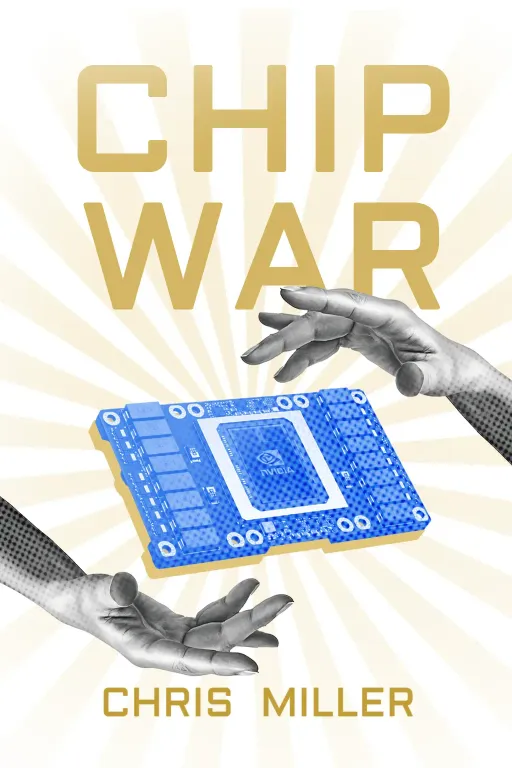
Nova: Think about the most powerful weapons of World War Two. Massive steel battleships, fleets of heavy bombers, thousands of tanks rolling across Europe. It was a war of industrial attrition, right? Pure, raw physical mass. But today, the balance of global power doesn't depend on how much steel you can melt. It depends on how many microscopic transistors you can pack onto a tiny sliver of silicon. Welcome to the show, everyone. I'm Nova, and today we are diving into the fascinating, high-stakes world of Chris Miller's groundbreaking book, Chip War. And joining me to unpack this technological battlefield is our brilliant guest, Nour Ghribi. Nour, it is so wonderful to have you here.
Nour Ghribi: Thanks, Nova. It's great to be here. You know, what strikes me immediately about this topic is how invisible this infrastructure is to the average person. We look at our smartphones, our cars, even our home appliances, and we see consumer convenience. But beneath that convenience lies a deeply complex, highly concentrated geopolitical struggle. The modern world isn't run on oil or steel anymore; it's run on silicon. And whoever controls the design and manufacturing of these chips essentially controls the computational leverage of the twenty-first century.
Nova: Computational leverage. I love that term because it perfectly captures what's at stake. Today, we're going to tackle this incredible story from two main angles. First, we'll look at the concept of the Silicon Shield—how a single company in Taiwan, TSMC, became the indispensable heart of the global tech economy, and why that makes the Taiwan Strait one of the most dangerous places on Earth. Then, we'll zoom in on the mind-boggling complexity of the supply chain itself, specifically focusing on ASML and the almost miraculous technology of Extreme Ultraviolet lithography. It's a journey from geopolitical strategy to physics at the atomic scale.
Nour Ghribi: It really is. And what's fascinating is that this isn't just a story of scientific breakthroughs. It's a story of business model innovation, supply chain statecraft, and sheer entrepreneurial grit. It's about how economic decisions made decades ago created the strategic choke points we see in the news every single day.
Deep Dive into Core Topic 1
SECTION
Nova: So, let's start with that first big idea: the Silicon Shield. To understand this, we have to go back to the mid-1980s. Taiwan was trying to transition from low-cost electronics assembly to high-tech manufacturing. Enter Morris Chang. He was a seasoned executive who had spent decades at Texas Instruments in the U. S., but he was passed over for the top job there. Taiwan's government essentially gave him a blank check and said, "Build us a semiconductor industry." And Morris had this absolutely revolutionary idea. At the time, every chip company designed their own chips and built them in their own factories, which we call fabs. But Morris realized that building these fabs was becoming insanely expensive. So, he founded TSMC—Taiwan Semiconductor Manufacturing Company—with a simple promise: We will never design our own chips. We will only manufacture chips for other companies.
Nour Ghribi: That was the crucial pivot, Nova. By promising never to compete with his customers, Chang created the world's first pure-play foundry. Suddenly, brilliant design startups in Silicon Valley didn't need to raise billions of dollars to build a factory; they could just design their chips on a computer and send the files to TSMC to print them. This fabless revolution democratized chip design, leading to the explosion of companies like Nvidia, Qualcomm, and Apple. But it also did something else—it concentrated the world's most advanced manufacturing capability on a single island just off the coast of mainland China.
Nova: Exactly. And today, TSMC manufactures about ninety percent of the world's most advanced processor chips. Think about that. If TSMC's factories were to go offline tomorrow due to a natural disaster or, say, a military conflict, global electronics manufacturing would grind to a halt. We're talking about a catastrophic economic impact that would dwarf the 2020 chip shortages.
Nour Ghribi: It's a classic double-edged sword. On one hand, Taiwanese officials refer to this concentration as their Silicon Shield. The logic is that the United States and the rest of the democratic world must defend Taiwan from any aggressive move by Beijing because their own economies depend entirely on Taiwanese chips. But on the other hand, it makes Taiwan an incredibly tempting prize. Chinese military analysts have openly written about the strategic necessity of securing TSMC's facilities if tensions escalate.
Nova: It's wild to think about. But here's the catch that Chris Miller points out so well in the book: you can't just "seize" TSMC and start running it. These fabs are not static factories; they are highly dynamic, living ecosystems. They require a constant, daily influx of specialized chemicals from Japan, design software from the U. S., and precision machinery from Europe. If you cut off those connections, the fabs become useless piles of concrete and cleanrooms within weeks.
Nour Ghribi: That is such an analytical point, Nova. It highlights the difference between physical territory and technological capability. You can occupy a oil field and pump the oil out of the ground. But you cannot occupy a leading-edge semiconductor fab and expect it to function without the global network of trust and intellectual property that feeds it. The Silicon Shield is real, but it's incredibly fragile because it relies on a globalized system that is currently fracturing under the weight of U. S.-China rivalry.
Nova: And we saw how the U. S. started using this leverage during the Trump and Biden administrations. They realized that Huawei, China's telecom giant, was poised to dominate global 5G networks. But Huawei's advanced chips, designed by their HiSilicon division, were actually being manufactured by TSMC using American chipmaking equipment. So, the U. S. government implemented export controls that essentially said, "If you use any American technology or software to manufacture chips, you cannot sell them to Huawei without a license."
Nour Ghribi: That was a masterclass in what political scientists call weaponized interdependence. The U. S. mapped the global supply chain, identified the key choke points that it still controlled—like design software and fabrication equipment—and squeezed them. It completely devastated Huawei's smartphone business almost overnight. It showed Beijing, in no uncertain terms, that their tech giants were built on a foundation of sand because they didn't control the underlying silicon manufacturing.
Deep Dive into Core Topic 2
SECTION
Nova: Which brings us perfectly to our second core topic: the sheer, mind-boggling complexity of the machines required to print these chips. If you want to build a leading-edge chip today, you need a machine called an EUV lithography system. EUV stands for Extreme Ultraviolet. And there is only one company in the entire world that makes these machines: ASML, based in a quiet town in the Netherlands. Nour, when we talk about these machines, we are talking about the most complex commercial devices ever created by human beings.
Nour Ghribi: Absolutely. To give our listeners some scale, a single EUV machine costs upwards of two hundred million dollars. It's about the size of a double-decker bus, contains over one hundred thousand specialized parts, and requires several cargo planes to ship. But the real magic is in how it works. To print transistors that are only a few nanometers wide—which is literally the width of a strand of human DNA—you need a wavelength of light that is incredibly short. Extreme Ultraviolet light is thirteen point five nanometers. But here's the problem: EUV light is so fragile that it is absorbed by almost everything, including regular glass lenses and even air. So the entire process has to happen in an ultra-high vacuum.
Nova: And how they actually generate that EUV light sounds like science fiction. Inside the machine, they drop tiny droplets of molten tin, about thirty-millionths of a meter wide, falling through a vacuum at two hundred miles per hour. Then, a high-power carbon dioxide laser blasts each droplet twice. The first pulse warms it up, and the second pulse, which is incredibly powerful, pulverizes the tin into a plasma that reaches half a million degrees Celsius—which is several times hotter than the surface of the sun! This plasma then emits the EUV light. And they have to repeat this process fifty thousand times per second to get enough light to print a chip!
Nour Ghribi: It's absolutely mind-blowing. And the mirrors used to direct this light, made by the German optics company Zeiss, are the flattest objects ever created by humanity. If you scaled one of these mirrors to the size of the United States, the largest bump on it would be less than an inch high. This level of precision is why no other company, not even giant Japanese competitors like Nikon or Canon, has been able to replicate ASML's success. It took ASML and its global network of suppliers over two decades and tens of billions of dollars in research—much of it funded by U. S. chipmakers like Intel—to make EUV commercially viable.
Nova: And this is why the idea of any single country achieving complete "semiconductor self-sufficiency" is essentially a myth. China has poured tens of billions of dollars into their "Big Fund" to try and build a domestic chip industry. But they are blocked from buying ASML's EUV machines due to international export agreements. Without EUV, you simply cannot manufacture the cutting-edge chips needed for the latest smartphones, supercomputers, or advanced artificial intelligence.
Nour Ghribi: Exactly. The semiconductor supply chain is a highly specialized, multinational web. The design software is American, the light source is American, the lasers and optics are German, the chemical filters are Japanese, the assembly is Dutch, and the manufacturing is Taiwanese. No single nation, no matter how wealthy or powerful, can replicate this entire ecosystem within its own borders. When we talk about the U. S.-China rivalry, it's not about who can build their own isolated supply chain first. It's about who can maintain control over the existing, highly integrated global network.
Nova: It really reframes the whole conflict, doesn't it? It's not a race to build a wall; it's a battle to control the gates. And for China, this has been described as their "Sputnik moment." The U. S. sanctions on Huawei and other Chinese tech firms have made Beijing realize that their reliance on foreign silicon is a critical vulnerability. They are working furiously to find workarounds, like using open-source chip architectures like RISC-V, or focusing heavily on older, legacy chips where they can dominate the market.
Nour Ghribi: That's a very smart strategic pivot by Beijing. While the world focuses on the cutting-edge chips for AI and smartphones, legacy chips—the ones built on older manufacturing nodes—are what power our cars, medical devices, military hardware, and industrial infrastructure. If China can dominate the production of these legacy chips, they gain a different kind of leverage. They might not have the fastest processors, but they could control the supply of the foundational chips that keep the global economy running day-to-day.
Synthesis & Takeaways
SECTION
Nova: It's a fascinating chess game, and the board is constantly shifting. As we wrap up our discussion today, it's clear that the semiconductor industry is no longer just a business story or a technology story. It is the defining geopolitical story of our era. Nour, what is your biggest takeaway from Chris Miller's analysis in Chip War?
Nour Ghribi: My biggest takeaway is that we need to move past the simplistic narrative of globalization versus protectionism. The semiconductor industry shows us that the future is defined by deep, highly complex interdependence. The challenge for policymakers and business leaders alike is not to achieve self-sufficiency, which is practically impossible, but to build resilience and redundancy into these critical supply chains. We have to ask ourselves: How do we protect these microscopic choke points while maintaining the global collaboration that made this technology possible in the first place?
Nova: Well said, Nour. It's about balancing national security with the collaborative spirit of innovation. And for our listeners, the next time you hold your smartphone, take a moment to appreciate the incredible journey of that tiny chip inside. It represents decades of human ingenuity, global cooperation, and a quiet, invisible war that is shaping the future of our world. Nour, thank you so much for sharing your brilliant insights with us today. This was an absolute pleasure.
Nour Ghribi: Thank you, Nova. It was a fantastic conversation.
Nova: And to our listeners, thank you for tuning in. We'll leave you with one question to ponder: In a world where computational power is the ultimate currency, how should democratic nations protect the delicate silicon webs that keep our societies running? Let us know your thoughts, and we'll see you next time on the podcast!