Personalized Podcast
Content
Content
Nova: -
Nova: -
Golden Hook & Introduction
SECTION
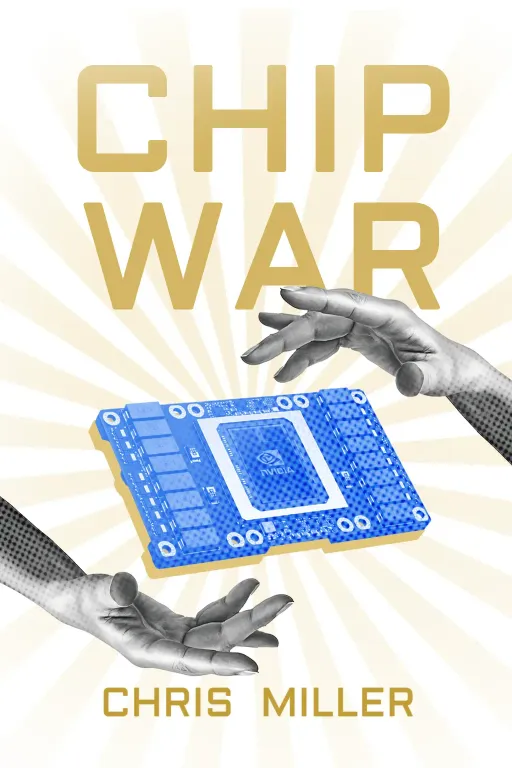
Nova: What if the most powerful geopolitical weapon on earth wasn't a missile, a fleet of warships, or a sophisticated software program, but a microscopic pattern carved onto a sliver of silicon using nothing but light and chemistry? It sounds like science fiction, but as Chris Miller reveals in his incredible book,, semiconductors are the absolute bedrock of modern military power, global finance, and daily life. Today, we are diving deep into this high-stakes technological battleground, but we are doing it with a very special twist. We have Katherine with us, a recent chemical engineering graduate who is currently working in science research. Katherine, it is so wonderful to have you here to help us unpack the physical and chemical magic behind these chips.
KatherineCS190: Thanks, Nova. I am incredibly excited to be here. You know, when we look at the semiconductor industry from a chemical engineering perspective, it is essentially the ultimate manifestation of transport phenomena, thermodynamics, and reaction kinetics scaled down to the nanometer level. But what really fascinated me about the book is how these incredibly rigid, structured physical processes are completely dependent on highly dynamic, sometimes chaotic human systems. It really made me think about how we, as technical minds, sometimes get so caught up in our own internal structures and overthinking that we forget that the real breakthroughs happen when we step out of our heads and connect with the systems around us.
Nova: Oh, I love that so much. We are absolutely going to weave those two worlds together today. We are going to tackle this book from two distinct, powerful angles. First, we'll explore the raw, physical chemistry of chip fabrication and how a relentless focus on real-world iteration and "learning by doing" saved the early industry from collapse. And second, we'll look at the mind-boggling global networks of human collaboration that make modern chips possible, uncovering how radical trust and communication are the ultimate blueprints for leadership and breaking out of isolation. Are you ready to dive into the cleanroom, Katherine?
KatherineCS190: Let's do it, Nova. Put on your bunny suit, because we are going straight to the heart of the silicon wafer.
Deep Dive into Core Topic 1
SECTION
Nova: Let's take a trip back in time to the late 1950s. Picture Dallas, Texas. It is a sweltering, humid summer, and inside the labs of Texas Instruments, engineers are struggling with a massive crisis. They have this brilliant theoretical concept—the integrated circuit, invented by Jack Kilby. The idea is to put multiple transistors, resistors, and capacitors on a single piece of semiconductor material. On paper, it is a masterpiece. But in reality? The manufacturing lines are a disaster. The "yield"—which is the percentage of usable chips that actually work at the end of the production line—is sitting at a big, fat zero percent. They are literally shipping nothing but junk. And then, in walks a young, brilliant engineer named Morris Chang. Katherine, as a chemical engineer, what is going through your mind when you hear about a zero percent yield on a cutting-edge production line?
KatherineCS190: Oh, it is the ultimate nightmare, but also the ultimate puzzle. In chemical engineering, we are trained to look at a system and identify the variables. When you have a zero percent yield, it means there is a fundamental disconnect between your theoretical model and the physical reality of your reactor—or in this case, the fabrication line. What Morris Chang did when he was put in charge of that line was so elegant in its simplicity, yet incredibly difficult in execution. He didn't sit in his office trying to design a perfect, flawless theoretical chip from scratch. Instead, he went right onto the factory floor. He started systematically tweaking the physical and chemical variables. He adjusted the temperature of the diffusion furnaces by a few degrees. He varied the pressure at which different chemical vapors were introduced to the silicon. He changed the exposure times during the photolithography process. He was treating the entire production line as a living, breathing chemical experiment.
Nova: Yes. He was getting his hands dirty. And the results were legendary. Within just a few months of this relentless, systematic tweaking, the yield on his production line jumped from zero to twenty-five percent. Suddenly, Texas Instruments could actually mass-produce reliable transistors for IBM's mainframe computers. This was a massive commercial and technological turning point. But what I find so beautiful about this story, Katherine, is the mindset shift. It is the triumph of real-world iteration over theoretical perfectionism.
KatherineCS190: Exactly, Nova. And this is something I struggle with personally, and I think many analytical minds do. We tend to want to structure everything perfectly in our minds before we take action. We spend hours, days, or even weeks overthinking, trying to calculate every possible outcome to avoid failure. But Morris Chang's success proves that the physical world—and honestly, the social world too—is far too complex to be solved purely through internal modeling. You have to run the experiment. You have to put the chemicals in the beaker, or in this case, you have to put yourself out there, make mistakes, analyze the data, and iterate. A twenty-five percent yield is a massive victory when you started at zero. It taught me that we need to treat our own lives, our social interactions, and our leadership journeys not as tests we have to pass perfectly on the first try, but as iterative processes where we constantly adjust our variables based on real-world feedback.
Nova: That is such a profound connection, Katherine. If we wait for a hundred percent theoretical certainty, we will never launch the product. We will never start the conversation. We will never take the lead. Morris Chang didn't wait for a perfect cleanroom; he worked with the messy, humid reality of Dallas and made it work. He went on to lead Texas Instruments' entire integrated circuit business because he understood that manufacturing know-how and process engineering were just as important as the initial scientific breakthrough.
KatherineCS190: It really highlights the difference between science and engineering. Science is about discovering the fundamental truth, but engineering is about making it work at scale, under real-world constraints, with limited resources. And that requires a level of pragmatism and adaptability that you can't learn from a textbook. You have to develop an intuition for the system. And you only get that intuition by interacting with it directly, by failing, and by adjusting.
Nova: Right. And speaking of systems, Morris Chang's journey didn't stop in Dallas. Decades later, he took this exact process-engineering mindset and used it to found Taiwan Semiconductor Manufacturing Company, or TSMC. But instead of designing his own chips, he created a completely new business model: the pure-play foundry. He told the world, "You design the chips, and we will focus entirely on the incredibly complex, capital-intensive chemistry of manufacturing them." And that leads us beautifully into our second core topic.
Deep Dive into Core Topic 2
SECTION
Nova: If you look at a modern smartphone, it usually has a label on the back that says something like, "Designed in California, Assembled in China." But as Chris Miller points out in, this label is incredibly misleading. The most irreplaceable, technologically advanced components of that phone—the processor chips—are fabricated in Taiwan, using software tools designed in the United States, silicon wafers from Japan, and lithography machines built in the Netherlands. The modern semiconductor supply chain is the most complex, highly integrated multinational endeavor in human history. No single company, and certainly no single country, can build a cutting-edge chip alone. Katherine, when you look at this level of global interdependence, what stands out to you?
KatherineCS190: It is absolutely mind-boggling. Let's take just one piece of this puzzle: the extreme ultraviolet, or EUV, lithography machines built by a Dutch company called ASML. These machines are the only tools in the world capable of carving the tiniest features onto modern chips—features that are just a few nanometers wide. To give you an idea of the scale, we are talking about structures that are smaller than a single strand of human DNA. To create the EUV light needed for this process, the machine has to blast a microscopic droplet of molten tin, which is traveling through a vacuum at two hundred miles per hour, with a high-power carbon dioxide laser. And it doesn't just do this once. It blasts the droplet twice: once to warm it up, and a fraction of a microsecond later, a second blast vaporizes the tin into a plasma reaching temperatures of half a million degrees Celsius—which is several times hotter than the surface of the sun. This process is repeated fifty thousand times per second to generate a steady stream of EUV light.
Nova: That is absolutely insane. It sounds like a cosmic event happening inside a machine.
KatherineCS190: It really is. But here is the catch: ASML didn't develop this technology in isolation. The laser is built by a German company called Trumpf. The ultra-precise mirrors that reflect the light are crafted by another German optics giant, Zeiss. The chemical photoresists are sourced from Japan. The initial research was funded by a consortium of American chipmakers and national labs. ASML is essentially the orchestrator of a global symphony of specialized expertise. They built what Morris Chang calls the "Grand Alliance." It is a network of radical trust and collaboration. If any one of these partners fails, or decides to keep their secrets to themselves, the entire system collapses.
Nova: That is a beautiful way to put it—a global symphony of specialized expertise. And it stands in stark contrast to the Soviet Union's approach during the Cold War. The Soviets tried to build their own "Soviet Silicon Valley" in a city called Zelenograd. But their strategy was entirely based on isolation and imitation. They had a "copy it" policy. They would steal American chips, reverse-engineer them, and try to replicate them exactly. But because they were cut off from the global supply chain, and because they stifled internal innovation through top-down bureaucratic control, they were always at least half a decade behind. They could copy the physical layout of a chip, but they couldn't copy the tacit manufacturing knowledge, the chemical purity standards, or the collaborative ecosystem that made Silicon Valley thrive.
KatherineCS190: That is such a powerful historical lesson. The Soviet failure shows that you cannot achieve greatness through isolation and imitation. You cannot just sit in a closed room, look at what others are doing, and try to copy it perfectly in your own head. True innovation—and true leadership—requires integration. It requires stepping out of your secure, controlled environment and engaging with a diverse network of people who bring different strengths to the table. As an INFJ, I naturally tend to spend a lot of time in my own mind, structuring my thoughts and trying to protect my inner world. But looking at the semiconductor industry, I realize that the most complex, beautiful things on earth can only be built when we open up our interfaces, build trust, and collaborate. We have to allow ourselves to be dependent on others, and allow them to depend on us. That is how you build a "Silicon Shield" of personal and professional resilience.
Nova: Oh, Katherine, that is incredibly beautiful and so true. The "Silicon Shield" is this concept that Taiwan's dominance in chip manufacturing makes the rest of the world, especially the United States, deeply invested in its security and prosperity. It is a shield built not on isolation or military might alone, but on deep, irreplaceable economic and technological interdependence. And we can build our own personal silicon shields by forging deep, meaningful connections with our peers, our colleagues, and our communities. When we share our unique technical expertise—our "specialized chemistry"—and combine it with the strengths of others, we become irreplaceable parts of a larger, more resilient system.
KatherineCS190: Exactly. And as a chemical engineer, I know that a catalyst doesn't work by staying isolated. It has to physically interact with the reactants to lower the activation energy and make the reaction happen. In the same way, if we want to develop our leadership and social abilities, we have to act as catalysts. We have to step into the mixture, initiate the contact, and facilitate the connection. It might feel chaotic or uncomfortable at first, but that is where the reaction happens. That is where the growth is.
Synthesis & Takeaways
SECTION
Nova: This has been such an incredibly rich conversation, Katherine. We have journeyed from the humid fabrication lines of Dallas in the 1950s to the ultra-precise, sun-hot plasma chambers of modern EUV machines in the Netherlands. And through it all, we've seen that the story of the chip war is not just a story of silicon and software, but a story of human grit, relentless iteration, and radical global collaboration. Let's synthesize our key takeaways for our listeners, and especially for you, Katherine, as you embark on your career in science research and your personal journey of leadership.
KatherineCS190: I think the first major takeaway is to embrace the "yield mindset." Don't let the fear of a zero percent yield keep you from running the experiment. Whether you are trying to optimize a chemical process in the lab, or trying to connect with a new group of peers, expect that the first few runs might be messy. Treat every social interaction or leadership opportunity as a low-stakes, iterative experiment. Systematically adjust your variables—your body language, your active listening, your openness—and analyze the feedback. Every iteration brings you closer to that twenty-five percent yield, and eventually, to mastery.
Nova: That is a fantastic takeaway. And the second is to build your own "Grand Alliance." Recognize that you do not have to have all the answers or possess every single skill to be a leader. The most effective leaders are like ASML—they are orchestrators of specialized talent. They build networks of trust, ask insightful questions, and facilitate collaboration. By stepping out of your head and actively seeking to understand and appreciate the unique strengths of your peers, you naturally build deep, resilient connections that elevate everyone involved.
KatherineCS190: I love that. It takes the pressure off having to be perfect. I don't have to be the laser, the mirror, and the chemical photoresist all at once. I just have to be willing to connect them and play my part in the symphony.
Nova: You are already playing your part beautifully, Katherine. Your analytical depth and your willingness to reflect so openly are incredible catalysts. We want to leave our audience with one powerful, thought-provoking question to ponder: In your own life or career, what is one "experiment" you have been overthinking and holding back on, and how can you take just one small, iterative step today to run that experiment and connect with the system around you?
Nova: Thank you, Katherine. Keep iterating, keep connecting, and keep being the amazing catalyst you are. And to our listeners, thank you for joining us on this episode of. Until next time, keep exploring, keep learning, and we'll see you in the next reaction.