Personalized Podcast
Golden Hook & Introduction
SECTION
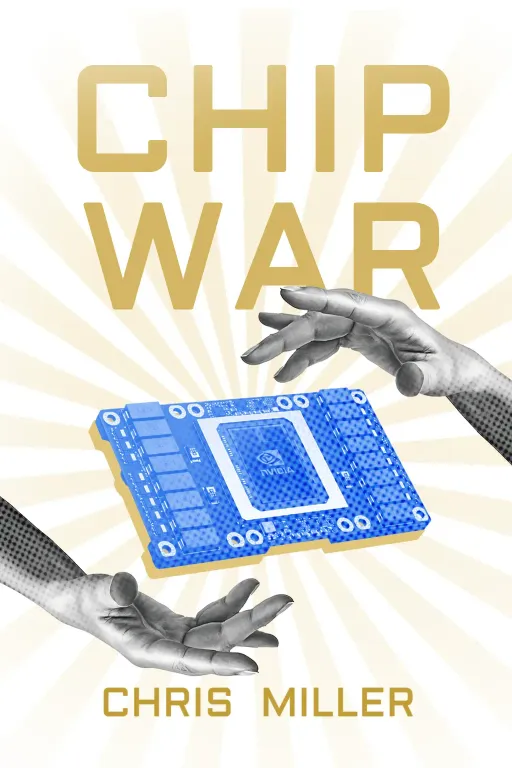
Nova: Imagine building a revolutionary AI software, only to realize its entire future depends on a machine that vaporizes tiny droplets of molten tin with a high-power laser fifty thousand times a second, inside a vacuum, using the smoothest mirrors ever made by humans. Welcome to the wild, high-stakes world of by Chris Miller. Today, we are diving deep into this incredible book with Frank Wu, cofounder of Aibrary and a Harvard Master in Public Policy. We are going to tackle this from two fascinating angles. First, we will dismantle the myth of technological self-sufficiency—why nations cannot just copy their way to chip supremacy. Second, we will map out the reality of weaponized interdependence and what this intense US-China tech rivalry means for the future of AI and the entrepreneurs caught in the middle. Frank, it is so wonderful to have you here. How does it feel to look at the physical bedrock of the AI systems you are building every day?
Frank Wu: Thanks, Nova. It is great to be here. You know, as someone building an AI startup, it is incredibly humbling to read. We tend to think of software and AI as these ethereal, weightless things existing in the cloud. But the cloud has a physical address, and that address is written on silicon. When I look at my three-year-old daughter, I wonder what the technological landscape will look like when she is my age. Will it be completely fragmented? My public policy background makes me look at this not just as a business challenge, but as a massive geopolitical chess game where the rules are being rewritten in real-time.
Nova: Oh, absolutely. It is like we have spent decades believing the internet made the world a global village, but reminds us that the village relies on a incredibly fragile, highly concentrated physical pipeline. Let us start with that first big idea: the myth of technological autarky, or self-sufficiency. Chris Miller does a brilliant job showing that you cannot just build a wall around your country and decide to make cutting-edge chips from scratch.
Frank Wu: Right, and that is a lesson history has already taught us, though some leaders seem to keep forgetting it. The Soviet Union's Zelenograd project is the perfect case study here.
Deep Dive into Core Topic 1
SECTION
Nova: Yes! Zelenograd. Nikita Khrushchev's dream of a Soviet Silicon Valley. It is such a wild story. They literally built a secret city dedicated entirely to microelectronics. They had brilliant scientists, massive state funding, and an incredibly active espionage network. They even had spies like Joel Barr and Alfred Sarant, who fled the US and helped design their early systems. But their core strategy was basically "copy it."
Frank Wu: Exactly. The "copy it" strategy. There is this striking moment in the book where Boris Malin, a Soviet semiconductor expert, returns from studying in Pennsylvania with a Texas Instruments SN-51 integrated circuit. He brings it to Alexander Shokin, the bureaucrat in charge of Soviet microelectronics. Shokin puts the chip under a microscope and says, "Copy it, one-for-one, without any deviations. I will give you three months."
Nova: It sounds so simple, right? Just reverse-engineer it! But why did that fail so catastrophically in the long run?
Frank Wu: Because copying is a static strategy in an exponentially moving industry. By the time the Soviet engineers finished reverse-engineering the SN-51, Texas Instruments and Fairchild had already doubled their transistor density. They were chasing a moving target, and they were always five to ten years behind. But more importantly, they copied the, but they could not copy the. They did not have the ultra-pure chemicals, the precise manufacturing yields, or the specialized machinery. In semiconductors, the "know-how" of manufacturing is actually more valuable than the blueprint itself.
Nova: That is such a crucial distinction, Frank. It is the difference between having a recipe and actually knowing how to bake a soufflé in a temperamental oven. And today, that "know-how" is even more concentrated. Let us talk about ASML and EUV lithography. This is mind-blowing. To print the smallest transistors, we need Extreme Ultraviolet light, which has a wavelength of just thirteen point five nanometers. And only one company in the world, ASML in the Netherlands, can make the machines that do this.
Frank Wu: And look at how ASML built that capability. It was not a Dutch triumph alone; it was a global triumph. The light source comes from Cymer, a company in San Diego, California. They generate EUV light by dropping microscopic droplets of molten tin through a vacuum at two hundred miles per hour and blasting them with a high-power carbon dioxide laser developed by Trumpf in Germany. The laser pulses twice for every single droplet—once to warm it up, once to vaporize it into a plasma at half a million degrees Celsius. This happens fifty thousand times a second!
Nova: It sounds like science fiction! And then those light rays have to be reflected by mirrors made by Zeiss in Germany that are so smooth that if you scaled them up to the size of the United States, the largest bump would be less than an inch high.
Frank Wu: Exactly! So when a country says, "We are going to achieve complete semiconductor self-sufficiency," they are saying they want to replicate the top-tier capabilities of Germany, the US, Japan, the Netherlands, and Taiwan, all within their own borders. It is economically and physically impossible. Even TSMC in Taiwan, which dominates fabrication, relies on this global "Grand Alliance" of suppliers. As an entrepreneur, this tells me that true innovation is never a solo sport. It is about integration and ecosystem building. At Aibrary, we are trying to build an AI agent for personal growth, and we realize we cannot build every part of the stack ourselves. We have to stand on the shoulders of giants, leveraging open-source models and global cloud infrastructure.
Nova: I love that connection, Frank. It is about recognizing where your unique value lies and collaborating for the rest. But what happens when those global collaborations get caught in the crossfire of national security? That brings us to our second core topic: weaponized interdependence.
Deep Dive into Core Topic 2
SECTION
Frank Wu: This is where my public policy brain really starts buzzing. "Weaponized interdependence" is a term that perfectly describes what is happening right now. In a highly integrated global economy, certain physical nodes become choke points. If you control those choke points, you can exert immense structural power over your rivals. The US has realized that while chip design is global, the software tools, the EDA software, and the manufacturing equipment are heavily dominated by American firms or allies.
Nova: Right, and we saw the US unleash this power against Huawei in 2020. Huawei was rising rapidly, dominating 5G network equipment and smartphones. They had their own chip design unit, HiSilicon, which designed world-class processors. But HiSilicon did not have its own fabs—they outsourced the actual manufacturing to TSMC in Taiwan.
Frank Wu: And the US used the Foreign Direct Product Rule. They basically said, "If you use any American software or equipment to manufacture chips, you cannot sell them to Huawei without a license." Since TSMC's fabs are packed with American equipment from companies like Applied Materials and Lam Research, TSMC had to cut off Huawei. Overnight, Huawei's access to advanced silicon vanished. It was a devastating blow. It showed that even if you are a tech giant with billions in R&D, you can be brought to your knees if you do not control the physical substrate of your technology.
Nova: It was a real "Sputnik moment" for Beijing, wasn't it? It triggered this massive, state-backed push to "Call Forth the Assault," as Xi Jinping put it, pouring over a hundred billion dollars into the "Big Fund" to build a domestic supply chain. But as we discussed, that is incredibly hard. We even saw massive scams like the Wuhan Hongxin project, where local governments were duped by scammers who promised advanced fabs but ended up going bust without producing a single chip.
Frank Wu: It is a classic policy dilemma. When you throw massive amounts of state capital at a highly complex, specialized problem without market discipline, you get immense waste and corruption. But for someone like me—a Chinese entrepreneur building an AI company in the US—this decoupling creates a very complex personal and professional dynamic. On one hand, I see the incredible talent pool in China, the drive, the "wolf culture" that companies like Huawei cultivate. On the other hand, the cutting-edge AI research and the advanced hardware, like Nvidia's H100 GPUs, are heavily concentrated in the US ecosystem.
Nova: How does that affect your day-to-day strategy at Aibrary? Are you constantly worried about GPU shortages or new export controls?
Frank Wu: It is a constant factor in our strategic planning. If you are building AI, you are essentially renting compute power. The cost of training and running large language models is directly tied to the efficiency of the underlying chips. When the US restricts the export of advanced GPUs to China, it creates a bifurcated AI landscape. In the US, we have access to the absolute cutting edge, which allows us to push the boundaries of what our AI agents can do. But it also means we have to design our software to be incredibly efficient. We cannot just rely on brute-force compute. We have to think about algorithmic efficiency, optimizing our models so they can run on less advanced hardware if needed. It forces a certain discipline.
Nova: That is a fascinating silver lining! The hardware bottleneck actually drives software elegance. It is like writing a beautiful poem within the strict constraints of a sonnet, rather than a rambling free-verse essay.
Frank Wu: Exactly! And it also makes you appreciate the importance of open-source movements. Technologies like RISC-V, the open-source chip architecture, are gaining massive traction, especially in China, because they are not subject to US export controls. In the software world, open-source AI models allow startups to compete with giants without needing a billion-dollar compute budget. It democratizes innovation.
Nova: It really does. But there is also a deeper, more sobering side to this. Chris Miller spends a lot of time on the "Taiwan Dilemma." TSMC builds almost all the world's most advanced processor chips, providing thirty-seven percent of the world's new computing power each year. If a conflict were to break out in the Taiwan Strait, the global economy would face a catastrophic shock. Some call TSMC Taiwan's "Silicon Shield," believing it forces the US to defend the island. But others worry it makes Taiwan a prime target. How do you view that risk through your public policy lens?
Frank Wu: It is a terrifying scenario, Nova. A blockade or invasion of Taiwan would not just stop smartphone production; it would halt global manufacturing. Cars, medical equipment, airplanes, data centers—everything would grind to a halt. The "Silicon Shield" is a double-edged sword. It deters conflict because the cost of disruption is too high for everyone, including China, which relies heavily on TSMC chips. But deterrence only works as long as rational economic calculations outweigh nationalist political goals. The Russia-Ukraine war showed us that geopolitical passions can sometimes override economic rationality. Russia's military has struggled immensely because they are cut off from Western chips, relying on foreign microelectronics found in downed drones. It is a stark reminder that in modern conflict, silicon is as vital as steel.
Synthesis & Takeaways
SECTION
Nova: It really is the "crude oil of the twenty-first century," as Jerry Sanders famously said. As we wrap up this incredibly rich conversation, Frank, let us synthesize some key takeaways. We have looked at the history, the mind-boggling physics of lithography, and the intense geopolitical chess game. For our listeners—whether they are tech builders, policy students, or just curious minds—what is the big lesson here?
Frank Wu: I think the biggest lesson is that we must embrace a "zero trust" mindset when it comes to supply chains, but a "maximum trust" mindset when it comes to global talent. The physical infrastructure of technology is becoming more fragmented and nationalistic, and we have to build resilience into our businesses to survive that. But the ideas, the brilliant minds that drive these breakthroughs, are still global. The US semiconductor industry succeeded because it attracted talent from all over the world—people like Morris Chang from China, Andy Grove from Hungary. As an AI entrepreneur, my goal is to keep bridging these worlds, using technology to foster personal growth and understanding, even as the physical world tries to build walls.
Nova: That is beautiful, Frank. It is about building bridges of intellect and empathy, even when the silicon pathways are being blocked. And for our listeners, maybe the next time you hold your smartphone or interact with an AI, take a moment to appreciate the incredible, global, near-impossible journey that those billions of tiny transistors took just to help you go about your day. Frank, thank you so much for sharing your brilliant insights with us today.
Frank Wu: Thank you, Nova. It was an absolute pleasure.
Nova: And to all our listeners, keep learning, keep growing, and remember: the future is built on silicon, but it is guided by human heart. See you next time!