

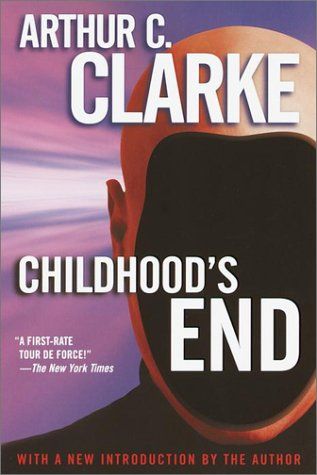
Childhood’s End
Introduction
Nova: Imagine waking up tomorrow morning and looking out your window to see a massive silver ship hovering silently over your city. Not just your city, but every major capital on Earth. No lasers, no demands, just... presence. This is how Arthur C. Clarke begins his 1953 masterpiece, Childhood's End. It is arguably one of the most profound and unsettling stories in the history of science fiction.
Atlas: It is the ultimate 'be careful what you wish for' story, right? We spend all this time looking at the stars, wondering if we are alone, and then suddenly, the answer arrives. But it is not a war. It is a management takeover. These beings, the Overlords, basically show up and say, 'Alright humans, you have had your fun, but you are making a mess. We are in charge now.'
Nova: Exactly. And what follows is a century of peace, prosperity, and the total end of war, poverty, and disease. It sounds like a dream, but as Clarke shows us, every utopia has a price. Today, we are diving deep into the evolution of humanity, the mystery of the Overlords, and why this book still haunts readers seventy years after it was written.
Atlas: I have always found it fascinating that Clarke wrote this right at the start of the Cold War. People were terrified of nuclear annihilation, and here comes a book saying, 'Don't worry, the aliens will stop the bombs.' But the way they do it... it is almost more terrifying than the bombs themselves because it means the end of our autonomy. I am ready to get into the weeds on this one.
Key Insight 1
The Golden Age and the Silent Masters
Nova: So, the story starts with the arrival of the Overlords. Their leader, Karellen, communicates only through a single human representative, a man named Stormgren. For fifty years, the Overlords rule Earth from their ships, but they never show their faces. They just issue edicts that make the world better. They end the cruelty of bullfighting, they stop apartheid, and they basically force humanity to grow up.
Atlas: It is like the world's most effective nanny state. But fifty years is a long time to stay behind a curtain. Why the secrecy? If they are so benevolent, why not just walk among us? That is the question that drives the first third of the book. Stormgren is constantly trying to get a glimpse of Karellen, even though Karellen says humanity just isn't ready to see them yet.
Nova: And that is the first big theme: the price of peace. Clarke describes this era as a 'Golden Age,' but he also notes that it is a stagnant one. Without struggle, without the threat of war or the need to solve massive social problems, human creativity starts to wither. Science slows down because the Overlords already have all the answers. Art becomes derivative. It is a comfortable cage.
Atlas: That is a chilling thought. We think of utopia as the goal, but Clarke suggests that if we don't earn it ourselves, it is just a form of arrested development. We are like pets in a very nice enclosure. And the Overlords even forbid us from going into space. They tell us, 'The stars are not for man.' That has to be the most crushing thing a space-faring species could hear.
Nova: It is a total rejection of the 'Star Trek' dream. Usually, sci-fi is about us conquering the final frontier. Here, the frontier is closed by beings who say we aren't mature enough to handle it. But the real kicker comes when the fifty years are up. Karellen finally agrees to step out of his ship and show the world what the Overlords actually look like.
Atlas: I remember reading that reveal for the first time. It is one of the greatest 'mic drop' moments in literature. After all that talk of benevolence and wisdom, they walk out and they look exactly like the traditional Christian image of the Devil. Horns, leathery wings, cloven hooves, the whole deal.
Nova: It is a brilliant subversion. Clarke is playing with our deepest cultural fears. But the explanation for why they look like that is even more mind-bending. It is not that they visited us in the past and inspired the myth of the Devil. It is actually a 'memory of the future.'
Atlas: Wait, explain that. How can you remember something that hasn't happened yet? That sounds like classic Clarke-level high-concept physics.
Nova: It is a psychic phenomenon. Clarke suggests that the human race had a collective premonition of its own end. Because the Overlords would be present at the literal end of humanity, that image leaked backward through time into our collective subconscious. We didn't fear the Devil because of some ancient evil; we feared the Devil because we subconsciously knew that this form represented the end of our species as we knew it. It is a psychological scar from a future event.
Key Insight 2
The Stowaway and the Cosmic Perspective
Nova: While the rest of humanity is settling into this comfortable, devil-managed utopia, there is one character who refuses to accept the 'stars are not for man' rule. Jan Rodricks. He is a young man with an insatiable curiosity, and he decides to do the unthinkable: he stows away on an Overlord supply ship.
Atlas: I love Jan's character because he represents that core human spark that the Overlords are trying to dampen. He wants to see the truth, even if it costs him everything. And it does cost him everything. Because of time dilation—the physics of traveling near the speed of light—his short trip to the Overlord home world means decades pass on Earth.
Nova: Exactly. He spends just a few months in transit, but when he returns, eighty years have gone by. He is a man out of time. But what he sees on the Overlord planet is vital. He realizes that as powerful as the Overlords are, they are also limited. They are masters of logic and technology, but they are completely devoid of the psychic potential that humans apparently possess.
Atlas: So the Overlords are basically the ultimate bureaucrats of the universe? They can run a planet perfectly, they can build ships that cross galaxies, but they can't 'ascend' or whatever it is that is happening to humanity? That is a tragic twist for them.
Nova: It really is. They are the 'midwives' of evolution. They travel from world to world, finding species that are on the verge of a psychic breakthrough, and they protect them until that breakthrough happens. But they themselves can never join that higher state of being. They are stuck in the material world forever.
Atlas: It makes you look at Karellen differently. He isn't a conqueror; he is a caretaker who knows he is an evolutionary dead end. He is watching these 'primitive' humans about to become something he can't even comprehend. It is like a high school teacher who knows their students will go on to win Nobel Prizes while they stay in the same classroom year after year.
Nova: That is a perfect analogy. And while Jan is away, the 'breakthrough' begins back on Earth. It starts with the children. It is not a gradual change; it is a total, terrifying transformation. The children stop playing, they stop talking to their parents, and they start having these collective dreams. They begin to develop telekinetic powers that they use to reshape the world around them.
Atlas: This is where the book turns from a utopian sci-fi into something almost like a horror story. The parents are watching their children turn into these cold, alien beings who don't even recognize them as family anymore. It is the literal end of the 'human' experience. The children aren't individuals anymore; they are becoming a single, collective consciousness.
Key Insight 3
The Overmind and the End of Earth
Nova: This collective consciousness is what Clarke calls the Overmind. It is a vast, galactic entity that absorbs sentient races once they reach a certain level of psychic development. The Overlords are its servants. They prepare the 'nursery'—which is Earth—until the 'children' are ready to be harvested.
Atlas: Harvested is a dark word for it, Nova. Is it a good thing? I mean, they are joining a cosmic god-mind, but they are also losing their souls, their personalities, their art, their love. Everything that makes us 'us' is just... deleted.
Nova: That is the central ambiguity of the book. Is this transcendence or is it extinction? Clarke doesn't give us an easy answer. When Jan Rodricks returns from his space trip, he is the last 'real' human left alive. All the other adults have died off, and the children are just standing in these weird, trance-like groups, waiting for the final transition.
Atlas: The description of the end of the world is so haunting. Jan is there, talking to Karellen over a radio link as the Overlords flee the solar system because the energy being released is too dangerous for them. Jan is the final witness. He describes the Earth becoming transparent, the mountains dissolving into light, and the children finally leaving the physical plane to join the Overmind.
Nova: It is a literal apocalypse, but a quiet one. There is no fire and brimstone, just a total restructuring of matter. The Overmind doesn't just take the children; it consumes the entire planet for energy to fuel their departure. Jan's last words are a report on the beauty of the destruction. He says, 'The light! It's reaching the stars!' and then... silence.
Atlas: It is such a lonely ending. The Overlords are watching from their ships, safe but forever excluded. Humanity is gone, either dead or transformed into something unrecognizable. And the Earth itself is just a memory. It makes you wonder if Clarke thought this was a happy ending or a tragedy.
Nova: Clarke was always fascinated by the idea that humanity is just a transitional phase. He famously said, 'Two possibilities exist: either we are alone in the Universe or we are not. Both are equally terrifying.' In Childhood's End, he suggests a third option: that we are just a larval stage for something much bigger. Our 'childhood' has to end so that something else can begin, but that doesn't make the loss of the child any less painful.
Atlas: It is a very unsentimental view of the universe. Most sci-fi wants us to stay human but get better—live longer, travel faster. Clarke says, 'No, to truly progress, you have to stop being human entirely.' That is a hard pill to swallow. It is the ultimate ego death for an entire species.
Key Insight 4
Legacy and the Price of Evolution
Nova: The legacy of Childhood's End is massive. You can see its fingerprints on everything from '2001: A Space Odyssey'—which Clarke also wrote, of course—to modern shows like 'Neon Genesis Evangelion' or even 'Stranger Things.' That idea of children having psychic powers that signal a shift in reality is a trope he basically pioneered.
Atlas: And let's talk about the 2015 miniseries for a second. It tried to modernize the story, but a lot of fans felt it lost that specific Clarke-ian 'cosmic indifference.' In the book, the Overlords aren't evil, and the Overmind isn't a villain. They are just parts of a natural, albeit alien, process. The TV show made it feel a bit more like a traditional invasion story, which I think misses the point.
Nova: I agree. The power of the book lies in its philosophical weight. It challenges the idea that human individuality is the pinnacle of existence. It asks: if you could have world peace and eternal life as part of a god-mind, but you had to give up your name, your memories, and your physical body, would you do it?
Atlas: Most people would say no! We are attached to our 'stuff' and our 'selves.' But Clarke suggests we might not have a choice. Evolution isn't something you vote on. It is something that happens to you. The Overlords are there to make sure we don't kill ourselves before we reach that point, but they aren't there to save 'us.' They are there to save what we will become.
Nova: It is also a reflection on the limitations of science. The Overlords represent the peak of scientific and material achievement, yet they are the ones left behind. The humans, who are 'primitive' and 'superstitious,' are the ones with the spark of the divine—or at least the psychic. It is a very interesting balance for a writer who was otherwise a very staunch rationalist.
Atlas: It is like Clarke is admitting that there are things science can't touch. He calls the Overlords 'masters of the world' but 'servants of the Overmind.' They have all the data, but they have no soul. It is a warning, maybe, that we shouldn't focus so much on the 'how' of the universe that we forget the 'why.'
Nova: And that is why the title is so perfect. Childhood's End. A child doesn't want to grow up and lose their toys and their imagination, but they have to. If they stay a child forever, that is a tragedy. But the transition to adulthood is also a kind of death. The child you were is gone. Clarke just scaled that up to the level of the entire human race.
Conclusion
Nova: Arthur C. Clarke's Childhood's End remains one of the most challenging books in the sci-fi canon because it refuses to give us a traditional hero's journey. There is no winning. There is only changing. It forces us to look at our species from a distance of millions of miles and ask what we really value.
Atlas: It is a humbling read. It reminds us that in the grand timeline of the universe, our entire history—the wars, the art, the empires—might just be the equivalent of a toddler playing in a sandbox. It is a bit depressing, but also strangely beautiful. We are part of something much larger than ourselves, even if we can't understand it.
Nova: If you haven't read it, or if it has been years, I highly recommend picking it up. It is a short book, but it will stay with you long after you close the cover. It makes you look at the night sky and wonder not just who is out there, but what we are destined to become.
Atlas: Just don't be surprised if you start looking for silver ships in the clouds tomorrow morning. And maybe hold your kids a little tighter tonight before they start moving things with their minds.
Nova: On that note, thank you for joining us for this deep dive into a true classic. This is Aibrary. Congratulations on your growth!