

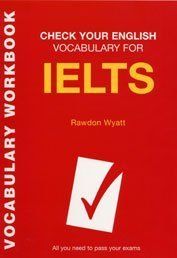
Check Your English Vocabulary for IELTS (Check Your English Vocabulary)
Introduction
Nova: Imagine this. You're sitting in an IELTS exam room. The clock is ticking. You're staring at a Writing Task 2 prompt about climate change, and the only word that comes to mind is "bad." Not ideal, right? Welcome to Aibrary, the podcast where we crack open books that change how you learn. I'm Nova.
Nova: : And I'm Sky. And Nova, that's a very specific nightmare you just painted. But honestly, for millions of IELTS test takers around the world, vocabulary panic is absolutely real. Over three and a half million people take the IELTS every year, and vocabulary is the silent killer across all four sections. Listening, Reading, Writing, Speaking. It's everywhere.
Nova: It is everywhere. And today we're talking about a book that has become something of a cult classic in IELTS preparation circles. It's called "Check Your English Vocabulary for IELTS" by Rawdon Wyatt. Now in its fourth edition, published by Bloomsbury, it's been helping students build their word power for over two decades.
Nova: : And here's what fascinates me. This isn't some massive textbook. The latest edition clocks in at around 139 pages. It's compact. Yet it has a 4 out of 5 star rating on Goodreads with hundreds of reviews. So what's the secret sauce? Why has this particular workbook survived while so many other IELTS prep books have come and gone?
Nova: That's exactly what we're unpacking today. We'll look at the structure, the method, the topics, the pros and cons, and most importantly, how you can actually use this book to squeeze more band score points out of your vocabulary. Let's get into it.
Author Background and Book Origins
Who Is Rawdon Wyatt and What Makes This Book Different?
Nova: So before we dive into the pages, let's talk about the person behind them. Rawdon Wyatt is not a household name like some celebrity test prep gurus, but in the world of English language teaching, he's prolific. He has over 65 books listed on Goodreads. The "Check Your English Vocabulary" series alone covers everything from TOEFL to FCE to Law, Medicine, Human Resources, even Living in the UK.
Nova: : Wait, 65 books? That's an entire library. But I have to ask. Is this a case of quantity over quality? Or is there something genuinely distinctive about his approach?
Nova: Fair question. What sets the IELTS volume apart is that it's not trying to be a complete IELTS course. It doesn't teach you test strategies or grammar rules or essay structures. It does one thing and does it relentlessly. It builds vocabulary through context-based exercises. Every single page is an activity. There are no long explanations, no lectures. You learn by doing.
Nova: : So it's a workbook in the truest sense. You're not reading about vocabulary. You're wrestling with it. And I think that matters because vocabulary acquisition research consistently shows that passive recognition, just seeing a word on a flashcard, is far less effective than active recall and contextual use.
Nova: Exactly. And Wyatt was ahead of the curve on this. The first edition came out in the early 2000s, long before spaced repetition apps and gamified language learning became mainstream. Yet his three-task module structure mirrors what cognitive scientists now recommend. Present the word in context, practice recognizing it, then produce it yourself in a gap-fill. That's the cycle.
Nova: : So the book is built on sound learning principles, not just test hacks. That already makes me more interested than I expected to be.
Deep Dive into the Workbook Architecture
Inside the Book: Structure and Content Breakdown
Nova: Let's crack the spine and look at how this thing is actually organized. The book splits into four major sections. Pages 1 through 57 cover general vocabulary. Pages 58 through 104 cover topic-specific vocabulary. Pages 105 through 119 are productive practice with IELTS-style speaking and writing tasks and sample answers. And pages 120 through 139 are the answer key.
Nova: : Hold on. Let me get this straight. More than a third of the book is dedicated to general vocabulary before you even touch the topic stuff? What's in there?
Nova: This is actually one of the smartest design choices in the book. The general vocabulary section isn't just random word lists. It covers functional language that you need across the entire exam. Things like describing changes, which is huge for Writing Task 1 graphs. Words for addition, equation, and conclusion, critical for Writing Task 2 essays. Confusing words and false friends, which are a nightmare for non-native speakers. Phrasal verbs, four whole modules of them. Condition, comparison, contrast, obligation, opinion, reason and result. These are the connective tissue of English.
Nova: : So it's not "here are some big fancy words to impress the examiner." It's "here are the words you need to actually think and express yourself clearly in English." That's a totally different philosophy.
Nova: Precisely. And the topic-specific section covers around 20 major IELTS themes. Education, the environment, technology, crime and the law, healthcare, the media, business and industry, architecture, the arts, children and the family, food and diet, geography, global problems, money and finance, science and technology, sport, town and country, travel, and work.
Nova: : That's essentially every possible IELTS topic compressed into about 45 pages. Each module, from what I've seen, has three tasks. The first two present vocabulary items in context with a practice or recognition exercise. The third is always a gap-fill where you review the vocabulary.
Nova: Right. And the exercises are genuinely varied. Matching words to definitions. Choosing the correct word in context. Completing sentences. Word formation tasks. Some modules even have short writing prompts. It never feels repetitive, which is a huge achievement for a vocabulary book.
Key Advantages and Effective Study Strategies
What Works: The Strengths That Set This Book Apart
Nova: So let's talk about what this book gets right. First, the answer key. This isn't just a list of correct answers. It's genuinely comprehensive. It provides additional information about specific vocabulary items, alternative words and phrases, and extra notes on usage. It's almost like having a tutor built into the back of the book.
Nova: : That's huge for self-study. Because one of the biggest frustrations with workbooks is finishing an exercise and thinking, "Okay, I got it right, but why?" Or worse, "I got it wrong and I still don't understand why." The answer key here actually teaches.
Nova: Second, the book covers both Academic and General Training modules. So whether you're applying for university or going for immigration, the vocabulary is relevant. Third, the IELTS-style productive practice section at the back. You get actual Writing Task 1 and Task 2 prompts, Speaking tasks, and sample answers. It's not just isolated vocabulary drills. You see how the words function in real exam contexts.
Nova: : I also want to highlight something subtle but important. The instructions in every exercise are extremely clear. For a self-study learner who might be working through this at 10 PM after a long day, clarity matters. You don't want to spend ten minutes just figuring out what the exercise is asking you to do.
Nova: Absolutely. And Wyatt himself recommends in the introduction that you should not work through the book mechanically from beginning to end. He says to choose areas you're unfamiliar with, or areas of specific interest. That's a refreshingly honest piece of advice from an author. He's telling you, don't be a completist. Be strategic.
Nova: : So how should someone actually use this book effectively? What does the research and user feedback suggest?
Nova: The consensus is pretty clear. First, study by topic, not randomly. Pick one topic module, work through all three tasks, and really absorb that vocabulary cluster before moving on. Second, keep a vocabulary notebook. Wyatt explicitly recommends recording new words, phrases, and expressions and reviewing them regularly. Third, combine this book with other materials. It's not a complete IELTS solution. You still need speaking practice partners, full mock tests, and grammar resources.
Nova: : And I'd add, don't just write down the word and its definition. Write the word in a sentence you created yourself. That personal connection dramatically improves retention.
Honest Assessment of Weaknesses
The Limitations and How to Work Around Them
Nova: Okay, let's be fair. No book is perfect, and this one has some clear limitations that you need to know about before you buy.
Nova: : I was waiting for this. What are the pain points?
Nova: First, and this is the biggest one, the book requires a solid intermediate English foundation. If you're at a beginner or even low-intermediate level, around IELTS band 3 or 4, you're going to struggle. The instructions, the example sentences, the answer key explanations, they all assume you already have a working vocabulary of probably 2000 to 3000 words. You need to be roughly at band 5 or above to use this comfortably.
Nova: : So it's not a starting-from-zero book. It's a refining and expanding book. What else?
Nova: Speaking practice is limited. Despite covering vocabulary for all four IELTS sections, the productive practice skews heavily toward writing. There are sample speaking tasks, but they're minimal. If your speaking score is your weak point, this book alone won't fix that. You'll need to supplement with a speaking partner, language exchange, or a dedicated speaking resource.
Nova: : And no detailed grammar explanations, right? I noticed that when looking through the content outline. You might encounter a word and wonder about the grammatical patterns it follows, but the book won't spell those out for you.
Nova: Correct. It's a vocabulary book, not a grammar book, and it stays in its lane. But for some learners, that can be frustrating. If you don't know why we say "interested in" but "keen on," you'll need to look elsewhere for that explanation. Also, some users have noted that if you're not disciplined, the workbook format can feel dry. It's not gamified. There are no colorful illustrations or multimedia elements. It's black and white pages with exercises.
Nova: : So it rewards focused, motivated learners and punishes those hoping for entertainment. Which, honestly, describes most genuinely effective study resources. But the price point, around 15 dollars for the paperback, is pretty reasonable compared to some IELTS prep books that run 40 or 50 dollars.
Nova: Very reasonable. And there's also a digital edition available. So for the cost of a couple of coffees, you're getting a focused, research-backed vocabulary tool. The key is knowing what it is and what it isn't. It's not a magic bullet. It's a sharp, well-designed tool for a specific job.
Conclusion
Nova: So here's the bottom line on "Check Your English Vocabulary for IELTS" by Rawdon Wyatt. It's a compact, no-nonsense workbook that has outlasted trendier competitors because it's built on sound principles. Active recall, contextual learning, spaced practice, and self-assessment. It won't hold your hand or entertain you, but if you bring the discipline, it will build your vocabulary in exactly the way the IELTS exam demands.
Nova: : What I'm taking away is this. Vocabulary isn't about memorizing the longest or rarest words. It's about precision. Knowing the difference between "decline," "drop," "plummet," and "dip" when describing a graph. Knowing when to use "furthermore" versus "moreover." Knowing the collocations. And this book drills that precision, module by module, topic by topic.
Nova: If you're preparing for IELTS and you're at an intermediate level or above, this book deserves a spot on your desk. Pair it with a good monolingual dictionary, which Wyatt himself strongly recommends, like the Macmillan English Dictionary for Advanced Learners. Keep a vocabulary notebook. Review regularly. And don't try to do the whole book in a week. Digest it slowly.
Nova: : And if you're a teacher, this book is a goldmine for lesson planning. The exercises are ready-made, the topics are comprehensive, and the answer key means less prep time for you. It's one of those rare resources that genuinely serves both self-study learners and classroom instructors.
Nova: So whether you're aiming for band 6 or band 8, remember this. Your vocabulary is not a collection of words. It's your toolkit for thinking in English. And the sharper your tools, the more precisely you can express yourself. Rawdon Wyatt's workbook is the whetstone.
Nova: : This is Aibrary. Congratulations on your growth.