

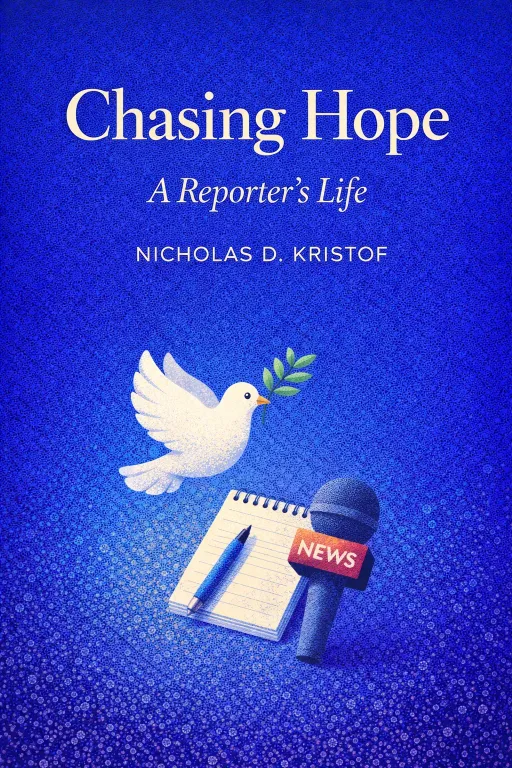
Chasing Hope
A Reporter's Life
Introduction
Nova: Imagine standing in the middle of Tiananmen Square in 1989 as tanks roll in, or walking through a village in Darfur where the air is thick with the aftermath of genocide. Most people would want to run away as fast as possible. But for Nicholas Kristof, those are the moments where he leans in. He has spent forty years at the New York Times going to the places the rest of the world tries to forget. And yet, after seeing the absolute worst of humanity, he titled his memoir Chasing Hope. It feels like a contradiction, doesn't it?
Nova: That is exactly what we are diving into today. Chasing Hope is not just a highlight reel of a famous journalist's career. It is a deeply personal look at how his upbringing on a sheep farm in Oregon shaped his worldview, and how he uses journalism as a tool for empathy. He argues that hope isn't a feel-good emotion; it is a choice and a strategy for change.
Key Insight 1
From the Sheep Farm to the Front Lines
Nova: To understand Nick Kristof, you have to start in Yamhill, Oregon. He grew up on a cherry and sheep farm. His parents were both professors, but they lived this very grounded, rural life. His father, Ladis, was actually a refugee from Eastern Europe who had seen the horrors of World War II firsthand. That background is crucial because it gave Nick a sense that the world is a fragile place, but also that individuals can survive and rebuild.
Nova: It started early. He writes about how he got his first taste of the power of the pen in eighth grade. He wrote an editorial for his school paper, and he realized that words could actually move people. He eventually went to Harvard and then Oxford as a Rhodes Scholar, but he never lost that 'farm boy' identity. He often says that his time in the Future Farmers of America was just as important as his time at Harvard.
Nova: His career really took off when he and his wife, Sheryl WuDunn, were posted to Beijing. They were the first married couple to win a Pulitzer Prize for journalism together. They were there for the Tiananmen Square protests in 1989. Nick describes the sheer bravery of the students and the horror of the crackdown. He wasn't just reporting facts; he was witnessing a turning point in history. He realized then that journalism wasn't just about recording what happened, but about making sure the world couldn't look away.
Nova: He does. He is very honest about the mistakes he made and the times he felt overwhelmed. But he also talks about the 'bridge.' He sees himself as a bridge between the comfortable people reading the New York Times and the people in a refugee camp who have lost everything. He believes that if he can just tell the story well enough, the readers will care, and if they care, they might act.
Case Study
The Weight of the Pulitzer
Nova: If Tiananmen Square put him on the map, his work in Darfur in the mid-2000s defined his legacy. He won his second Pulitzer for his columns on the genocide there. He was one of the few voices in the mainstream media who kept banging the drum, day after day, saying 'this is happening, and we are letting it happen.'
Nova: It is a fair challenge, and Nick grapples with it in the book. He admits that journalism often fails to stop the immediate violence. But he points out that his reporting helped mobilize a massive grassroots movement in the U. S. It led to sanctions and a peacekeeping force. It didn't solve everything, but it saved lives. He tells this story about a Catholic nun he met in a war zone who was just relentlessly helping people. He asked her how she kept going, and she basically told him that you don't do it because you're sure you'll win; you do it because it's the right thing to do.
Nova: That is something he is very sensitive to. In Chasing Hope, he emphasizes the importance of giving his subjects agency. He doesn't just want to show them as victims. He wants to show their courage. He writes about a girl he met in a brothel in Cambodia who he helped rescue. He didn't just write the story and leave; he stayed in touch for years. He watched her go to school, get a job, and start a family. For him, the story doesn't end when the column is published. The relationship continues.
Nova: He argues that if we sanitize the world, we become complicit in its problems. He uses this analogy of a 'tightrope.' If he makes the story too depressing, people will turn the page. If he makes it too light, they won't realize the gravity of the situation. He has to walk that line perfectly to keep the reader engaged without making them feel hopeless. That is the 'chasing' part of Chasing Hope. You are constantly pursuing that balance.
Deep Dive
The Tightrope at Home
Nova: One of the most surprising parts of the book is when he turns his gaze back to his hometown of Yamhill. He wrote a book called Tightrope with his wife Sheryl a few years ago, and he reflects on it in this memoir. He realized that while he was traveling the world covering poverty, his own childhood friends were dying of despair.
Nova: Exactly. He looks at the kids who rode the school bus with him. A shocking number of them are dead or in prison. He uses his hometown as a case study for how we have failed the working class in America. He talks about the loss of good-paying jobs and the erosion of the social safety net. It is a very different kind of reporting because it is so personal. These aren't strangers; these are people he played with as a kid.
Nova: He does, but it is a grittier kind of hope. He talks about the importance of early childhood education and better healthcare. He is a big believer in evidence-based interventions. He doesn't just want to complain about the problem; he wants to find the programs that actually work. He highlights people in these communities who are fighting back—teachers, social workers, neighbors who refuse to give up on each other.
Nova: Yes, he ran for Governor of Oregon in 2022. It was a huge deal. He stepped down from the New York Times after 37 years because he felt like he couldn't just keep writing about the problems; he had to try to solve them from the inside. But it didn't go as planned.
Nova: It was a public and painful setback. He writes about it with a lot of humility. He doesn't blame the system; he reflects on his own naivety. But even in that failure, he finds a lesson. He realized that his voice as a journalist is actually his most powerful tool. He went back to the Times, but with a renewed sense of purpose. He saw that he could do more by shining a light on issues than by navigating the bureaucracy of state government.
Key Insight 2
The Philosophy of the Long Game
Nova: So, let's talk about the 'Hope' part of the title. Nick Kristof isn't talking about blind optimism. He is talking about what he calls 'the long game.' He points out that if you look at the data over the last fifty years, the world has actually improved in massive ways. Child mortality is down, literacy is up, and extreme poverty has been cut in half.
Nova: He says that journalism has a 'negativity bias.' We report on the plane that crashes, not the thousands of planes that land safely every day. He argues that by only focusing on the disasters, we actually rob people of the agency to fix things. If people think the world is just a lost cause, they won't bother trying to help. Hope, for him, is a necessary fuel for progress.
Nova: Exactly. He often quotes Dr. King about the arc of the moral universe bending toward justice. But Nick adds that it doesn't bend on its own; people have to grab it and pull. He shares stories of individuals who have done just that. Like the doctors who have nearly eradicated Guinea worm disease, or the activists who have changed laws on human trafficking. These aren't miracles; they are the result of persistent, hopeful work.
Nova: He definitely addresses that. He believes that 'objectivity' shouldn't mean 'neutrality' in the face of evil. If you are reporting on a genocide, being 'neutral' is actually a form of bias. He thinks journalism has a moral mission. He wants to comfort the afflicted and afflict the comfortable. He knows that makes some people uncomfortable, but he sees it as the highest calling of his profession.
Conclusion
Nova: As we wrap up our look at Chasing Hope, the big takeaway is that Nicholas Kristof's life is a testament to the power of paying attention. He shows us that while the world can be a dark place, there are always people holding up candles. His memoir is an invitation to join them.
Nova: He leaves us with the idea that we all have a role to play. You don't have to be a Pulitzer-winning journalist to make a difference. You just have to be willing to look at the things that are easier to ignore. Whether it is a global crisis or a struggle in your own neighborhood, the first step is always the same: you have to show up and bear witness.
Nova: Well said. If you are looking for a reason to believe that the world can get better, Chasing Hope is a great place to start. It is a reminder that even in the darkest corners, there is always a story worth telling and a life worth saving.
Nova: My pleasure. This is Aibrary. Congratulations on your growth!