

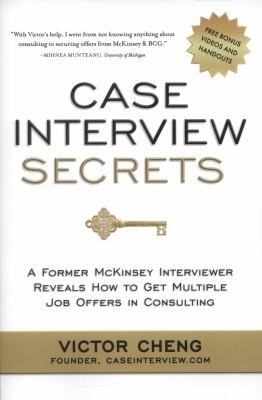
Case Interview Secrets
Introduction
Nova: Imagine you're a Stanford graduate with stellar grades, sitting across from a McKinsey interviewer, confident you're about to crush it. Three and a half minutes later, the interviewer stands up, thanks you, and ends the meeting. That's exactly what happened to Victor Cheng—the man who would later write one of the most popular consulting prep books ever published, Case Interview Secrets. Welcome to Aibrary, I'm Nova.
Atlas: And I'm Atlas. So wait—his forty-minute interview ended after three and a half minutes? That's not just a bad day. That's a catastrophe.
Nova: It was. And here's what makes Cheng's story remarkable: instead of giving up, he spent over a hundred hours preparing, did fifty practice sessions, and eventually passed sixty out of sixty-one case interviews. He got six job offers—from McKinsey, Bain, Monitor, L. E. K., Oliver Wyman, and A. T. Kearney. At McKinsey, he ranked in the top ten percent of consultants worldwide in his starting class.
Atlas: Okay, that's a redemption arc if I've ever heard one. But what did he actually learn that transformed him from a three-and-a-half-minute disaster to someone who could pass almost every case interview thrown at him?
Nova: That's exactly what his book answers. Case Interview Secrets, published in 2012, has sold over a hundred thousand copies and maintains a 4.5-star rating across more than a thousand Amazon reviews. It's structured around one central idea: case interviews don't test what you know—they test how you think. And Cheng reveals the repeatable, systematic problem-solving process that top consulting firms are actually evaluating.
Atlas: So this isn't about memorizing answers. It's about learning a method. Let's dig into what that method actually looks like.
Four Core Problem-Solving Tools
The Consultant's Toolbox
Nova: Cheng organizes his entire approach around four tools that real consultants use every single day. The first is the hypothesis. Within five minutes of starting a case, you must state an educated guess about what's causing the client's problem. He calls this the Five-Minute Hypothesis Rule, and he's blunt about it: if you haven't offered one by minute five, state one immediately, because waiting any longer risks never stating one at all.
Atlas: Five minutes? That's not much time. Is this like a scientific method thing?
Nova: Exactly. Cheng argues that consulting firms essentially use the scientific method—hypothesis, experiment, testing—but applied to business problems. You make a guess, you test it with data, and you refine. The hypothesis determines everything that follows, because it tells you which framework to use and which questions to ask. Cheng says the single biggest red flag in case interviews is applying a standard framework without linking it to a specific hypothesis. Interviewers call those candidates framework robots.
Atlas: Framework robots. I love that term. So what comes after the hypothesis?
Nova: The second tool: the issue tree. This is a logical structure that lays out conditions which, if proven true, prove your hypothesis. Think of it like a decision tree where each branch represents a question you need to answer. Cheng insists on three tests for a valid issue tree. First, it must actually test your specific hypothesis. Second, it must be MECE—mutually exclusive, collectively exhaustive—meaning your categories don't overlap and together cover all possibilities. Third, it must be conclusive: proving all branches true should make the opposite conclusion unimaginable.
Atlas: MECE sounds like one of those consulting buzzwords that actually means something useful. Categories with no overlap and no gaps. But how do you actually use the tree once you've built it?
Nova: That's tool number three: drill-down analysis. You work through each branch systematically, gathering data to prove or disprove it. Cheng says start with the branch that eliminates the most uncertainty. If you disprove a branch, you revise your hypothesis and build a new issue tree. This cycle of drilling down and pulling up continues until a hypothesis is validated. And here's a surprising ratio: he says a typical case involves roughly seventy percent quantitative analysis and thirty percent qualitative. You need both—the numbers tell you what's happening, the qualitative investigation tells you why.
Atlas: So you're constantly updating your hypothesis as you go, not just sticking rigidly to your first guess.
Nova: Precisely. And then comes tool number four: synthesis. This is how you communicate your findings. Cheng is very specific about the format: state an action-oriented conclusion first, provide up to three supporting points, then restate the recommendation. This is dramatically different from a chronological summary where you just walk through what you did. He notes that roughly eighty percent of the feedback he received from his McKinsey managers was about communication skills, not analytical ones.
Atlas: Wait, eighty percent of the feedback was about communication? For people who are supposedly hired for their analytical brilliance?
Nova: That's the counterintuitive truth. Cheng says clients only accept recommendations they can understand. You can have the most brilliant analysis in the world, but if you can't communicate it clearly and confidently, you're useless to the firm. Nervousness reads as a lack of conviction. That's why he emphasizes synthesis as a core skill, not an afterthought.
Three Frameworks and a Case Study
Frameworks That Flex
Nova: Now, one of the most distinctive aspects of Cheng's book is his approach to frameworks. While the competing book Case in Point teaches you ten or more specific frameworks to memorize, Cheng argues you only need three: the Profitability Framework, the Business Situation Framework, and the Mergers and Acquisitions Framework. He claims these cover roughly seventy percent of cases you'll encounter.
Atlas: Three frameworks versus ten-plus? That's a bold claim. Walk me through them.
Nova: The Profitability Framework is the simplest: it breaks profit into revenue minus costs. Revenue further breaks into unit price times units sold. Costs split into fixed and variable. Cheng emphasizes that raw numbers are meaningless without context—you must always compare metrics to historical periods or industry benchmarks. The Business Situation Framework is more qualitative and has four branches: customer, product, company, and competition. You use it when you need to understand the broader context of a problem. The M&A Framework simply applies the business situation framework independently to each company in a potential deal, then to the combined entity.
Atlas: So it's really two core frameworks, and the M&A one is just an application of the business situation framework. That's even simpler than three.
Nova: Right. And Cheng demonstrates this flexibility through an extended case study about Omega and Omega, a fictional billion-dollar advertising agency with flat sales and profits. He walks through how you'd start with the profitability framework, discover the stagnation is company-specific rather than industry-wide, then switch to the business situation framework. That's when you uncover that digital advertising is booming while the client is stuck entirely in traditional advertising. The case then pivots into M&A analysis, evaluating three acquisition targets.
Atlas: So the frameworks are like tools on a belt—you grab the one that matches your current hypothesis, and you're not afraid to switch.
Nova: Exactly. And this is where Cheng's philosophy differs radically from the memorize-and-regurgitate approach. He says frameworks are issue tree templates for commonly recurring business problems. They must be customized for each case. Using a standard framework with no relation to your hypothesis is, in his words, the single biggest red flag in an interview. He wants candidates to think like consultants, not like robots executing a script.
Practice, Interpersonal Skills, and the Ten Deadly Mistakes
The Consulting Mindset
Nova: Let's talk about what Cheng says about actually getting the offer. He's strikingly data-driven here. Of the candidates who received offers at top firms, approximately ninety percent invested fifty to a hundred hours in preparation. Candidates who cleared McKinsey, Bain, or BCG participated in an average of fifty practice cases.
Atlas: Fifty practice cases? That's a lot. So you can't just read the book and walk in.
Nova: You absolutely cannot. Cheng compares case interview prep to training for a bicycle race rather than studying for an exam. It tests what you do under pressure, not what you know in theory. He outlines four steps to mastery: build knowledge through resources like his book, find role models by watching experts give case interviews, practice in live settings for ideally fifty cases, and seek assessment from a mentor who can spot subtle mistakes you won't notice yourself.
Atlas: And what about interpersonal skills? Earlier you mentioned that eighty percent of McKinsey feedback was about communication. Does Cheng address the soft side?
Nova: He does, and he uses two memorable concepts. The first is the airplane test. Interviewers ask themselves: would I want to sit next to this candidate on a three-hour flight? It's a proxy for whether you can manage client relationships. If you're brilliant but unpleasant, you fail. The second concept is boiling the ocean—consultants' term for doing far more analysis than necessary under tight time and resource constraints. Cheng says interviewers want to see you do as little as possible to get the job done, because that's the consulting reality.
Atlas: So efficiency matters as much as accuracy. What about the most common ways people fail?
Nova: Cheng closes the book with ten mistakes that cause roughly ninety percent of rejections, in interview order. Here they are: failing to state a hypothesis, not linking your framework to your hypothesis, insufficient mutual exclusivity in your issue tree, omitting a key factor, missing insights because you didn't quantify enough, missing insights because you didn't ask enough qualitative questions, making math errors—which he says result in automatic rejection roughly ninety-five percent of the time—jumping around instead of drilling down linearly, pursuing unnecessary analysis, and delivering an activity-based summary instead of a synthesis.
Atlas: Ninety-five percent rejection rate for math errors? That's brutal.
Nova: It is, and Cheng emphasizes that most candidates who commit these mistakes actually understand the principles intellectually. They just haven't practiced enough to turn knowledge into habit. That's why he's so insistent on those fifty to a hundred hours of live practice.
Criticisms, Evolution, and Practical Takeaways
The Book's Legacy and Limits
Nova: Of course, no book that's been on the market for over a decade is beyond criticism. Let's talk honestly about where Case Interview Secrets falls short.
Atlas: Please do. I was wondering about that. The book came out in 2012. Consulting interviews have probably changed.
Nova: They have. McKinsey has introduced the Solve assessment—a gamified problem-solving test. BCG launched the Casey chatbot simulation and expanded written cases. Bain updated its online assessments. None of these developments appear in the book. Interviewers have also caught on to Cheng's specific frameworks. Multiple current consultants on recruiting forums have noted that candidates who rigidly apply the business situation framework are easy to spot, and not in a good way.
Atlas: So using Cheng's frameworks robotically can actually hurt you now?
Nova: It can. One BCG interviewer on PrepLounge put it bluntly: firms now want to see creative ideas communicated in a structured manner, not a cookie-cutter framework pulled from a book. Some firms have reportedly told candidates, quote, don't give me a Victor Cheng framework or draw me a freaking issue tree—think. The consulting world has evolved to expect more originality.
Atlas: What about the book itself? Any structural criticisms?
Nova: Several. The biggest: it contains zero practice cases. For a book about passing case interviews, that's a significant gap. Successful candidates typically complete thirty to fifty practice cases before their real interviews, and you won't find a single one in this book. Cheng directs readers to his website and paid programs like LOMS, his Look Over My Shoulder video series. Some Amazon reviewers have expressed frustration, feeling that essential practice material was withheld to drive upsells.
Atlas: That's a fair criticism. What about the writing style?
Nova: Multiple reviewers, including on Management Consulted, note that the writing can be repetitive. One Amazon reviewer summarized it well: the core approach can be distilled to four steps—hypothesis, issue tree, drill-down analysis, synthesis—but Cheng takes many pages of anecdotes to make those points. The book could probably be thirty to fifty percent shorter without losing substance.
Atlas: So where does that leave someone preparing today? Should they still read it?
Nova: The consensus across multiple expert reviews—from Hacking the Case Interview, Management Consulted, StrategyCase, and others—is nuanced. Treat Case Interview Secrets as a solid introduction to fundamentals, not a complete preparation system. Its explanations of hypothesis-driven thinking, MECE structuring, and synthesis are timeless and still exactly what interviewers evaluate. But supplement it with practice cases, updated assessment prep, and at least one other case prep book for a well-rounded approach. The book is a starting point, not a finish line.
Atlas: That feels like fair advice. The fundamentals are evergreen even if the specific frameworks need updating.
Nova: Exactly. And here's something I find genuinely inspiring: Cheng reveals that most of his McKinsey colleagues were introverts whose confidence came from technical competence, not personality. He identifies three sources of confidence: extreme competence built through preparation, correct mental framing—like viewing the interview as a two-way assessment rather than a judgment—and extensive practice. The message is that this is a learnable skill, not an innate talent.
Conclusion
Nova: So what should a listener take away from Case Interview Secrets? First, case interviews are a skill, not a talent. Victor Cheng went from a three-and-a-half-minute failure to passing sixty of sixty-one interviews through systematic, disciplined practice—and his book maps that system. Second, the core tools—hypothesis, issue tree, drill-down analysis, synthesis—are timeless. They're still what interviewers look for, even if rigid application of Cheng's specific frameworks can now backfire. Third, communication matters as much as analysis. The airplane test is real, and eighty percent of McKinsey feedback is about how you deliver your findings, not what you found.
Atlas: And fourth, reading isn't enough. Fifty to a hundred hours of practice. Fifty live cases. You can't absorb this from a book alone, which is ironically the book's biggest limitation—it doesn't provide the practice cases you need.
Nova: Right. Cheng's book gives you the theory. The practice has to come from elsewhere. But as a foundation for understanding how consultants think and what interviewers actually evaluate, it remains one of the most influential prep books in the industry, with over a hundred thousand copies sold for a reason.
Atlas: I think the most surprising thing for me was that math errors get you rejected ninety-five percent of the time. That's terrifying but also clarifying—it tells you exactly where to focus your practice.
Nova: And that's the value of Cheng's insider perspective. He sat on both sides of that interview table—as a candidate who failed spectacularly, as a consultant who excelled, and as an interviewer who decided other people's futures. That triple perspective is what makes Case Interview Secrets more than just another prep guide. It's a window into how the world's most prestigious consulting firms actually make their hiring decisions.
Atlas: Well said. Now I want to go practice some case interviews.
Nova: That's the spirit. This is Aibrary. Congratulations on your growth!