

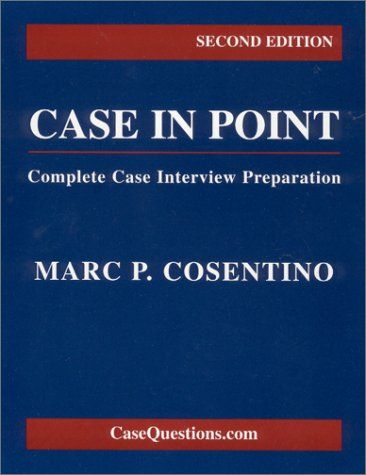
Case in Point
Complete Case Interview Preparation
Introduction
Nova: Picture this. You're sitting across from a McKinsey partner. She slides a piece of paper across the table and says: "Our client is a regional grocery chain. Profits per store have dropped 15 percent over three years. What would you do?" There's no multiple choice. No textbook to consult. Just you, the problem, and the next 30 minutes.
Nova: : And let me guess — that's the exact moment when most candidates wish they had a secret weapon.
Nova: Exactly. And for the last 25 years, that secret weapon for hundreds of thousands of aspiring consultants has been a book called Case in Point, written by a man named Marc P. Cosentino. The Wall Street Journal calls it the MBA Bible. It's sold over 700,000 copies worldwide and has gone through 12 editions since 1999.
Nova: : That's wild. A self-published book about job interviews becoming the MBA Bible? What's the story behind this thing?
Nova: That's what we're diving into today. The origin story, the methodology, the controversy, and the question every aspiring consultant is asking right now: does Case in Point still work, or has the world moved past it? I'm Nova.
Nova: : And I'm here to ask the questions you'd ask if you were sitting at the table. Let's get into it.
How a Layoff Created a Legacy
The Accidental Godfather
Nova: So the story of Case in Point starts with failure, which is maybe the most fitting origin for a book about high-stakes interviews. Marc Cosentino was working at Fidelity Investments in the late 1980s when he got laid off, along with 1,400 other people.
Nova: : Wait — the guy who wrote the ultimate guide to landing your dream job got laid off first?
Nova: He did. And he landed at Harvard's Office of Career Services, where he became what students affectionately called the Keeper of the Dark Side. About half the Harvard undergraduate class went through consulting and investment banking recruiting back then, and Cosentino was the one person who coached them all.
Nova: : The Keeper of the Dark Side — that's going to be my new job title.
Nova: Right? He spent nearly a decade at Harvard College, then moved to the Kennedy School, but here's the key thing: for years, he was the only person across all of Harvard's campuses who really understood case interviews. He sat in on interviews, debriefed students afterward, talked to recruiters constantly, and took notes on everything.
Nova: : So he basically had a front-row seat to thousands of case interviews and no one else was documenting what actually worked.
Nova: Precisely. At the time, there was only one other book on the subject, Ace Your Case by WetFeet Press — and they had actually asked Cosentino to help them write it. That's when he realized he should write his own. He moved to the Kennedy School on the condition that he could write a book and own the rights. In 1999, he wrote the first edition of Case in Point in just five weeks while working full-time.
Nova: : Five weeks? Come on. That's insane.
Nova: It is, but he says it was all he talked about every day. The book came out through a small educational publisher, but they forgot to include a barcode, so it couldn't be sold in stores. He got the rights back and self-published the second edition in 2000. Then he walked a box of books down to the Harvard Coop bookstore and convinced them to take 10 copies on consignment.
Nova: : Let me guess — they sold out immediately.
Nova: Two days later they called and ordered 100 more. For the next three or four years, it was the Coop's best-selling nonfiction book. Within six months, Cosentino was making more from book sales than from his Harvard salary. All word of mouth — no marketing budget, just students telling other students.
Nova: : That's the dream right there. A book that doesn't need advertising because it actually delivers results. So what exactly is in this thing that made it take off like that?
What Case in Point Actually Teaches
Inside the MBA Bible
Nova: Case in Point is about 300 pages organized into four major blocks. The first block is fundamentals — the first hundred pages that explain what a case interview actually is, how consulting recruiting works, and what interviewers are evaluating. He also covers behavioral and fit interview basics, which most case prep books skip entirely.
Nova: : That's actually smart because fit interviews account for roughly half your overall evaluation at firms like McKinsey, BCG, and Bain. Most people don't realize that.
Nova: Exactly. The second block is his signature contribution — the Ivy Case System, which we're going to really dig into in a moment. The third block covers market sizing and mental math — how to estimate things like how many golf balls fit in a 747 or how big the US dog food market is.
Nova: : I've always wanted to know how consultants pull those numbers out of thin air.
Nova: And Cosentino's approach is genuinely good here. He teaches you to segment by population, layer assumptions, and calculate bottom-up. About 30 percent of case interviews at firms like BCG and Bain include a market sizing component. The fourth block is 40 full strategy cases with answer guidance — covering everything from profitability to market entry to mergers.
Nova: : Forty cases is a lot of practice material.
Nova: It is, and the breadth is impressive — strategy, operations, human capital, marketing. Some are written as scripted dialogues between interviewer and candidate, which helps beginners understand the flow. The 12th edition also added a brand-new chapter on the consultant's mindset — hypothesis-driven thinking, comfort with ambiguity, and something called the "so what" test that separates strong answers from filler.
Nova: : What's the "so what" test?
Nova: It's essentially asking: you've just shared an insight or a number — what does it actually mean for the client? Why should they care? Consultants don't get paid for data. They get paid for the implications of that data. The 12th edition also added a graph and chart analysis section that's directly applicable to modern digital assessments like BCG's Casey chatbot.
Nova: : Okay, so it sounds like a comprehensive package. But you said we'd dig into the Ivy Case System. What makes that the centerpiece — and I sense there's a but coming?
Brilliant Scaffold or Dangerous Crutch?
The Ivy Case System
Nova: Here's the idea: Cosentino says there are 12 basic types of case questions you'll encounter. You memorize a framework for each one — profitability, mergers and acquisitions, new product, market sizing, entering a new market, pricing strategies, industry analysis, starting a new business, competitive response, growth strategies, increasing sales, and reducing costs.
Nova: : So on interview day, you pattern-match. The interviewer mentions a profitability problem and you pull the profitability framework off the shelf like a tool from a toolbox.
Nova: That's the appeal. And for someone who has never seen a case interview before, it's incredibly reassuring. You feel like you have a playbook.
Nova: : But?
Nova: But here's where it gets contentious. A former Bain manager and interviewer named Taylor Warfield says he could spot a memorized Ivy Case System framework within the first 60 seconds of a candidate presenting their structure. McKinsey's own recruiting guidance explicitly evaluates whether candidates "structure problems in a logical and creative way," not whether they can retrieve a template.
Nova: : So the very thing the book teaches you to do is the thing interviewers are trained to penalize?
Nova: That's the criticism. And there are three specific problems. First, real cases rarely fit neatly into one of 12 categories. Warfield says roughly 70 percent of cases he saw at Bain blended elements from multiple categories. A profitability case might require market sizing. A market entry case might involve pricing analysis.
Nova: : So you memorize 12 rigid frameworks and the actual case doesn't match any of them. Then what?
Nova: Many candidates freeze. That's the second problem — cognitive overload. Memorizing 12 complex frameworks and trying to pattern-match under interview pressure is a recipe for paralysis. And the third problem is that modern consulting interviews emphasize hypothesis-driven thinking. They want you to form an early hypothesis and test it with data, not exhaustively walk through every branch of a pre-built framework.
Nova: : One Amazon reviewer put it this way: "The Ivy Case System is pointless. There is no learning involved, it is only memorization of 12 case types. Once you have done that, it is admitted that cases almost never fall into only one type, so you are back to just thinking through each situation logically." Ouch.
Nova: That's harsh but not wrong. Cosentino himself acknowledges this in the book — he says cases rarely fit one type. But the structure of the system still encourages template retrieval. That said, for Big Four accounting firm interviews, where cases tend to be more structured and predictable, many reviewers say the frameworks actually work quite well.
Nova: : So it really depends on where you're interviewing and what they're testing for.
What the Book Covers — and What It Misses
The Modern Consulting Landscape
Nova: This brings us to the big question: in 2026, is Case in Point still worth reading? The consensus from reviewers is yes — but with serious caveats.
Nova: : Give me the breakdown.
Nova: The book earns roughly a 5 out of 10 as a standalone resource. The first hundred pages are genuinely useful for orientation if you've never seen a case interview. The market sizing and mental math sections are evergreen. And working through 15 to 20 of the 40 cases builds pattern recognition. But.
Nova: : There's always a but.
Nova: Several, actually. The book has zero coverage of digital and AI-driven assessments. McKinsey Solve, the interactive simulation that screens candidates before they even get a human interview? Not in the book. BCG's Casey chatbot? Not covered. Bain's SOVA assessment? Not there. These digital gatekeepers now eliminate candidates before they ever reach a traditional case interview.
Nova: : And even the traditional interview format has evolved, right?
Nova: Absolutely. When Case in Point was first published in 1999, most interviews were candidate-led — meaning you drove the analysis and decided where to go. Today, about 60 percent of case interviews at top firms use an interviewer-led format, where the interviewer breaks the case into discrete modules and controls the flow. It's a fundamentally different experience.
Nova: : What about the behavioral side?
Nova: Thin. Cosentino covers behavioral basics, which is more than most case books do, but he doesn't provide a repeatable structure for crafting your answers. Modern McKinsey interviews have the Personal Experience Interview, which demands very specific story structures around leadership, drive, and personal impact. Case in Point doesn't go deep enough there.
Nova: : So what's the right way to use this book if you're prepping today?
Nova: Industry insiders recommend treating it as a launchpad, not a system. Read chapters one through four for orientation. Skim the Ivy Case System chapter once but don't memorize the 12 frameworks. Drill the market sizing and mental math. Work through 15 to 20 of the strategy cases — but build your own custom structure first, then compare it to the book's approach. Then move to live practice with partners or AI tools as quickly as possible.
Nova: : The phrase I keep seeing is that reading 200 more pages of Cosentino does less for your offer odds than five live cases with feedback.
Nova: Which is a humbling thing to say about the best-selling case interview book of all time. But it appears to be true. The candidates who get MBB offers typically complete 30 to 50 practice cases with live feedback, not just book reading. The book is foundation. Live practice is preparation.
Conclusion
Nova: So let's bring it together. Marc Cosentino was the right person at the right moment. He found himself at Harvard with extraordinary access to the inner workings of consulting interviews when almost no one else understood them. He wrote Case in Point in five weeks, self-published it, and built a word-of-mouth empire that has shaped how hundreds of thousands of people prepare for the most competitive job interviews on the planet.
Nova: : And the book genuinely delivers value — especially for complete beginners who need to understand what a case interview looks like, how to do market sizing, and how to approach business problems with structure.
Nova: But here's the paradox at the heart of this story. The very system that made Case in Point famous — the Ivy Case System with its 12 memorizable frameworks — is now the thing that most limits its usefulness. Because consulting firms don't want candidates who retrieve templates. They want candidates who think.
Nova: : It's almost poetic. A book designed to teach you how to think like a consultant ends up teaching you to memorize like a student.
Nova: And Cosentino himself seems to understand this tension. He told Business Insider that he updates the book every few years because "the field evolves." He says, "I craft cases, not just write them, because each one has a lesson built in." He's not standing still. But the core methodology hasn't fundamentally changed across 12 editions.
Nova: : So the takeaway for anyone listening who's prepping for consulting interviews: read Case in Point, but read it like a tourist guide, not like a script. Learn the landscape. Practice the math. Then put the book down and do the hard thing — live cases where you build your own frameworks from scratch.
Nova: And maybe the deepest lesson from Marc Cosentino's own story isn't about frameworks at all. It's about what he actually did at Harvard for 18 years: he built confidence. He said 90 percent of his time was spent helping brilliant students believe in themselves. The frameworks help, but confidence — earned through practice — is what carries you through the door.
Nova: : Confidence and creativity. Cosentino says if five people give the same answer, creativity is what separates them. And you can't memorize creativity.
Nova: You can't. You have to build it. So read Case in Point for the foundation, but build your own house.
Nova: : This is Aibrary. Congratulations on your growth!