Wealth, Freedom, and the Modern Mind
Golden Hook & Introduction
SECTION
Nova: If you managed to buy your dream car tomorrow, park it outside a beautiful penthouse, and look at your bank account to see seven figures, you might expect to feel complete. Yet, the data shows that the moment people achieve these external milestones, their psychological baseline often remains completely unchanged, leaving them searching for answers.
Atlas: That sounds incredibly sobering, and honestly, it is a reality check that a lot of high-achievers desperately need to hear. We are constantly told to build, scale, and conquer, but we rarely ask what happens to our minds once we actually get there.
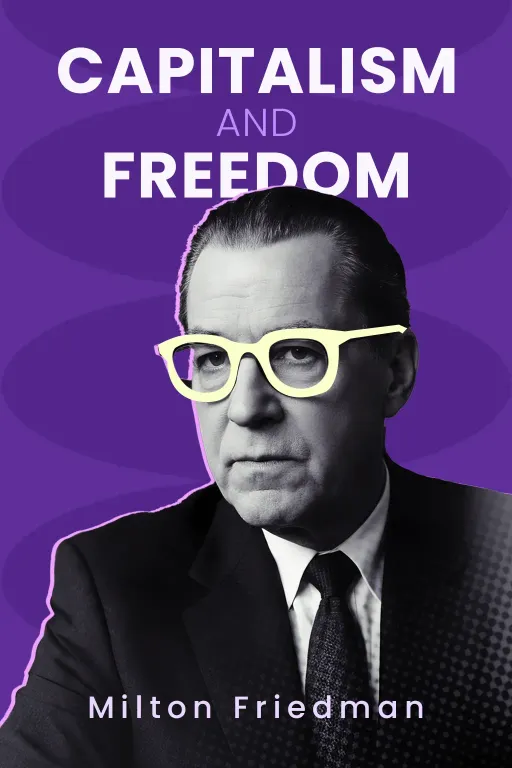
Nova: Exactly, and that is why we are diving into a powerful juxtaposition today. We are looking at the macro systems of wealth and the micro systems of the human mind by exploring two foundational books. First, Milton Friedmans classic, Capitalism and Freedom, originally published in 1962, which went on to become one of the most influential economic texts of the twentieth century, earning him a Nobel Prize. Second, we have Happy Sexy Millionaire by Steven Bartlett, the young entrepreneur who built a multi-million dollar marketing agency, became the youngest investor on the BBC television show Dragons Den, and then wrote a raw critique of the very hustle culture that made him famous.
Atlas: This is a fascinating pairing because on one side, you have Friedman explaining how global economic systems protect our individual liberty, and on the other side, you have Bartlett warning us that we might use that very liberty to trap ourselves in a digital cage of our own making.
Nova: That is the core of our conversation today. We are exploring the idea that true prosperity requires mastering both the external systems of market freedom and the internal psychology of personal contentment.
Atlas: I am ready to dig into this because, for anyone trying to build a lasting legacy, understanding how these two worlds collide is absolutely essential. Where do we start?
External Systems: Economic Freedom as the Ultimate Shield
SECTION
Nova: Let us start with Milton Friedmans grand blueprint in Capitalism and Freedom. Friedmans core argument is that economic freedom is an indispensable prerequisite for political freedom. Many people view politics and economics as separate boxes, but Friedman shows they are deeply intertwined.
Atlas: That sounds like a massive claim. I think a lot of people might say, look, I can care about free speech and voting rights without having to worry about the mechanics of competitive capitalism. How does Friedman bridge that gap?
Nova: He does it by looking at the concentration of power. Imagine a society where the government controls the entire economy. In that scenario, the state is the sole employer, the sole owner of all property, and the sole distributor of goods. Now, imagine you want to start an opposition political party. How do you fund it? How do you print your newsletters if the government owns all the printing presses and paper mills? How do you rent a hall for a rally if the state owns all the real estate?
Atlas: Oh, I see the connection now. If the state controls the economic levers, they do not even need to pass a law banning free speech. They can simply turn off the financial oxygen to anyone who disagrees with them.
Nova: Precisely. Friedman argues that competitive capitalism acts as a decentralized shield. By keeping economic power separate from political power, the market creates a space where individuals can act independently of the state. If you lose your job because of your political beliefs in a state-controlled economy, you starve. In a competitive market, you can go work for a competitor, or start your own business, because the market cares about the value you provide, not your political opinions.
Atlas: That is a powerful realization. The market is essentially a giant, decentralized voting machine where transactions happen based on mutual benefit rather than ideological compliance.
Nova: Yes, and Friedman uses a beautiful analogy of a supermarket to explain this. In a political system, decisions are often binary and collective. If fifty-one percent of the population votes for a specific policy, the other forty-nine percent must live with it. It is a winner-take-all scenario. In a free market, however, the system accommodates incredible diversity. If you want organic kale, you can buy organic kale. If your neighbor wants processed cereal, they can buy processed cereal. You do not have to vote on what everyone eats for breakfast; the market allows both preferences to exist simultaneously without conflict.
Atlas: I love that supermarket analogy because it highlights how the market minimizes social friction. But let us play devils advocate for a second. What about the criticisms that free markets lead to extreme inequality, or that they leave vulnerable people behind? Friedman was a highly controversial figure, and his ideas sparked massive global debates, especially among critics who argued his model ignored the social safety net.
Nova: That is a crucial point, and it is where the debate gets highly nuanced. Friedman was not blind to these concerns. His response was that the best way to help the vulnerable is through direct, transparent financial assistance, like his famous proposal for a negative income tax, rather than distorting the market with price controls, minimum wages, or bureaucratic regulations. He argued that when governments try to fix social problems by interfering with market prices, they often create unintended consequences that hurt the very people they are trying to help.
Atlas: So he wanted to keep the system clean and direct. Instead of building massive regulatory agencies to manage industries, just give people the economic resources and let the market do what it does best.
Nova: Exactly. He believed that the market is far more efficient at allocating resources than any centralized committee of experts. When you allow prices to fluctuate freely, they act as signals. If there is a shortage of lumber, the price goes up. That high price signals to builders to conserve lumber, and to suppliers to produce more of it. No government official had to issue a decree; the system self-corrects through millions of individual decisions.
Atlas: It is a beautiful, self-regulating system on paper. But as we look at our modern world, we have this incredible economic freedom, yet so many people feel completely trapped. We have the freedom to choose our careers, buy whatever we want, and build businesses, but the mental health statistics suggest we are more anxious and unfulfilled than ever.
Nova: And that is the perfect bridge to Steven Bartlett. Friedman gave us the ultimate blueprint for external freedom, but Bartlett shows us what happens when we do not have an internal blueprint to match it.
Internal Psychology: Shattering the Happy Sexy Millionaire Illusion
SECTION
Atlas: This is where the conversation gets incredibly real. Steven Bartletts book, Happy Sexy Millionaire, feels like a direct response to the modern side effects of the economic freedom Friedman championed. Bartlett talks about this concept of the social media script that we are all handed the moment we create an online profile.
Nova: Yes, he refers to it as the modern illusion of success. We are bombarded with images of young, attractive, incredibly wealthy individuals who seem to have life completely figured out. The algorithm feeds us a very specific definition of achievement: wealth, status, and physical perfection.
Atlas: I can definitely relate to that, and I know our listeners do too. It is like this silent pressure to constantly perform. You are not just building a career anymore; you have to curate a personal brand that makes your life look like a continuous victory lap.
Nova: Bartlett lived this firsthand. He dropped out of university, was struggling to buy food, and became obsessed with the idea of becoming a millionaire by the age of twenty-five. He eventually built Social Chain, a massive marketing agency, and achieved his financial goals ahead of schedule. He describes the moment he realized that the happiness he expected to feel simply did not arrive. He was the same person, with the same insecurities, sitting in a larger room.
Atlas: That is a classic psychological phenomenon, the hedonic treadmill. We think that once we reach a certain destination, we will permanently step up our happiness level. But our brains are wired to adapt to new baselines incredibly quickly.
Nova: Exactly. Bartlett argues that we have traded genuine fulfillment for a cheap imitation called social media validation. We are chasing likes, views, and external applause because we have been conditioned to believe that our self-worth is tied to how others perceive our achievements.
Atlas: So how do we break free from that? If we have the economic freedom that Friedman talked about, how do we use it to build actual happiness instead of just chasing the next milestone?
Nova: Bartlett suggests we have to radically redefine what he calls our internal metrics. Most of us are running on external metrics: net worth, job titles, followers. He proposes shifting our focus to internal metrics like autonomy, deep relationships, physical health, and creative expression.
Atlas: That sounds great in theory, but let us be practical. If you are a young professional trying to establish yourself, or an entrepreneur trying to keep the lights on, telling them to focus on internal metrics might feel like a luxury they cannot afford. How do you balance the very real need for financial security with this pursuit of inner contentment?
Nova: Bartlett does not say we should abandon financial ambition. He acknowledges that money is incredibly useful for solving problems of survival and security. But he makes a critical distinction: money is a tool for freedom, not a source of intrinsic happiness. Once your basic needs are met, the correlation between wealth and happiness flattens out dramatically. The mistake we make is assuming that if ten thousand dollars solved our immediate stress, ten million dollars will make us one thousand times happier.
Atlas: Right, it is a tool of diminishing returns. It is like building a house. You need the foundation, which is the economic security Friedman talks about, but the foundation itself is not a home. You still have to build the warmth, the relationships, and the purpose inside those walls.
Nova: That is a perfect analogy. And Bartlett shares a powerful story about his own company to illustrate this. At one point, Social Chain was growing rapidly, and they were winning all sorts of industry awards. On paper, it was the ultimate success story. But internally, Bartlett realized that the pressure to maintain this public image was causing his team immense stress, and he was spending more time managing public relations than doing the creative work he loved. He had to make the conscious decision to step back, re-evaluate, and eventually exit the company to align his daily life with his true values.
Atlas: That takes an incredible amount of courage, especially when the entire world is telling you to keep going, keep scaling, keep conquering. It shows that the ultimate form of freedom is actually the ability to say enough.
Nova: Yes, and that is a concept that is completely missing from the standard economic models. Friedman tells us how to maximize our choices, but Bartlett reminds us that if we do not know who we are, having infinite choices will only lead to decision paralysis and existential dread.
Synthesis & Takeaways
SECTION
Atlas: As we bring these two perspectives together, a really fascinating picture begins to emerge. Friedman gives us the macro blueprint: we need a free, competitive market to protect our individual agency and prevent the centralization of power. Bartlett gives us the micro blueprint: once we have that agency, we must use it intentionally, rather than letting the cultural algorithm dictate our goals.
Nova: They are two sides of the same coin. Without the economic freedom Friedman describes, we do not have the luxury to choose our own path. We are at the mercy of whatever centralized power controls the resources. But without the internal clarity Bartlett champions, our economic freedom simply becomes the freedom to choose our own prison.
Atlas: That is a profound way to look at it. The ultimate goal is not just to accumulate wealth, but to build a life of genuine independence. And that independence is both financial and psychological.
Nova: Absolutely. For our listeners who are highly analytical, purpose-driven, and focused on building a lasting legacy, the takeaway here is to look at your life as a dual system. You must design your economic engine using the principles of leverage, value creation, and market dynamics. But you must also design your internal operating system to resist the social media comparison trap.
Atlas: I love that idea of an internal operating system. It means consciously choosing your values, setting boundaries on your ambition, and realizing that the most valuable asset you can ever own is your own time and attention.
Nova: Well said, Atlas. We must build our external freedom so we have the power to choose, and cultivate our internal fulfillment so we know how to choose wisely.
Atlas: This has been an incredibly rich discussion. For everyone listening, take a moment today to examine your current pursuits. Are you building a system of true freedom, or are you running on a treadmill designed by someone else? Thank you for joining us on this journey of growth.
Nova: This is Aibrary. Congratulations on your growth!