

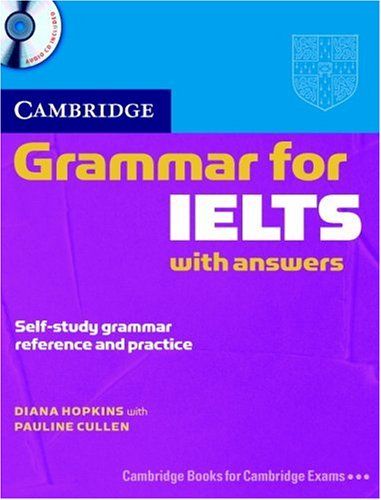
Cambridge grammar for IELTS with answers
Introduction
Nova: Here is a number that might surprise you: 25 percent. That is how much grammar counts toward your IELTS Writing and Speaking scores. It is called Grammatical Range and Accuracy, and it can absolutely make or break your band score. Yet so many test-takers overlook it entirely. Today we are diving into one of the most trusted resources for tackling that exact challenge: Cambridge Grammar for IELTS with Answers by Diana Hopkins, with Pauline Cullen.
Nova: It really is. And this book, published by Cambridge University Press in 2007, has become something of a legend in IELTS preparation circles. On Goodreads it holds a 4.3 out of 5 rating from over 300 readers, and you will find it on almost every list of recommended IELTS books. It is a 270-page self-study reference and practice book, and it comes with an audio CD.
Nova: Exactly. The book is designed so you can pick it up and go at your own pace. In fact, the introduction explicitly says it can be used to support an IELTS coursebook, with a general English language course, or entirely on its own. And here is what I love: it has an entry test right at the beginning, on page ix, that diagnoses exactly which units you need to focus on.
How Each Unit Is Built for Mastery
Inside the 25-Unit Architecture
Nova: The book contains 25 units, and each one follows a remarkably consistent four-part structure. This is not just a dry grammar reference. The architecture is intentional and, honestly, quite elegant.
Nova: Part one is called Context Listening. Before you even see a grammar rule, you listen to a recording that uses the target grammar in a scenario relevant to the IELTS test. So you are developing your listening skills while being exposed to the grammar naturally.
Nova: Exactly. Then part two is the Grammar section — clear explanations with examples for each grammar point. Short, focused, never overwhelming. Part three is Grammar Exercises where you write your answers and check them in the answer key. And part four is Test Practice — an actual IELTS-style task from the Academic or General Training Reading, Writing, or Listening modules.
Nova: It is intense, but brilliantly practical. Each test practice is followed by a grammar focus task that gives you extra targeted practice on the unit's grammar point. So you are never just learning grammar in the abstract. You are always connecting it to the actual exam.
Nova: This is where the book really shines. The answer key does not just tell you what is right and wrong. It tells you which part of the grammar section to review if you made a mistake. It includes sample answers for writing tasks, test tips for each exercise type, and full recording scripts for all the listening material.
Nova: That is exactly the right way to think about it. The recording scripts are especially valuable because you can listen again while reading along, which helps you connect pronunciation to grammar structures. The appendices also include irregular verbs and phrasal verbs — two perennial trouble spots for English learners.
Nova: It covers both. All the Context Listening recordings and all the Test Practice listening tasks are on the CD. There is even a tracklist at the back so you can jump straight to specific units.
The Grammar Journey Across 25 Units
From Tenses to Nominalisation
Nova: Let us talk about what the 25 units actually cover. The book takes you on a carefully sequenced journey from foundational grammar to advanced academic writing skills.
Nova: It does. The first six units are dedicated entirely to the tense system: present tenses, two units on past tenses, present perfect, and two units on future forms. This is smart because tense accuracy is the bedrock of grammatical range. If you cannot control your tenses, everything else crumbles.
Nova: Units 7 through 12 shift to nouns and noun phrases: countable and uncountable nouns, articles and determiners, pronouns and referencing, adjectives and adverbs, comparing things, and the noun phrase. These are crucial for Writing Task 1, where you describe data and trends, and for Reading, where you need to track what pronouns refer to.
Nova: That is exactly the skill Unit 9 teaches. And Unit 12 on noun phrases is a hidden gem — it covers noun plus prepositional phrase, noun plus participle clause, and noun plus to-infinitive clause. These are the kinds of structures that separate a band 6 writer from a band 7 or 8 writer.
Nova: Units 13 through 20 cover modals, reported speech, verb patterns, conditionals, prepositions, and relative clauses. Unit 17 and 18 on conditionals are particularly important because IELTS Writing Task 2 often requires you to discuss hypothetical situations. And Unit 20 on relative clauses helps you build more sophisticated sentences.
Nova: This is where the book gets truly advanced. Units 21 through 25 tackle text organization, the passive voice, linking ideas, showing your position in a text, and nominalisation in written English. Nominalisation — turning verbs and adjectives into nouns — is a hallmark of academic writing. Instead of "We discovered that the climate is changing," you write "The discovery of climate change." These final units are gold for anyone aiming for band 7 and above.
Nova: Precisely. And the range of authentic texts used in the Test Practice sections is impressive. The acknowledgments page reveals that the authors drew material from New Scientist, The Economist, BBC Wildlife Magazine, Scientific American Mind, and Australasian Science Magazine. These are real-world academic and professional publications.
Unique Features and the Updated Edition
Why This Book Stands Out
Nova: There are a lot of IELTS grammar books on the market — English Grammar in Use by Raymond Murphy, Collins English for Exams, and many others. So what makes this one special?
Nova: The key difference is that this book is laser-focused on IELTS. Murphy's English Grammar in Use is a wonderful general-purpose grammar reference, but it does not include IELTS test tasks. Hopkins and Cullen have woven IELTS practice into every single unit. The Context Listening exercises mirror the actual Listening test format. The Test Practice tasks are drawn directly from Academic and General Training Reading, Writing, and Listening papers.
Nova: Exactly. Another standout feature is how the book develops multiple skills simultaneously. You think you are studying grammar, but you are also practicing listening comprehension. You are reading academic texts. You are analyzing model writing answers. It is an integrated approach.
Nova: The entry test presents you with a series of grammar questions. After you check your answers in the key, it tells you which specific units are most important for you. So if you consistently get conditional sentences wrong, it might direct you to Units 17 and 18. If articles are your weakness, it sends you to Unit 8. This saves enormous amounts of time.
Nova: That is a fair question. The book's primary strength is in receptive skills and writing, but the Context Listening does train your ear, and the grammar exercises help you internalize patterns that will emerge in your speaking. That said, this is primarily a book for building grammatical knowledge, not for conversational fluency practice. Pair it with a speaking partner or a speaking-focused resource.
Nova: Great catch. The book has been reissued under the title "IELTS Grammar for Bands 6.5 and Above" with downloadable audio instead of a CD. The core content remains largely the same — same 25-unit structure, same four-part approach — but the branding now explicitly targets higher-band candidates and the audio is accessed via a code rather than a physical disc.
Nova: Absolutely. The entry test helps you identify your level, and the explanations start from the fundamentals. But the content does get quite advanced by the later units. A band 5 student can certainly benefit, especially from the early units on tenses and countable nouns, but they should be prepared for a steep learning curve in the second half.
Practical Strategies and the Bigger Picture
Putting the Book to Work
Nova: Let us get practical. If someone buys this book tomorrow, how should they use it to get the maximum benefit?
Nova: Step one: take the entry test. Do not skip it. It takes maybe 20 minutes and it will save you weeks of studying the wrong things. Step two: based on your results, prioritize the units you need most. Do not feel obligated to work through the book sequentially from Unit 1 to Unit 25.
Nova: A focused student can complete one unit in about 60 to 90 minutes. That includes the Context Listening, reading the grammar explanations, doing the exercises, checking answers, and completing the Test Practice task. If you do two or three units a week alongside other IELTS preparation, you can work through your priority units in a couple of months.
Nova: Rushing through the grammar explanations without doing the exercises, or checking the answer key before attempting the questions. Grammar is not knowledge you acquire by reading — it is a skill you build by doing. The exercises are the point. The explanations just get you ready for them.
Nova: After. Always after. Listen to the recording and try to answer the questions before you look at the script. Then listen again while reading the script to catch what you missed. This is exactly what IELTSMaterial. com recommends in their detailed review of the book. The double pass — first without the script, then with — is where deep learning happens.
Nova: Everywhere. In Writing Task 1, your use of comparative structures and passive voice directly affects your score. In Writing Task 2, conditional sentences, modal verbs, and cohesive devices like linking words all fall under grammatical range. In the Speaking test, your ability to move between past, present, and future tenses fluidly is what the examiner is listening for. In Reading, your understanding of complex sentence structures — relative clauses, nominalisation, referencing — determines whether you can locate the right answers.
Nova: Beautifully put. And that is why a book like this, which ties every grammar point to a specific IELTS task, is so powerful. You are never learning grammar in a vacuum. You are always learning it in the exact context where you will need to use it.
Nova: That is the perfect analogy. Cambridge Grammar for IELTS is like having a swimming coach who explains the stroke, demonstrates it, lets you practice, and then immediately puts you in a race. The Context Listening is the demonstration. The exercises are the practice. The Test Practice is the race.
Conclusion
Nova: So here is what we have learned. Cambridge Grammar for IELTS with Answers by Diana Hopkins and Pauline Cullen is not just a grammar book — it is an integrated IELTS preparation tool built around 25 carefully structured units. Each unit moves you from listening to a grammar point in context, to understanding the rules, to practicing them, to applying them in a real IELTS task.
Nova: The book covers everything from basic tense control in Units 1 through 6, to advanced academic writing skills like nominalisation and text organization in Units 21 through 25. It is suitable for self-study, it comes with audio, and the updated edition — now called IELTS Grammar for Bands 6.5 and Above — keeps the same architecture with digital audio access.
Nova: The actionable steps are clear. Take the entry test first. Focus on your weak units. Complete the exercises before checking the answers. Listen without the script, then with it. And most importantly, do the Test Practice tasks — because grammar only matters if you can deploy it under exam conditions.
Nova: Thanks for joining us on this deep dive into Cambridge Grammar for IELTS. We hope it helps you walk into your test with confidence. This is Aibrary. Congratulations on your growth!