

The Stress-Free Blueprint for Peak Clarity
Golden Hook & Introduction
SECTION
Nova: If you feel like your brain is a browser with five hundred tabs open, and half of them are frozen, you are in the right place. We are talking about the high cost of caring about everything, all at once.
Atlas: Oh, I know that feeling all too well. It is that specific kind of exhaustion where you are not actually doing anything, but you are mentally carrying the weight of a thousand potential disasters. It is exhausting.
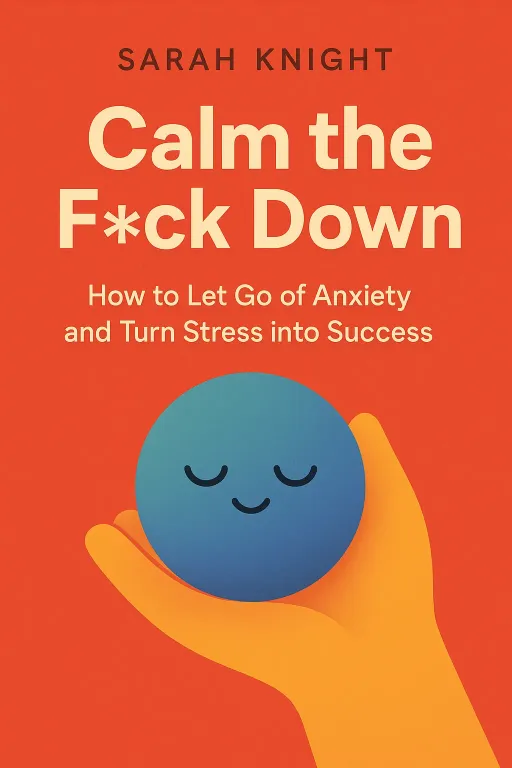
Nova: Exactly. And that is the exact problem we are solving today. We are looking at a blueprint for stress-free clarity. We are pulling insights from Sarah Knight’s approach in Calm the Fuck Down, where she introduces the NoFucks Given method to separate what you can control from what you cannot. And we are balancing that with the work of Nina Purewal and Kate Petriw in Let That Sh*t Go, which provides the mindfulness framework for reclaiming your mental space when the daily grind feels like a tidal wave.
Atlas: That sounds like a necessary toolkit. I am curious how we reconcile those two things. Sarah Knight is known for that sharp, no-nonsense, almost rebellious style, right? She spent years as an editor in the publishing world before deciding to just write the books she wanted to read. She essentially turned the self-help genre on its head by being blunt about the fact that we have limited energy.
Nova: She did. And Purewal and Petriw come at it from a different angle. They focus on the professional environment, helping high-performers detach from the chaos. It is a powerful combination because one gives you the system for prioritization, and the other gives you the psychological tools to actually maintain that boundary.
Atlas: That makes sense. It is the difference between having a map and actually being able to walk the trail without getting distracted by every squirrel in the woods. Let’s get into it. How do we actually start separating what we can control from what we cannot?
The Control List – Radical Prioritization
SECTION
Nova: The first step is what Knight calls the Control List. It sounds simple, almost deceptively so. When you feel that wave of overwhelm, you stop. You take a piece of paper, and you draw a line down the middle. On the left, you list everything you are worried about. On the right, you force yourself to categorize each item: Can I actively influence this right now, or is it entirely out of my hands?
Atlas: I can already see the pushback from our listeners. Someone might say, but everything feels like it is in my hands. If I don’t worry about the project deadline, who will? If I don’t stress about the client’s reaction, the whole thing falls apart.
Nova: That is the trap. That is the illusion of control. The reality is that worrying about the client’s reaction is not the same thing as managing the project. When you are stressing about their reaction, you are burning mental fuel on a variable you cannot manipulate. You are trying to control the weather instead of building a better umbrella.
Atlas: That is a great way to put it. So, if I am an architect, or someone working in a high-stakes environment, I am not ignoring the client. I am just focusing my energy on the design phase or the communication plan, which are the things I can actually touch.
Nova: Precisely. You are shifting from a reactive state to an active state. When you write down that list and you look at the items that are out of your hands, you literally cross them out. You acknowledge that they exist, but you refuse to give them your internal resources. You are setting a boundary for your own brain.
Atlas: I like the physical act of crossing them out. It feels like a small, cathartic release. But let’s talk about the difficulty of that. Because sometimes, the things out of our hands are tied to our identity or our success. If I am an architect and the building permit gets denied, that is technically out of my hands. But it feels like a failure of my competence. How do we stop that from bleeding into our sense of self?
Nova: That is where the second layer comes in. You have to recognize that your professional output is not a direct reflection of your inherent worth. When the permit gets denied, that is a data point. It is not an indictment of your character. The stress comes when we conflate the two. We think, if the project fails, I am a failure. But if you look at it as a variable—like a load-bearing wall that needs to be moved—you can approach it with the same cool, analytical mind you use for your actual work.
Atlas: That resonates. It is like treating your own emotions as a design problem to be solved. If I am stressed, that is a symptom of a design flaw in my current workflow. I need to re-engineer the process, not beat myself up for the stress.
Nova: Exactly. You are the architect of your own mental space. If you are constantly feeling the weight of things you cannot control, your foundation is going to crack. You have to be ruthless about where you spend your attention. If you can’t change it, you have to find a way to detach from it. And that is exactly where the work of Nina Purewal and Kate Petriw comes in.
Mindfulness as a Strategic Tool
SECTION
Atlas: I am glad you brought them up, because I have to be honest, when I hear the word mindfulness, I sometimes think of incense and quiet rooms, which is not really my speed. How does this fit into a high-stakes, fast-paced life?
Nova: That is a common misconception. Purewal and Petriw do not frame mindfulness as a way to escape reality. They frame it as a way to stay in reality without getting crushed by it. Think of it as mental bandwidth management. When you are stressed, your brain is running background processes you are not even aware of. You are playing out conversations that haven’t happened, you are ruminating on mistakes from three years ago, and you are trying to predict the future.
Atlas: Yeah, that sounds like my Wednesday afternoon. It is like those background apps on a phone that drain the battery even when you aren't using them.
Nova: Exactly. And those background apps are stealing your focus. Mindfulness, in their view, is the process of closing those apps. It is about bringing your awareness back to the present moment, which is the only place where you can actually take action. When you are fully present in the task you are doing, you are significantly more efficient. You are not splitting your focus between the work and the anxiety about the work.
Atlas: So, it is not about being Zen and detached from the world; it is about being hyper-focused on the task at hand. That actually sounds like a massive productivity hack. How do we do that without needing to go on a retreat?
Nova: It is in the small, micro-moments. Purewal and Petriw talk about reclaiming mental space through simple rituals. It could be as simple as a transition ritual. When you finish one task and before you start the next, you take thirty seconds. You close your eyes, you take a deep breath, and you consciously let go of the previous task. You are essentially clearing the cache of your brain.
Atlas: I have tried that, and I find that my brain immediately jumps to the next thing before I have even finished the breath. It is like my mind refuses to be empty.
Nova: That is completely normal. The goal is not to have an empty mind. The goal is to notice when the mind has wandered and gently bring it back. It is like training a muscle. Every time you catch your mind drifting to a future worry or a past mistake, and you pull it back to the present, you are doing a rep. You are strengthening your ability to focus.
Atlas: That makes it feel less like a failure when I get distracted and more like a training session. I like that. So, let’s connect these two. We have the Control List from Knight to prune the list of things we care about, and we have the mindfulness practice from Purewal and Petriw to manage our energy while we tackle the things that remain.
Nova: You nailed it. Think about the synergy there. The Control List is your structural plan. It tells you where the load-bearing walls are and which walls you can tear down. Mindfulness is your maintenance strategy. It ensures that you are not exhausting yourself by trying to hold up the ceiling with your bare hands when you don't need to.
Atlas: That is a great analogy. Most people are trying to hold up the ceiling because they are afraid it will collapse if they don't. But if you look at the blueprint, you realize the columns are already there. You just have to trust the structure you have built.
Nova: And that requires a level of trust in yourself. It requires the belief that you can handle what comes your way without needing to pre-worry about it.
Applying the Blueprint to High-Stakes Environments
SECTION
Atlas: Let’s push this into a real-world scenario. Let’s say I am working on a project, and the client changes the requirements at the eleventh hour. That is a classic high-stress scenario. How would we apply this dual approach?
Nova: First, you apply the Control List. You take the news, you feel the initial frustration, and then you pause. You write down the situation. What can you control? You can control your response, your communication with the team, and your assessment of the new timeline. What can you not control? You cannot control the client’s indecision, the market forces that caused the change, or the fact that they are annoying.
Atlas: Right. So, I cross out the annoyance and the market forces. I keep the communication and the timeline assessment.
Nova: Exactly. And then, you apply the mindfulness piece. You are in that meeting, the client is changing everything, and you feel that spike of cortisol. Your heart rate goes up, your chest tightens. In that moment, you use a mindfulness technique. You ground yourself. You feel your feet on the floor. You take that breath. You are essentially telling your nervous system, we are not in danger. This is a business problem, not a threat to my survival.
Atlas: That is the crucial distinction. We treat business problems like existential threats.
Nova: We do. And that is why we burn out. When you treat a project pivot like a saber-toothed tiger, your brain goes into fight-or-flight mode. You lose access to your prefrontal cortex, which is where your creativity and your problem-solving skills live. You are literally making yourself less capable by stressing out.
Atlas: That is a fascinating way to look at it. So, by staying calm, I am actually keeping my brain’s hardware running at full capacity.
Nova: You are. You are keeping the system online. If you panic, you are running on the emergency generator, and that is a very inefficient way to build anything.
Atlas: I imagine that for someone who is career-focused, like our listeners, this is a massive competitive advantage. If everyone else is running around with their hair on fire, and you are the one person who is calm, collected, and focused on the controllable variables, you are going to be the one who delivers.
Nova: You will be the most valuable person in the room. People are drawn to calm. They are drawn to clarity. When you can cut through the noise and focus on what matters, you become a beacon for others.
Synthesis & Takeaways
SECTION
Atlas: This has been a really helpful breakdown. It feels less like abstract advice and more like an operating manual. So, to wrap this up, if someone wants to start this today, what is the single most important thing they should do?
Nova: Start with the Control List. Do not wait for a crisis. Do it tonight. Write down everything that is currently taking up space in your head. Everything. The big stuff, the small stuff, the annoying stuff. Then, look at that list and be brutal. If it is out of your hands, cross it out. And don't just cross it out on paper; cross it out in your mind. Say to yourself, this is not my responsibility. This is not my load to carry.
Atlas: And then, for the things that remain, use that mindfulness practice to stay present while you work on them. Don't let your mind drift to the outcome. Focus on the process.
Nova: That is the key. The outcome is often out of your hands. The process is the only thing you truly own. And if you focus on the process, the outcome usually takes care of itself.
Atlas: I love that. It takes the pressure off the result and puts it on the craft, which is where it belongs.
Nova: Exactly. And remember, this is a practice. You are going to slip up. You are going to start worrying about things you cannot control. That is human. The goal is not to be perfect; the goal is to be aware. The moment you catch yourself, you celebrate that awareness, and you bring yourself back to the present.
Atlas: That is such a hopeful way to look at it. It is not about reaching some enlightened state where you never feel stress again. It is about having the tools to navigate the stress when it inevitably shows up.
Nova: Precisely. You are building resilience, not immunity. And that is a much more sustainable way to live and work.
Atlas: I feel like I have a much clearer view of the landscape now. This has been a great conversation.
Nova: I am glad to hear that. The blueprint is simple, but the execution is where the magic happens. Take that Control List, start small, and watch how much mental space you reclaim.
Atlas: I am definitely going to do that. Thank you for walking me through this.
Nova: It was my pleasure. And to everyone listening, remember that you are the architect of your own focus. Design it well. This is Aibrary. Congratulations on your growth!









