

The Burnout Antidote
Golden Hook & Introduction
SECTION
Nova: Productivity culture has a massive blind spot. We treat our brains like processors that can run at one hundred percent capacity indefinitely, yet the latest science suggests that efficiency crashes when we strip away the one thing we deem a luxury: play.
Atlas: That hits hard. We view play as the reward for finishing work, not as part of the work itself. I spend my entire day optimizing systems, and if someone told me to go play, I would honestly think they were wasting my time.
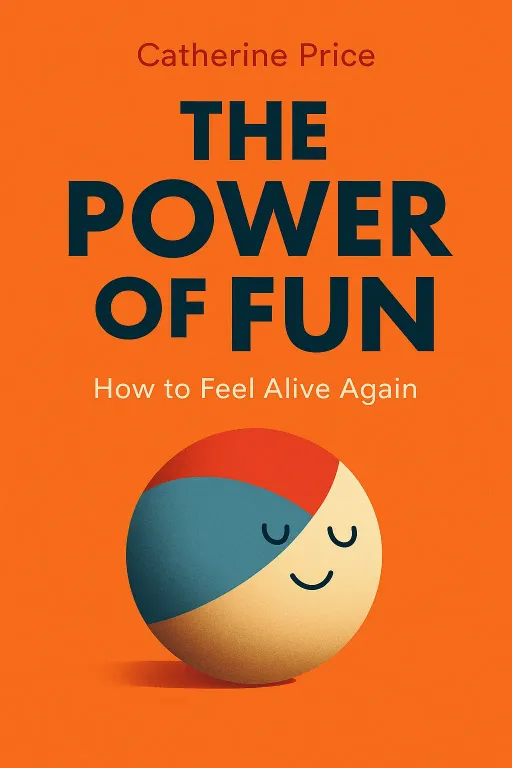
Nova: That is exactly the mentality we need to dismantle. Today we are diving into a synthesis of two essential frameworks. First, we have The Power of Fun by Catherine Price, who argues that true fun is a biological necessity for performance. Then, we are pairing that with the NoWorries Method from Sarah Knight’s Calm the Fuck Down. It is a dual approach: one side builds your energy, and the other side stops the leak.
Atlas: Two authors with very different vibes, but I see the connection. Price is talking about the fuel, and Knight is talking about the engine maintenance.
Nova: Precisely. Sarah Knight, known for her sharp, no-nonsense approach to mental health, actually wrote this as a follow-up to her previous work on boundaries, specifically addressing the mental fatigue of modern life. She brings a refreshing, almost brutal honesty to the table. Catherine Price, on the other hand, comes at this from a science-based perspective, unpacking why our cortisol levels spike when we lose our sense of play.
Atlas: So, we are looking at how to stop the brain from running on empty and how to stop the brain from spinning its wheels on things we cannot control. Let’s start with the fuel. Why is fun a professional strategy?
The Biological Necessity of Fun
SECTION
Nova: The core of Price’s argument is that we have misunderstood what fun actually is. Most people think fun is just passive consumption. We scroll through social media or binge-watch a series, and we assume we are recharging. Price calls this fake fun. It is usually solitary and leaves you feeling drained or numb.
Atlas: I know that feeling. You spend two hours doom-scrolling, and you close the screen feeling more tired than when you started. That is not restoration.
Nova: Exactly. Price defines True Fun as the intersection of three things: playfulness, connection, and flow. Playfulness is about letting go of the need for an outcome. Connection is about shared experience with another human or even an animal. Flow is that state where you are so immersed in an activity that you lose track of time. When you hit that trifecta, your cortisol levels drop, and your brain actually enters a recovery state that sleep alone cannot always provide.
Atlas: Okay, I can see the logic, but let’s bring this down to earth for someone who is buried in projects. If I am an architect or a strategist, how do I find flow and connection in a way that doesn't feel like a distraction? I have a schedule to keep.
Nova: The shift is in the structure. Price suggests we need to stop waiting for fun to happen and start scheduling it. Think of it like a high-stakes meeting. If you had a meeting with a high-value client, you would not just hope it happens. You would carve out the time. You need to treat your playfulness with the same level of respect.
Atlas: I like that. It turns play into a deliverable. But what about the 'connection' part? Is that just socializing?
Nova: It is deeper than that. It is about shared presence. It could be ten minutes of conversation with a colleague where you are not talking about work, but actually engaging in a mutual interest. Or it could be a shared hobby. The biological mechanism here is that shared laughter and interaction trigger the release of oxytocin, which acts as a buffer against stress. It effectively hacks your biology to keep your focus sharp for when you return to your deep work.
Atlas: So, the goal is not to stop working. The goal is to regulate the nervous system so that when I am working, I am not fighting against my own biology.
Nova: That is the perfect way to put it. When you ignore the need for play, you are essentially driving a car with the parking brake on. You are burning more fuel to go the same speed, and eventually, the engine overheats.
The Architecture of Anxiety
SECTION
Atlas: That makes sense. I can see how the lack of flow creates a constant state of low-level stress. But let’s talk about the other side of this. Even if I am well-rested and having fun, I still have a mountain of problems that feel urgent. This is where the NoWorries Method comes in. How does Sarah Knight help us filter that noise?
Nova: Knight’s method is essentially a triage system for your brain. We tend to treat every problem as an emergency. When you are a high-achiever, your brain is wired to identify threats and solve them immediately. But the problem is that we waste immense cognitive bandwidth on things we have zero influence over.
Atlas: We call that 'worrying about the weather.' You can check the forecast ten times, but it is not going to change the rain.
Nova: Exactly. Knight forces you to categorize your anxieties. You create two buckets. Bucket one: things you can control. Bucket two: things you cannot control. It sounds simple, but the implementation is where the strategy happens. For the things in bucket two, you have to practice what she calls 'strategic indifference.'
Atlas: Strategic indifference. That sounds almost cold, but I imagine it is necessary for survival. How do you distinguish between what you can control and what you cannot when everything feels like it needs your attention?
Nova: You have to get granular. Let’s say you are worried about a project outcome. Is the outcome entirely in your control? No. Other people, market conditions, and technical glitches play a role. But is your process in your control? Yes. Is the quality of your communication in your control? Yes. So, you move the focus from the outcome, which is a bucket-two problem, to the process, which is a bucket-one problem.
Atlas: That is a pivot. You are basically saying, stop trying to control the uncontrollable variables and double down on the variables you own.
Nova: Correct. And for the things that are truly outside your influence, Knight suggests a mental exercise of naming them and then consciously deciding to let them go. It is not about ignoring them; it is about acknowledging them and refusing to give them your limited mental fuel. Every time you worry about something you cannot control, you are stealing focus from the tasks that actually move the needle for your career or your life.
Atlas: I can see how this creates a lean mental operating system. If I stop spending energy on things I cannot change, I have way more capacity for the things I can. It is about resource allocation.
Nova: Precisely. And that is why these two books work so well together. You are reclaiming your capacity by shedding the useless worry, and you are recharging your battery by integrating true fun. You are essentially building a more resilient, high-performance version of yourself, but not by adding more work. You are doing it by subtracting the friction.
Synthesis & Takeaways
SECTION
Atlas: This feels like a blueprint. If I am listening to this and I want to start today, what is the most pragmatic way to combine these? I don't want another massive to-do list.
Nova: Start with the fifteen-minute rule. Price suggests scheduling a fifteen-minute block for 'screen-free play.' It could be anything—drawing, playing with a pet, a quick game, or just a conversation that has nothing to do with your career. Do not look at your phone. Do not check your email. Just play.
Atlas: And what about the worry side?
Nova: For the NoWorries Method, take three of your current anxieties—the ones that are keeping you up or taking up the most space in your head. Write them down. Then, draw a line next to each. If you can take a specific action to influence the outcome, it goes in the control column. If you cannot, you have to label it as something you are choosing to accept. It sounds simple, but the act of writing it down and categorizing it is what breaks the loop.
Atlas: I like the simplicity. It is actionable, and it is measurable. You are not asking me to change my personality; you are asking me to change my system.
Nova: That is the key. You are an architect of your own life. You do not need to overhaul the entire building; you just need to update the systems that are causing the most inefficiency. By managing your energy through fun and managing your focus through the control test, you are setting yourself up for sustainable growth.
Atlas: It is a shift from managing time to managing energy. If you are constantly drained, it does not matter how much time you have. You will just spend it in a state of low-level anxiety.
Nova: Exactly. And when you look back at your week, you want to see that you accomplished your goals, but also that you actually enjoyed the process of getting there. That is the ultimate metric of a well-lived life.
Atlas: I think I am going to start with that fifteen-minute block. I have a feeling that if I actually commit to it, the rest of the day is going to look a lot different.
Nova: That is the goal. Give it a shot, and you will see how quickly the brain responds when you actually give it what it needs. This is Aibrary. Congratulations on your growth!









