

The Art of Tactical Calm Under Pressure
Golden Hook & Introduction
SECTION
Nova: Every single morning, you wake up with a finite tank of gas. It is your cognitive fuel. By noon, most of us have burned through half of it on things that we cannot change, things that are not happening yet, or things that have already happened. We are essentially lighting our productivity on fire before we even get to the real work.
Atlas: That is a brutal way to start the day, but you are not wrong. It feels like we are all running a marathon while wearing a weighted vest made entirely of hypothetical problems. I spend half my energy worrying about the fallout of a meeting that has not even happened yet. It is exhausting.
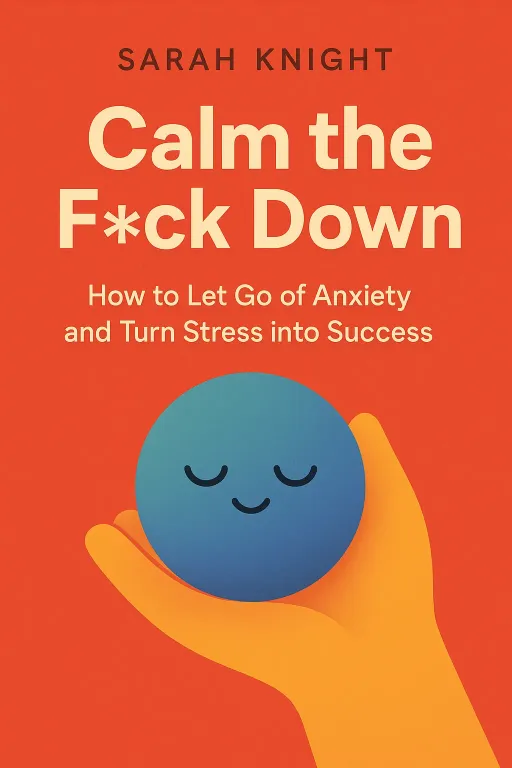
Nova: Exactly, and that is why we are looking at two specific frameworks today. We are diving into the NoWorries Method from the book Calm the Ft Go by Nina Purewal and Kate Petriw.
Atlas: I have heard of these. Sarah Knight is the one who basically turned the art of not caring about the wrong things into a science, right? And the Purewal and Petriw book is usually recommended for people who are in high-pressure roles, the kind of professionals who have zero time for long, drawn-out meditation retreats.
Nova: That is the perfect summary. Knight, who spent years in the high-stress world of book publishing, realized that the mental overhead of worrying was a choice, not a requirement. And Purewal and Petriw, who come from the worlds of corporate human resources and wellness, focus on the reality of a busy life. They are not asking you to sit on a mountaintop. They are asking you to survive the boardroom. Today, we are going to build a blueprint for staying cool when everything else is burning.
The Control Filter
SECTION
Atlas: Okay, let us start with the triage. I am listening to you talk about burning through cognitive fuel, and I am thinking about my inbox. It is a disaster. I have a deadline, a team member who is behind, and a client who is unhappy. If I use this NoWorries Method, how do I actually sort through that mess without just ignoring the problems?
Nova: That is the most common misconception. People think that letting go of worry means becoming indifferent or lazy. It is actually the opposite. It is about precision. The NoWorries Method is essentially a triage system. Imagine you are a doctor in an emergency room. You do not treat the patient with a paper cut with the same urgency as the patient with a broken leg. You have to categorize your stressors into things you can control and things you cannot.
Atlas: But everything feels like a priority when you are in the middle of it. How do you distinguish between what you can control and what you cannot when the pressure is mounting?
Nova: Here is the litmus test. Ask yourself, can I do something about this right now, or is this a variable I have no influence over? Let us take your scenario. The unhappy client. Can you control their emotional reaction to the news? No. You cannot. That is a variable outside your control. But, can you control the quality of the solution you present to them, the speed of your response, and the transparency of your communication? Yes. Those are your variables.
Atlas: I see what you are doing. You are stripping away the emotional weight of the uncontrollable variables. So, instead of stressing about the client's anger, which is a waste of energy, I focus entirely on the execution of the solution.
Nova: Precisely. The cognitive energy you would have spent agonizing over their reaction is diverted into the actual work. It is like shifting a car into a higher gear. You are no longer spinning your wheels in the mud of anxiety. You are moving forward. Knight makes a great point about this. She suggests that we often treat our internal monologue like a television that we cannot turn off. But we actually have the remote. We can change the channel.
Atlas: That is a great analogy. But let me push back a little. Is it not dangerous to stop worrying about the things we cannot control? If I am a project manager, for example, I need to anticipate risks. If I stop worrying about the market, or the budget, or the client's mood, do I not become blindsided?
Nova: That is a smart distinction. There is a difference between planning for risk and ruminating on it. Planning is tactical. Ruminating is emotional. When you plan, you are looking at the uncontrollable variable and asking, what is my contingency? When you ruminate, you are looking at the uncontrollable variable and asking, why is this happening to me? The first leads to a strategy. The second leads to burnout.
Atlas: Right. So, the goal is to acknowledge the risk, create a plan for it, and then—this is the hard part—let the worry die.
Nova: Exactly. And that brings us to the second layer of this, which is the physiology of that stress. Because even when you decide not to worry, your body is still in fight-or-flight mode. That is where the work of Purewal and Petriw comes in. They argue that you cannot think your way out of a physiological reaction. You have to address the body first.
Tactical Mindfulness in the Trenches
SECTION
Atlas: This is the part that usually loses me. When people talk about mindfulness, I picture incense, soft music, and thirty minutes of sitting cross-legged. If I am in the middle of a high-stakes crisis at work, I do not have time for that. Does their approach account for the fact that I am in a cubicle, not a yoga studio?
Nova: They do. In fact, their entire premise is built for that exact environment. They call it tactical mindfulness. It is not about zoning out. It is about zoning in. Think of it as a circuit breaker for your nervous system. When you feel that spike of cortisol, when your heart starts racing because of a bad email, you are essentially in a state of hyper-arousal. Your prefrontal cortex, the part of your brain responsible for logic and decision-making, is going offline.
Atlas: That explains why I make terrible decisions when I am stressed. I am literally losing brain function.
Nova: You are. Evolutionarily, it makes sense. If you were being chased by a predator, you did not need to solve a complex spreadsheet; you needed to run. But in a modern office, that same reaction is a liability. Purewal and Petriw suggest a simple, powerful intervention: the micro-pause.
Atlas: Define micro-pause. Is this just taking a deep breath?
Nova: It is deeper than that. It is a deliberate, physical reset. They recommend a technique where you stop what you are doing—literally drop your hands from the keyboard—and take three deep, intentional breaths. But the trick is the focus. You have to focus on the sensation of the air entering your nostrils and the expansion of your diaphragm.
Atlas: That sounds almost too simple. How does three breaths fix a crisis?
Nova: It does not fix the crisis. It fixes you. It interrupts the feedback loop between your stressor and your nervous system. By forcing your body to slow down, you are sending a signal to your brain that says, we are not in mortal danger. This allows your prefrontal cortex to come back online. You are buying yourself thirty seconds of clarity. And in a high-pressure situation, thirty seconds is an eternity.
Atlas: I can see how that works. It is like rebooting a computer that is frozen. You are not fixing the software, but you are getting the system to respond again.
Nova: That is exactly right. And once you have done that, you can apply the NoWorries Method. You are now calm enough to categorize the problem, identify the controllable variables, and execute the solution. The mindfulness is the prerequisite for the strategy.
Atlas: This is starting to click. We are looking at a two-step process. First, the physical reset, which is the Purewal and Petriw approach. Then, the cognitive triage, which is the Knight approach.
Nova: You have got it. It is the tactical combination of mind and body. Most people try to use logic to calm down their body, which is like trying to put out a fire with a spreadsheet. It does not work. You have to stabilize the body first, then apply the logic.
Case Study: The Project Meltdown
SECTION
Atlas: Let us put this into a real-world scenario. Let us say I am leading a project, and two days before the launch, the lead developer quits. The client is expecting a demo, and the team is panicking. My heart is pounding, my head is spinning, and I feel like I am about to have a panic attack. Walk me through how I use these two methods in that moment.
Nova: Okay, you are in the office. You get the news. Your body is screaming. What is the very first thing you do?
Atlas: I usually start firing off emails, trying to find a replacement, or calling the client to apologize.
Nova: Stop. That is the reaction of an uncalibrated mind. Instead, you take the micro-pause. You physically stand up, walk away from the desk, and take three breaths. You are not thinking about the developer. You are not thinking about the client. You are just feeling your lungs expand. You are resetting your nervous system.
Atlas: Okay, I have done that. I feel slightly less like my head is going to explode. Now what?
Nova: Now, you categorize. You take a piece of paper—not a screen, paper—and you draw a line down the middle. One side is "Control," the other is "Cannot Control."
Atlas: What goes on the "Cannot Control" side?
Nova: The developer quitting. That is done. It is in the past. You cannot force them to stay. The fact that the client might be angry. You cannot control their feelings. The fact that the launch date is looming. That is a hard constraint.
Atlas: That is actually frustrating to write down, but it is true. I cannot change those things. So, what goes on the "Control" side?
Nova: Your communication with the client. You can control the transparency of that conversation. You can control the conversation with the remaining team members. You can control the assessment of the remaining work. You can control the request for an extension or a change in scope.
Atlas: When I look at it that way, the panic starts to recede. The "Cannot Control" list is just facts. The "Control" list is a to-do list.
Nova: That is the magic. The anxiety lives in the mix of the two. It lives in the space where you are trying to control the uncontrollable. Once you separate them, the anxiety loses its fuel source. You are no longer trying to solve the developer quitting; you are solving the resource gap. That is a manageable problem.
Atlas: I have been doing this wrong for years. I have been trying to solve the "developer quitting" problem, which is unsolvable, and neglecting the "resource gap" problem, which is solvable.
Nova: Most people do. We spend our lives fighting reality. This method forces you to accept reality so you can work with it. And remember, the mindfulness piece is the bridge. Without that micro-pause, you would never have the clarity to sit down and make that list. You would have stayed in the panic loop.
The Long-Term Strategy
SECTION
Atlas: This makes sense for a crisis, but what about the day-to-day grind? I am not in a crisis every day, but I am constantly in a state of low-level, background anxiety. How do these books help with the slow burn of professional life?
Nova: That is where the growth recommendation comes in. You do not wait for the crisis to practice these skills. You build them into your daily routine. That is where the 20-minute daily habit is critical. Think of it like physical fitness. You do not wait until you have to run a marathon to start training. You train every day so that when the marathon comes, your body knows what to do.
Atlas: So, what does that 20 minutes look like?
Nova: It is a combination of the two. You spend ten minutes practicing the mindfulness—the micro-pause, the breathing, the grounding. You are teaching your brain to return to a state of calm. Then, you spend ten minutes reviewing your day through the NoWorries lens. You look at what stressed you out and you categorize it. Did I waste energy on an uncontrollable variable today? If yes, why?
Atlas: That is interesting. You are treating it like an audit.
Nova: Exactly. You are auditing your cognitive expenses. If you find that you are constantly worrying about things you cannot control, you are running a deficit. You are becoming a more efficient thinker by constantly identifying these leaks and plugging them.
Atlas: I can see how this leads to long-term growth. If I do this for a year, I am not just less stressed; I am more effective. I am literally spending more of my time on high-leverage activities because I am not wasting it on low-leverage worry.
Nova: That is the ultimate goal. You are not just trying to be calm; you are trying to be high-performing. Calmness is a competitive advantage. In a world of panic, the person who can remain clear-headed is the most valuable person in the room.
Atlas: And it is not about being cold or robotic. It is about being purposeful.
Nova: Precisely. You care deeply about the work, but you do not let the work destroy your capacity to do it. You are the architect of your own mental state.
Synthesis & Takeaways
SECTION
Atlas: This has been a complete shift in perspective for me. I think we often wear stress as a badge of honor, like if I am not worried, I must not care. But what we are talking about here is the opposite. It is about taking radical responsibility for your own energy.
Nova: That is a beautiful way to put it. You are protecting your most valuable asset, which is your ability to focus and execute. If you take anything away from this, let it be the deep question we started with. When the next crisis hits, stop. Ask yourself, is this a situation I can actually control, or am I wasting valuable cognitive energy trying to manage the unmanageable?
Atlas: It is such a simple question, but it has the power to change everything. I think I am going to start using that as my screensaver. "Is this controllable?"
Nova: And remember, the physical reset comes first. Do not try to think your way out of a physiological reaction. Breathe, ground yourself, and then categorize. It is a simple, two-step system that works in any environment, from a home office to a corporate boardroom.
Atlas: I love the idea that this is a skill we can train. It gives me a lot of hope. It means that the next time I am in a high-pressure meeting and I feel that familiar tightening in my chest, I have a protocol. I am not a victim of my own biology. I have a remote control for my mind.
Nova: You absolutely do. And the more you practice, the faster you will be able to switch channels. It is not about never feeling pressure. It is about not staying there. It is about returning to a state of clarity, again and again.
Atlas: This has been incredibly grounding. I feel like I have a new set of tools to bring to my work.
Nova: I am glad to hear that. Just remember, consistency beats intensity. You do not need to be perfect. You just need to be consistent with the practice. That is where the real growth happens.
Atlas: I am ready to start.
Nova: Then let us get to it. This is Aibrary. Congratulations on your growth!









