

The Anxiety Antidote
Golden Hook & Introduction
SECTION
Nova: If this conversation found you today, there is a very high probability that your brain is currently running twenty-seven open tabs, and at least three of them are playing music you cannot turn off. We are living in an era of peak mental noise, where our minds are constantly hijacked by things we cannot control.
Atlas: Oh, I know that exact feeling. It is like having a tiny, hyperactive manager in your head who insists on treating every minor email and delayed text message as an absolute, five-alarm emergency.
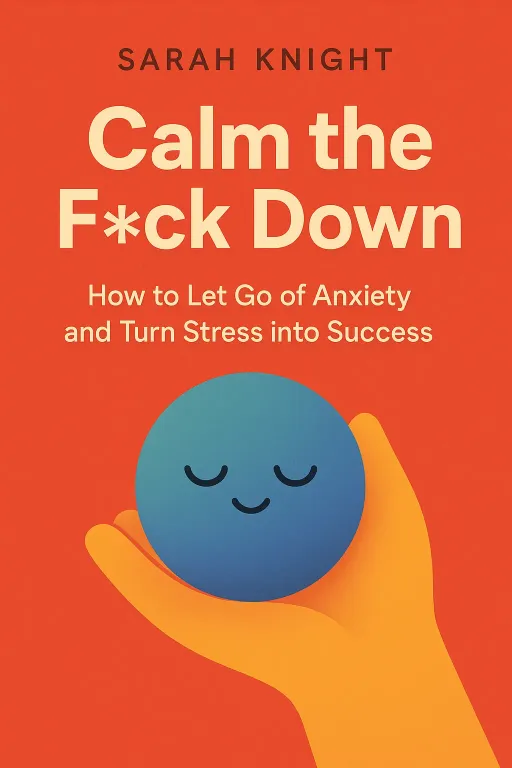
Nova: Exactly. And that is why we are diving into a powerful double-feature today to help us reclaim our sanity. We are looking at Calm the Fuck Down by Sarah Knight, alongside Cognitive Behavioral Therapy by Olivia Telford.
Atlas: Now, that is an interesting pairing. You have Sarah Knight, who famously walked away from a high-pressure, fifteen-year career as a top-tier New York book editor to live in a tropical paradise, bringing this wonderfully blunt, anti-guru energy. And then you have Olivia Telford, who takes these heavy, clinical psychological frameworks and makes them feel incredibly accessible for regular people.
Nova: It is the perfect combination of a reality check and scientific strategy. Knight gives us the permission to stop caring about the wrong things, while Telford gives us the cognitive tools to restructure how we process stress. Together, they offer a complete blueprint for mental triage.
Atlas: That sounds like exactly what we need. Where do we even begin to untangle this mess?
Nova: We begin with the foundational concept that Sarah Knight calls the NoShitsGiven method. It is a deceptively simple premise. We have a finite amount of mental energy, or emotional currency, to spend every single day. Yet, we spend it on things that are completely outside of our influence.
The Art of Mental Triage
SECTION
Nova: To understand how this plays out, let us look at a scenario that many of us can relate to. Imagine a project manager named Maya. She has spent six months planning a massive outdoor product launch. It is her career-defining moment. Two days before the event, the weather forecast predicts a historic, torrential rainstorm.
Atlas: Oh, that is a nightmare. I can already feel the collective stomach drop of everyone listening who has ever planned anything. What does Maya do?
Nova: Maya does what most of us do. She enters a state of total emotional panic. She spends forty-eight hours glued to her weather app, refreshing it every three minutes. She calls meteorologists. She cries in her car. She snaps at her team. She is burning one hundred percent of her emotional currency on the atmospheric pressure of the Earth.
Atlas: That sounds incredibly exhausting, and honestly, very familiar. But here is the hard truth. No matter how much she cries or refreshes that app, she cannot change the weather.
Nova: Exactly. The rain is going to fall regardless of Maya's stress levels. Knight's method is about drawing a hard, uncompromising line between what she calls the uncontrollable facts of life, and the things we can actually do something about. The weather is an uncontrollable fact. Maya's reaction, her backup plan, and her communication with the clients are the controllable elements.
Atlas: So, instead of screaming at the clouds, she needs to redirect all that panic into action.
Nova: Yes. The breakthrough happens when Maya stops wasting her emotional currency on the storm itself. She accepts the rain as an unchangeable reality. Suddenly, her mind clears. She secures an indoor venue, orders custom umbrellas with the company logo, and drafts a witty email to the guests about embracing the storm. She shifts from a state of paralyzed panic to a state of active mobilization.
Atlas: That makes a lot of sense, but it sounds much easier said than done. When you are in the middle of a crisis, your brain does not naturally want to be logical. It wants to freak out. How do we actually make that shift in the heat of the moment?
Nova: It requires us to recognize that worry is often a form of cognitive laziness. It is easier to sit and worry than it is to do the hard work of organizing our thoughts and taking constructive action. Knight argues that we treat worry as if it is a shield that protects us from bad outcomes. If I worry enough, maybe the bad thing won't happen.
Atlas: That is a fascinating way to look at it. We use worry as a superstitious ritual. Like, if I stop worrying, I am letting my guard down, and that is when the universe will strike.
Nova: Precisely. We confuse worrying with caring, and we confuse worrying with preparation. But worrying is actually just running on a treadmill. You are sweating, your heart rate is up, you are exhausting yourself, but you are not moving an inch forward.
Atlas: So how do we step off the treadmill?
Nova: We start by categorizing our concerns. Knight suggests asking yourself a brutal question whenever a stressful situation arises. Can I, in this exact moment, do something to physically change this outcome? If the answer is no, then spending emotional energy on it is a literal waste of your life. You have to actively decide to give zero shits about the uncontrollable part, so you can save your energy for the parts where you actually have leverage.
Atlas: I can see how that would free up a massive amount of mental bandwidth. But what about those situations where the worry is not about an external event like the weather, but rather about our own internal thoughts? What if the storm is entirely inside our own heads?
Nova: That is the perfect bridge to Olivia Telford's work on Cognitive Behavioral Therapy. Because while Knight helps us triage our external reactions, Telford teaches us how to dismantle the internal machinery that generates the anxiety in the first place.
Dismantling the Doom Loop
SECTION
Nova: Telford focuses heavily on what psychologists call cognitive distortions. These are biased ways of thinking that we use to convince ourselves of things that are simply not true. They are the lies our brains tell us to keep us anxious.
Atlas: Oh, I am definitely guilty of believing those lies. What are some of the classic distortions we should be looking out for?
Nova: One of the most common is catastrophizing. This is when your brain takes a small, negative event and immediately builds a massive, runaway bridge to the absolute worst-case scenario.
Atlas: Let us hear an example of that. How does that play out in a daily routine?
Nova: Let us look at Leo. Leo is a software engineer. He receives a brief, vague email from his manager on Friday afternoon. The email simply says, we need to talk on Monday morning at nine.
Atlas: Oh boy. That is a universal trigger. I think ninety-nine percent of people would immediately assume they are getting fired.
Nova: Exactly. Leo's brain goes into overdrive. He starts catastrophizing. The sequence goes like this. The manager wants to talk, which means I made a massive error on the latest code deployment. That means I am getting fired on Monday. If I get fired, I won't be able to pay my rent. If I can't pay my rent, I will be evicted. I will end up ruined, my career will be over, and my family will think I am a complete failure.
Atlas: Wow. He went from a simple meeting request to total ruin in about four seconds. It is like his brain is a Hollywood director specializing exclusively in disaster movies.
Nova: That is the perfect analogy. And the tragedy is that Leo's weekend is completely ruined. He cannot sleep, his stomach is in knots, and he cannot engage with his family. He is living in a future catastrophe that has not actually happened, and most likely never will.
Atlas: That is the real cost of these distortions. We suffer in imagination far more often than we suffer in reality. So, how does Olivia Telford suggest we break that cycle?
Nova: Through a process called cognitive restructuring. The core principle of CBT is that our emotions are not caused by external events, but rather by our thoughts about those events. The meeting invitation itself did not make Leo anxious. Leo's thought, which was, I am getting fired, is what triggered the anxiety.
Atlas: That is a subtle but incredibly powerful distinction. If the event itself is neutral, then we have the power to change how we feel by changing how we interpret the event.
Nova: Exactly. To do this, Telford says we must become scientists of our own minds. We have to treat our anxious thoughts not as absolute truths, but as hypotheses that need to be tested. When Leo feels that surge of panic, he needs to pause and put his thought on trial. He has to look for actual, objective evidence.
Atlas: How would he do that? What does putting a thought on trial actually look like?
Nova: He would ask himself, what is the objective evidence that I am getting fired? Well, his last performance review was stellar. The team recently praised his work. There have been no company-wide layoffs. The evidence for the negative hypothesis is actually incredibly weak. Then, he looks for alternative explanations. Why else would the manager want to talk? Perhaps to discuss a new project, to ask for feedback on a team member, or simply to check in.
Atlas: That is a much more balanced perspective. But what if the anxious voice in your head fights back? What if it says, yeah, but what if this is the one time you actually are in trouble?
Nova: That is where we have to challenge the utility of the thought. Telford suggests asking, does believing this thought help me solve any problems right now? Is worrying about getting fired all weekend making me a better engineer or preparing me for Monday? The answer is always no. It is actively harming him. By examining the evidence and realizing the thought is unhelpful, Leo can reframe the situation. He can tell himself, my manager wants to talk on Monday. I do not know the agenda, but my track record here is strong, and I am fully capable of handling whatever comes up.
Atlas: That feels like taking a deep, clean breath of air. It deflates the monster in the closet. But what about other distortions? I know mind reading is another big one that people struggle with.
Nova: Mind reading is incredibly destructive. It is the belief that we know exactly what other people are thinking, and it is almost always something negative about us. You walk past a colleague in the hallway, they do not smile, and you immediately think, they are angry with me. I must have done something wrong.
Atlas: Oh, absolutely. We assume we are the center of everyone else's universe, and that their bad mood is a direct reaction to our existence.
Nova: In reality, that colleague might just be stressed about their own workload, or running late for a meeting, or simply trying to remember if they turned off their stove. By recognizing mind reading as a distortion, we can stop taking other people's behavior personally. We can let go of the need to manage their internal states.
Atlas: This really highlights how much of our anxiety is self-generated. We are constantly building these elaborate, stressful narratives out of thin air.
Nova: We really are. And the beauty of combining Knight's triage with Telford's CBT is that we get both a macro-level strategy and a micro-level toolset. We learn to stop caring about the things we cannot control, and we learn how to dismantle the negative thinking patterns that make us feel helpless.
Synthesis & Takeaways
SECTION
Atlas: This brings us to the practical application. How do we take these big, heavy concepts and turn them into something we can actually use tomorrow morning when we start feeling overwhelmed?
Nova: This is where we introduce the tiny step. It is a incredibly elegant exercise that bridges both books perfectly. The next time you feel a wave of anxiety or a crisis hits, do not try to resolve it all in your head. Grab a physical piece of paper and a pen.
Atlas: I love a good pen-and-paper exercise. It physicalizes the mental clutter. What do we do with it?
Nova: Draw a single, solid line right down the middle of the page, creating two columns. On the left side, write down the elements of the situation that you can control. On the right side, write down the elements that you cannot control.
Atlas: Let us map that out with a real-world example. Say, someone is stressed about a major presentation they have to deliver to their company's executives next week. What goes on their paper?
Nova: Excellent example. On the right side, in the cannot control column, they would write things like: the mood of the executives, whether the technology glitches, the questions they might ask, or how the audience ultimately reacts to the presentation. Those are all external variables.
Atlas: That is a lot of heavy stuff on the right side. It is easy to see why someone would be anxious. What goes on the left side?
Nova: On the left side, in the can control column, they write: how thoroughly they research the topic, how many times they practice their delivery, arriving early to test the equipment, and having a backup printed copy of their slides in case the projector fails.
Atlas: I see the magic here. Once the paper is filled out, what is the next move?
Nova: The rule is absolute and uncompromising. You must focus one hundred percent of your energy, your focus, and your emotional currency exclusively on the left column. You actively surrender the right column. You make a conscious decision to give zero shits about the right side of the page, because no amount of worry will change a single item on it.
Atlas: That is incredibly liberating. You are essentially giving yourself permission to ignore half of your worries because they are literally not your job to solve.
Nova: Exactly. It is a process of radical acceptance. You accept the uncontrollable elements as the landscape of the situation, and you focus entirely on how you navigate that landscape. It shifts you from a victim of circumstance to an active agent of your own life.
Atlas: It also seems like this exercise would naturally disrupt those cognitive distortions we talked about. By writing things down, you are forced to look at them objectively, which makes it much harder for your brain to catastrophize.
Nova: It absolutely does. When you see your fears written out on paper, they lose their ghostly power. You can look at the right column and say, yes, the executives might be in a bad mood. That is a possibility, but it is not a catastrophe, and it is not a reflection of my worth. I will focus on delivering a great presentation, which is on my left side.
Atlas: That is such a profound shift in perspective. It is about realizing that we do not need to control the world to feel safe. We only need to control our own responses to it.
Nova: That is the ultimate takeaway. The true antidote to anxiety is not a life completely free of chaos, but rather a mind that knows how to navigate that chaos with clarity and purpose. By practicing this simple split-page exercise, we train our brains to stop fighting the wind and start adjusting our sails.
Atlas: I think that is a beautiful place to wrap up today's discussion. For everyone listening, the next time you feel that mental noise starting to build, find a piece of paper, draw that line, and reclaim your peace of mind.
Nova: This is Aibrary. Congratulations on your growth!









