

Breaking the Cycle of Mental Exhaustion
Golden Hook & Introduction
SECTION
Nova: Most people think the antidote to a crushing, overwhelming workload is better time management. They buy the planners, they color-code the calendar, they set the digital alarms. But the problem isn't your schedule. The problem is that you are trying to manage things that aren't even yours to control.
Atlas: That is a bitter pill to swallow, especially for anyone who prides themselves on being the person who can fix anything. We treat every single problem as if it is a project that requires our direct intervention.
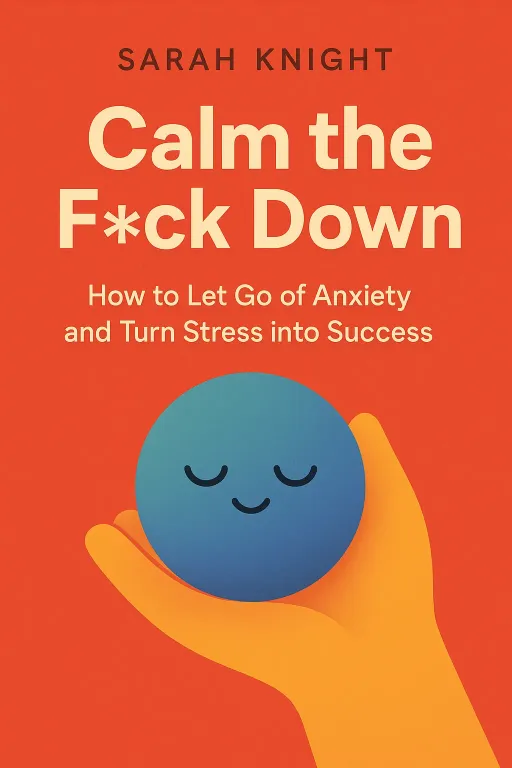
Nova: Exactly. And that is the exact cycle we are here to dismantle today. We are looking at two essential guides to sanity: Calm the Fuck Down by Sarah Knight and How to Stop Feeling Like Shit by Andrea Owen. These authors have essentially mapped out the emotional and psychological landscape of burnout.
Atlas: I have read both. Sarah Knight is fantastic because she doesn't try to coddle you. She cuts right to the chase. And Andrea Owen? She is the queen of calling out the specific, sneaky behaviors we use to sabotage our own peace of mind. It is a powerful combination for anyone who feels like they are running on a treadmill that is set to maximum speed.
Nova: It is the perfect toolkit. Knight gives us the tactical, structural way to categorize our worries, while Owen helps us identify the internal patterns that keep us trapped in that cycle of exhaustion. Today, we are going to bridge those two worlds. We are going to show you how to stop the internal spiral and regain your mental bandwidth.
The Anatomy of Self-Sabotage
SECTION
Atlas: Let’s start with the internal noise. Andrea Owen identifies fourteen common self-sabotaging behaviors, but the ones that always seem to stick in my throat are imposter syndrome and catastrophizing. Why do we do that to ourselves? Why does the brain default to, I am a fraud and everything is going to explode?
Nova: It is a survival mechanism that has outlived its usefulness. Think about it. Thousands of years ago, our ancestors needed to be hyper-vigilant. If they heard a rustle in the grass, they had to assume it was a tiger, not the wind. If they guessed wrong, they were lunch. Today, we don't have tigers. We have emails. We have quarterly reviews. We have academic deadlines.
Atlas: So, the brain is just misapplying that ancient survival instinct to a modern inbox?
Nova: Precisely. That is the essence of catastrophizing. You get an email from a professor or a boss, and your brain immediately jumps to the worst possible outcome. It is a protective mechanism gone haywire. You are trying to prepare for the disaster so you won't be blindsided, but all you are doing is flooding your system with cortisol.
Atlas: That makes so much sense. I see this with people who are high achievers. They feel like they have to constantly anticipate the disaster because that is what got them to the top. They think, If I am not worried, I am not prepared.
Nova: That is the trap. Imposter syndrome is the flip side of that same coin. You achieve something great, but instead of celebrating, your brain says, This was a fluke. They are going to find out I have no idea what I am doing. You are constantly waiting for the other shoe to drop. Andrea Owen breaks this down beautifully. She points out that these behaviors are not just personality quirks. They are energy drains. They are like background apps on your phone that you forgot to close, slowly eating away at your battery life until you are running on empty by noon.
Atlas: I love that analogy. It is the perfect way to visualize it. You are trying to run a high-performance program, but you have fifty background tabs open, all of them screaming about potential failure. How do we even begin to close those tabs?
Nova: That is where we have to shift from internal monitoring to external sorting. This is the core of Sarah Knight’s work. She talks about the Disarming technique. It is essentially about taking that massive, amorphous cloud of anxiety and forcing it into a structured container.
The Architecture of Calm
SECTION
Atlas: Okay, let’s get into the mechanics of that. I am a skeptic when it comes to simplified systems. Is this just another way of saying don't worry about it? Because telling someone who is stressed to just stop worrying is about as useful as telling a drowning person to just breathe water.
Nova: I completely agree. Telling someone to calm down is useless. Sarah Knight’s approach is not about apathy. It is not about saying you don't care. It is about triage. The Disarming technique is about taking every single thing that is currently occupying your mental space—your worries, your tasks, your anxieties—and putting them into one of two buckets. Bucket one: Things you can control. Bucket two: Things you cannot control.
Atlas: It sounds simple, but I imagine the execution is where people get stuck. What happens when the thing you cannot control is also the thing that has the highest stakes? For example, the outcome of a major project or an academic grade. You can control your effort, but you cannot control the person grading it or the final result.
Nova: That is the crux of the issue. You are absolutely right. The outcome is often outside your control. The process is inside your control. When you conflate the two, you create a feedback loop of anxiety. You start trying to control the outcome through sheer force of worry. You think, If I worry about this grade hard enough, the grade will be better.
Atlas: Which is objectively insane when you say it out loud.
Nova: It is, but we do it every day. Sarah Knight’s Disarming technique forces you to physically separate the two. When you write it down—and I mean physically write it on paper—you are externalizing the thought. You are taking it out of the chaotic, emotional part of your brain and putting it into the logical part.
Atlas: So, if I am freaking out about a deadline, the worry is, I am going to fail. That is the uncontrollable outcome. What is the controllable part?
Nova: The controllable part is your time management, your research method, your drafting process, your communication with your advisor. That is it. That is the list. Everything else—the professor's mood, the grading criteria, the subjective opinion of the reviewer—that goes in the No Control column.
Atlas: And what do you do with the No Control column? You can't just delete it. My brain is going to keep looping on it.
Nova: This is the genius part. You don't delete it. You acknowledge it, and then you disarm it. You say, This is a factor. I am aware of it. But I have zero agency here. Therefore, giving it any more of my mental energy is a net negative. It is a waste of resources. It is like trying to change the weather. You can check the forecast, but you cannot change the rain. So, you pack an umbrella and you move on.
Atlas: I see the power in that. It is a way of reclaiming agency. Instead of feeling helpless, you are saying, I have done everything I can within my jurisdiction. The rest is out of my hands. It is almost a stoic approach.
Nova: It is deeply stoic. It is the recognition that the only true power you have is over your own actions and your own focus. When you stop trying to influence the uncontrollable, you suddenly find yourself with a massive surplus of energy. That is where the shift happens. You are no longer exhausted because you are no longer fighting invisible, unwinnable battles.
The Practical Implementation
SECTION
Atlas: Let’s make this concrete for our listeners. Let’s say someone is listening to this, and they are in the middle of a massive academic or professional crunch. They are drowning. What is the first thing they should do?
Nova: They should grab a sheet of paper. Don't do this on a screen. Do it on paper. Draw a line down the middle. Label the left side Control and the right side No Control. Then, do a brain dump. Write down every single thing that is keeping you up at night regarding that project. Every fear, every task, every hypothetical disaster.
Atlas: And then?
Nova: Then, you look at the list. You go item by item. If it is in the No Control column, you physically cross it out. Not a light strike-through. A heavy, permanent cross-out. It is a symbolic act of release. You are telling your brain, I am officially retiring from this concern. I am no longer responsible for the outcome of this specific variable.
Atlas: I like the physical aspect of that. There is something about the tactile sensation of crossing something out that feels like closing a door. It is sensory confirmation that you are done with it.
Nova: It is. And for the items in the Control column, you turn those into actions. That is your to-do list. That is your plan. That is where your energy goes. If you are worried about failing, and you write that in the No Control column, you cross it out. But if you write, I need to finish the literature review, that goes in the Control column. That is a task you can actually complete.
Atlas: It transforms a paralyzing, amorphous cloud of anxiety into a manageable, linear path.
Nova: Exactly. And that is the secret to breaking the cycle of mental exhaustion. You stop spending 90 percent of your energy on the 90 percent of things you cannot change. You redirect that energy into the 10 percent of things you can.
Atlas: I have to ask, though—what about the people who feel like their worth is tied to the outcome? The high achievers who feel like, if they don't stress about the outcome, they aren't working hard enough?
Nova: That is a classic trap. It is the belief that anxiety is a performance enhancer. It is not. Anxiety is a performance inhibitor. When you are operating from a place of fear, you are not thinking clearly. You are not creative. You are not strategic. You are reacting. When you clear the decks of the things you cannot control, you gain the clarity to do your best work. You are not lowering your standards. You are sharpening your focus.
Atlas: That is a crucial distinction. It is not about caring less. It is about caring more effectively.
Nova: Exactly. It is about stewardship of your own energy. You only have so much capacity. Why would you waste it on things that do not move the needle?
Synthesis & Takeaways
SECTION
Atlas: We have covered a lot of ground here, from the internal sabotage of imposter syndrome to the external sorting of the Disarming technique. If someone were to walk away from this conversation with one core shift in perspective, what should it be?
Nova: It is the realization that your mental energy is a finite resource. It is not renewable. Every time you ruminate on a factor you cannot influence, you are depleting your own reserves. You are effectively choosing to be exhausted.
Atlas: That is a tough thing to hear, but it is empowering. It means the exhaustion is not just something that happens to you. It is something you participate in.
Nova: And that is the key. You have the power to stop participating. The next time you feel that familiar panic, that tightening in your chest, remember the chart. Remember the two columns. Ask yourself, Is this in the Control column or the No Control column? If it is the latter, cross it out.
Atlas: I am going to try that. I have a project coming up next week that is already starting to manifest that familiar, nagging anxiety. I am going to map it out.
Nova: Do it. And remember, the goal is not to eliminate all stress. The goal is to eliminate the stress that serves no purpose. That is how you build a life that feels as good as it looks. You become the conscious builder of your own experience, rather than a passenger in your own emotional chaos.
Atlas: I love that. It is a shift from being a victim of your own thoughts to being the architect of your own focus.
Nova: That is the ultimate goal. Clarity is not the absence of work or responsibility. It is the presence of focus. When you know exactly what is yours to do, and you let go of the rest, you don't just stop feeling like shit. You start feeling capable. You start feeling effective. And most importantly, you start feeling like yourself again.
Atlas: This has been incredibly grounding. It is rare that we get to combine the psychological "why" with such a sharp, tactical "how."
Nova: It is the only way to make change stick. Theory without practice is just philosophy. Practice without theory is just busy work. You need both to really move the needle.
Atlas: Well, I feel better equipped to handle my week already. And to all of our listeners, I hope you take that piece of paper, draw those two lines, and start reclaiming your energy today. It is a small step, but it changes everything.
Nova: It really does. Thank you for joining us in this exploration. Keep building, keep reflecting, and most importantly, keep your focus where it actually matters. This is Aibrary. Congratulations on your growth!









