

Beyond the Metrics: Crafting Irresistible Brand Narratives
Golden Hook & Introduction
SECTION
Nova: What if the very metrics you're obsessing over, the ones you chase daily, are quietly sabotaging your brand's long-term future?
Atlas: Whoa, Nova, that's a bold claim right out of the gate! I mean, as strategic analysts, we're hardwired for data. We those metrics to prove impact, right? Are you suggesting we just… ignore them? Because that feels a bit counterintuitive to everything we're taught.
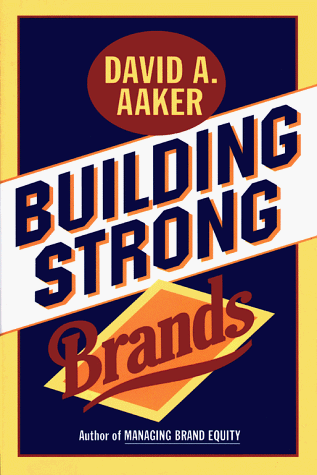
Nova: Absolutely not ignore them, Atlas. But what if we've got the cart before the horse? What if we're measuring the wrong things, or worse, optimizing for short-term gains at the expense of something far more valuable and enduring? Today, we're diving into the timeless wisdom of branding with foundational works like David A. Aaker's "Building Strong Brands" and Al Ries and Jack Trout's "Positioning: The Battle for Your Mind."
Atlas: Ah, the classics. I’m curious, what makes these books, some of them decades old, still so relevant in our hyper-digital, constantly shifting landscape?
Nova: That's a great question, and it speaks to their genius. Aaker, a pioneering marketing professor, essentially codified the language of brand identity. He gave us the vocabulary to understand a brand's essence, shaping how businesses think about their core being. It’s like he handed everyone the blueprint for building a soul for their company. And Ries and Trout, with their agency background, they sparked a revolution in how brands compete for mental real estate. They showed us it’s not just about what you sell, but the singular idea you own in a customer's mind. Their ideas are enduringly relevant because they tap into fundamental human psychology and competitive strategy, lessons that transcend any specific platform or fleeting trend.
Atlas: So, it’s about going deeper than the surface, beyond the click-through rates and conversion numbers. It’s about understanding the very fabric of perception.
Nova: Exactly. And to truly build something irresistible, something that lasts, you need to understand two critical dimensions: who you are internally, and how you're perceived externally. So, let's start with the internal. Imagine your brand isn't just a product or a service, but a living entity with its own personality, values, and purpose. That's where David A. Aaker comes in, with his powerful concept of brand identity.
The Inner Architecture of Brand Identity: Aaker's Foundation
SECTION
Nova: Aaker argues that a brand's identity is this core set of associations that define it. Think of it as the brand's DNA, the internal compass that guides every decision, every message, every interaction. It's not just a logo or a catchy slogan; it’s the fundamental promise, the unique character you want your audience to associate with you.
Atlas: Okay, so it’s like a person’s character. You don’t just you’re trustworthy; your actions, your decisions, your reputation you are. But how does this intangible 'character' translate into tangible marketing efforts for someone in a high-stakes, data-driven environment? How do you even begin to define something so… abstract?
Nova: That’s where the power lies, Atlas. It's about intentionality. Aaker breaks it down into different dimensions – brand as product, brand as organization, brand as person, and brand as symbol. But the key is coherence. When you have a clear, well-articulated identity, it ensures consistency and differentiation in what could otherwise be a chaotic, crowded market. Let me give you a classic example: Patagonia.
Atlas: Oh, I love Patagonia. Their gear is incredible.
Nova: And why do you love them? It's more than just the quality of the jackets, isn't it? Patagonia's brand identity is deeply rooted in environmental activism and sustainability. Their founder, Yvon Chouinard, built the company around these core values. The cause? A deep commitment to protecting nature. The process? This isn't just marketing fluff for them. They use recycled materials, they repair their clothes for free, they donate 1% of sales to environmental causes, and famously, they once ran an ad telling people to buy their jackets, encouraging repair instead.
Atlas: Right! I remember that. "Don't Buy This Jacket." It was so bold! It felt… authentic.
Nova: Exactly! The outcome? This unwavering identity guides every product decision, every campaign, even their business model. It creates fierce customer loyalty, even at premium prices, because their audience aligns with those deeper values. They're not just buying a jacket; they're buying into a movement.
Atlas: That’s actually really inspiring. But wait, looking at this from a strategic analyst's perspective, isn't that risky? To be so committed to one identity, especially in a world where consumer values can shift, or competitors might try to mimic your stance? How do they balance that long-term vision with, let's say, quarterly earnings reports?
Nova: That's the tension, isn't it? And it's precisely where Aaker's insights become critical. The of that identity is what allows them to weather those shifts. If your identity is clear and authentic, it acts as a filter. It helps you decide which trends to chase and which to ignore. It helps you pivot without losing your soul. It’s not about being rigid, but about having a strong core that allows for flexible adaptation without compromise. The short-term metrics might fluctuate, but the brand equity, the loyal customer base, the – those are long-term assets that become incredibly valuable.
Winning the Mind Share: Ries & Trout's Positioning Strategy
SECTION
Nova: And that naturally leads us to the second key idea we need to talk about, which often acts as the external manifestation of that internal identity: positioning. Once you know who you are, the next step is ensuring your audience knows who you are, and more importantly, why you matter more than anyone else. This is where Al Ries and Jack Trout's classic "Positioning: The Battle for Your Mind" becomes indispensable.
Atlas: I’ve been thinking about this. In a world saturated with information, where every brand is shouting for attention, how do you even begin to carve out a unique space? The idea of 'owning one thing' feels almost simplistic, or maybe even impossible, with so many complex products and services out there.
Nova: It seems simple, but it’s profoundly difficult to execute. Ries and Trout argue that marketing isn't a battle of products, it's a battle of perceptions. It’s about owning a single, powerful idea in the consumer's mind. Not a list of features, not a laundry list of benefits, but a clear, memorable concept that distinguishes you from every competitor.
Atlas: So you’re saying, it's about simplifying the message to an almost brutal degree?
Nova: Exactly. Think of it like this: your customer's mind is already crowded. To get in, you need to find an empty slot, or re-position a competitor to create one. The challenge for a leader is to identify that unique slot. Let's look at Volvo. For decades, what single word did they own in your mind?
Atlas: Safety. Definitely safety. My parents always drove Volvos because they were "the safest cars."
Nova: Precisely. Volvo didn't invent safety features, nor were they always the safe car. But they the concept of safety in the consumer's mind. Every advertisement, every design choice, every communication reinforced that single idea. The cause? A strategic decision to focus on a core benefit. The process? Consistent, relentless communication around that single concept. The outcome? They carved out an incredibly strong mental real estate, making them the automatic choice for safety-conscious buyers for generations.
Atlas: That’s a perfect example. And it highlights how just having a great product isn't enough; you need to control the narrative around it. But how do you, as a leader, identify brand's unique positioning? How do you avoid trying to be everything to everyone and dilute that powerful single idea?
Nova: It goes back to your identity, first and foremost. Your positioning should be an external expression of your internal truth. For leaders, it’s about rigorous self-assessment and competitive analysis. What is genuinely unique about your offering that your competitors authentically claim, or that they haven't explicitly claimed yet? It requires discipline to resist the urge to add more features or chase every market segment. It’s about saying no to a lot of good ideas, to focus on the one great idea that defines your space. Nova's take here is that focusing on these foundational brand principles allows you to create marketing that not only performs but also builds enduring value and customer loyalty. It’s the ultimate long-term strategy.
Synthesis & Takeaways
SECTION
Nova: So, what we’re really talking about today, Atlas, is the profound dance between brand identity and brand positioning. Identity is your internal compass, your authentic self, guiding every action. Positioning is your external map, the unique space you claim in the crowded minds of your audience. You need both. Without identity, positioning can feel hollow. Without positioning, a strong identity might never be truly understood.
Atlas: And this brings us right back to our initial challenge about metrics. If you have a clear identity and a strong positioning, your metrics become a reflection of that strength, not the sole dictators of your strategy. You're building something that resonates so deeply, that people are drawn to it, creating sustainable growth and loyalty that short-term optimization alone can never achieve. It shifts the conversation from chasing numbers to building meaningful connections.
Nova: Exactly. And for our listeners, especially those strategic analysts and future-proof innovators, here’s a tiny step you can take: Identify one core brand identity element you want your audience to associate with your product or service. Really distill it down to its essence. Then, think about your next campaign, your next communication. How can you embed that single, powerful element into it? How can you make sure it shines through, not just in what you say, but in what you?
Atlas: That’s actionable. It’s about being intentional, being focused, and leading with clarity. It's about making a significant mark, not just a fleeting impression.
Nova: Absolutely. It's about building a brand that isn't just seen, but deeply felt and remembered.
Atlas: This is Aibrary. Congratulations on your growth!