

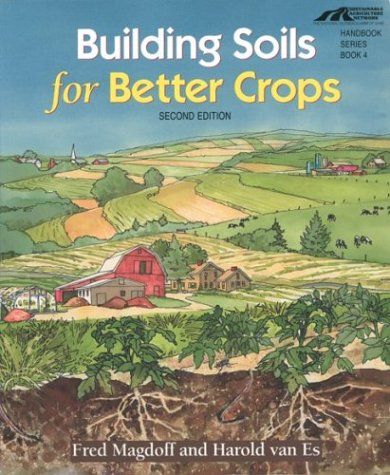
Building Soils for Better Crops
Introduction
Nova: Imagine holding a teaspoon of truly healthy soil in your hand. In that single spoonful, there are more living organisms than there are people on Earth. We're talking billions of bacteria, miles of fungal threads, thousands of protozoa, and dozens of nematodes — all working together in a hidden universe beneath our feet. That's the world Fred Magdoff and Harold van Es invite us into in their book "Building Soils for Better Crops."
Nova: That distinction — soil versus dirt — is actually central to the whole book. Fred Magdoff himself has said dirt is what you sweep off your floor. Soil is a living, breathing ecosystem. And this book, now in its fourth edition, has become something of a bible for farmers, gardeners, and anyone who wants to understand how to work with nature rather than against it.
Nova: What's remarkable is that this book started from a single focus — soil organic matter — and expanded over two decades into a comprehensive guide to ecological soil management. It's published by SARE, the Sustainable Agriculture Research and Education program at the USDA, and what's wonderful is that it's available as a free download. The authors are both heavyweights: Fred Magdoff, emeritus professor at the University of Vermont and a recipient of the Presidential Award from the Soil Science Society of America, and Harold van Es, professor at Cornell who literally co-developed one of the most widely used soil health tests in the country.
Nova: Exactly. And the core message is surprisingly simple: if you take care of the organic matter in your soil, the soil will take care of your crops. But as we'll discover, the how is where it gets fascinating. Let's dig in.
Why Organic Matter Is Everything
The Heart of the Matter
Nova: So let's start with the central thesis of the entire book. Magdoff and van Es argue that soil organic matter is quite literally the heart of soil health — and by extension, the heart of all agriculture. The first edition of this book focused exclusively on organic matter management, and for good reason.
Nova: That's such a key question, and I think the book answers it beautifully. Organic matter isn't just one thing among many — it's the engine that drives all the other processes. It feeds the soil organisms. It creates the sponge-like structure that holds water. It stores and slowly releases nutrients. It binds soil particles together so they resist erosion. The authors point out that the mineral particles and pore spaces form the basic structure of the soil, but organic matter is mostly what makes it fertile.
Nova: Precisely. And here's a striking statistic from the book: they note that many agricultural soils in the United States have lost 30 to 50 percent of their original organic matter through decades of intensive tillage and monoculture. Some have lost even more. This isn't just an academic concern — when organic matter drops, everything suffers. Water infiltration slows down, compaction increases, nutrient cycling breaks down, and crops become more vulnerable to drought and pests.
Nova: It varies by climate and soil type, but the book provides useful benchmarks. A sandy soil with 1 to 2 percent organic matter might be considered decent, while a silt loam might aim for 3 to 5 percent. The key insight is that it's not about hitting a magic number — it's about the trend. Are your management practices building organic matter or depleting it? And the authors are honest: they say it's not easy. Improving organic matter requires a sustained effort over years, not a quick fix.
Nova: Not at all. In fact, the book cautions against simplistic thinking throughout. They quote a wonderful Vermont saying from the mid-1900s: "Used to be anybody could farm. All you needed was a strong back, but nowadays you need a good education to understand all the advice you get so you can pick out what'll do you the least harm." The authors take that seriously — they refuse to give blanket recommendations because every field is different.
Understanding the Living Soil
The Underground Metropolis
Nova: Chapter four of the book is called "The Living Soil," and this is where things get genuinely mind-bending. The authors describe a world beneath our feet that most of us never think about — a complex food web involving bacteria, fungi, protozoa, nematodes, arthropods, and earthworms.
Nova: Because those nematodes are performing services you would otherwise have to pay for. Here's a concrete example from the book: mycorrhizal fungi form symbiotic relationships with about 80 percent of all plant species. These fungi extend thread-like hyphae far beyond the plant's root system, essentially acting as an extension of the root. They bring water and nutrients — especially phosphorus — to the plant, and in exchange, the plant feeds them carbon compounds produced through photosynthesis.
Nova: Exactly! And the book explains that these mycorrhizal networks don't just benefit individual plants — they can connect different plants together, creating what some researchers call a "wood wide web." The fungi also produce glomalin, a sticky protein that binds soil particles into aggregates, improving soil structure. When you till aggressively, you tear apart these fungal networks, and it can take months or even years for them to recover.
Nova: It really does. And then there are earthworms — the book's description of earthworms is almost affectionate. A healthy soil can contain a million earthworms per acre, and these creatures are ecosystem engineers. Their burrows create channels for water infiltration and root penetration. Their casts — essentially worm manure — are incredibly rich in plant-available nutrients. Darwin wrote an entire book about earthworms, and the authors clearly share his admiration.
Nova: A very good sign. But the book also makes an important point: earthworms are not native to all ecosystems — in some northern forests, for example, they can actually be invasive and harmful. Context matters, which is a running theme throughout.
Cover Crops, Reduced Tillage, Crop Rotation, and Livestock Integration
The Four Pillars of Ecological Soil Management
Nova: Let's get into the practical heart of the book — the management practices that actually build soil health. Magdoff and van Es organize these around four interconnected strategies: using cover crops, minimizing tillage, diversifying crop rotations, and integrating livestock.
Nova: Cover crops are plants grown not for harvest but to protect and improve the soil. And the chapter is fascinating because it shows cover crops aren't a modern invention — Chinese manuscripts describe green manures from over three thousand years ago, and the Romans used them extensively. The book quotes Columella from first-century Rome saying that lupines plowed into poor soil "will answer as well as the best manure."
Nova: Pretty much! And the modern data is compelling. The book cites a national cover crop survey from 2019 to 2020 involving over eleven hundred farmers across every U. S. state. In the drought year of 2012, farmers using cover crops saw soybean yields improve by 12 percent and corn yields by 10 percent compared to conventional fields. And here's the economic kicker: 41 percent of those farmers saved on herbicide costs for soybeans, and 49 percent saved on fertilizer costs for corn.
Nova: Multiple ways. Their roots hold soil in place, preventing erosion. Grasses like cereal rye can produce three to five tons of residue per acre, which builds organic matter. Legumes like hairy vetch and crimson clover fix nitrogen from the atmosphere — up to one hundred to two hundred pounds per acre. Deep-rooted crops like radishes break up compacted soil layers. And they provide habitat for beneficial insects and maintain mycorrhizal fungal populations between cash crop seasons.
Nova: The book devotes an entire chapter to this, and it includes a case study of Steve Groff, a farmer from Lancaster County, Pennsylvania, who pioneered no-till practices combined with cover crops. The core argument is that every time you till, you burn through organic matter by exposing it to oxygen and speeding up decomposition. You destroy earthworm burrows and fungal networks. You create plow pans — dense layers just below the tillage depth.
Nova: That's exactly the concern, and the book addresses it head-on. It's not about simply stopping tillage — it's about replacing the functions that tillage served with ecological alternatives. Cover crops can suppress weeds. Crop rotation breaks pest cycles. And the book profiles farmers who "plant green" — seeding their cash crop directly into a standing cover crop, then terminating the cover crop afterward. In that national survey, 52 percent of farmers were planting green on at least some of their fields, and 71 percent of them reported better weed control.
Nova: Diversifying cropping systems is chapter eleven, and it features a case study of Celia Barss, a farmer in Georgia. The principle is simple but powerful: different crops have different root structures, different nutrient demands, and different relationships with pests and diseases. A monoculture lets problems build up. A diverse rotation keeps everything in balance. The book emphasizes that diversity above ground creates diversity below ground.
Nova: This is chapter twelve, with a case study of Darrell Parks from Manhattan, Kansas. The idea is that separating crops and livestock — which modern industrial agriculture has done — breaks a natural nutrient cycle. Animals graze cover crops and crop residues, converting them into meat, milk, or wool while depositing manure that feeds the soil. It's a closed loop. The book presents this not as nostalgia for old-fashioned farming but as a sophisticated ecological strategy.
Farmer Case Studies and Real-World Results
From Theory to Practice
Nova: One of the most powerful features of the book is its case studies. These aren't hypothetical examples — they're real farmers who have transformed their operations using the principles in the book.
Nova: Gabe Brown farms in Bismarck, North Dakota, and his story is remarkable. He originally practiced conventional farming — tillage, monoculture, synthetic inputs. Then he hit a series of crises: multiple years of drought and hail that devastated his crops. He was on the brink of losing the farm. That's when he started experimenting with no-till, cover crops, and diverse rotations. Today, his soil organic matter has increased from less than 2 percent to over 6 percent in some fields. His water infiltration rates are extraordinary — his soils can absorb several inches of rain per hour while his neighbors' fields pond and run off.
Nova: It is. And it translates directly to resilience. When drought hits, his soil holds moisture longer. When heavy rains come, his fields absorb the water instead of eroding. The book frames this as the ultimate payoff of soil health: not just higher yields in good years, but survival in bad years.
Nova: Absolutely. There's Bob Muth in New Jersey, who runs a diversified vegetable operation. There's Cam Tabb in West Virginia, who uses compost extensively. And there's City Slicker Farms in Oakland, California — a newer case study from the fourth edition that addresses urban agriculture, which is an entirely new chapter in this edition. The book recognizes that soil health principles apply whether you're farming a thousand acres or a quarter-acre community garden.
Nova: It has, and the fourth edition reflects that. Urban soils come with unique challenges — contamination from lead and other heavy metals, compaction from construction, strange pH levels. The chapter provides specific guidance on testing, remediation, raised beds, and composting in urban settings. It's a recognition that soil health isn't just a rural issue.
Soil Health, Climate, and the Future of Agriculture
The Bigger Picture
Nova: Let's zoom out for a moment. The book makes a compelling case that soil health isn't just about growing better crops — it's connected to some of the biggest challenges we face as a species.
Nova: Exactly. The book discusses carbon cycling in detail. Soils are the second-largest carbon reservoir on Earth after the oceans. When we degrade soils through intensive tillage and poor management, we release that carbon into the atmosphere as carbon dioxide. But when we build soil organic matter, we're actually pulling carbon out of the atmosphere and storing it underground — what's now called carbon farming or regenerative agriculture.
Nova: That's the elegant alignment the book presents. The national cover crop survey found that cover crops sequester, on average, about 0.3 to 0.5 tons of carbon per acre per year. Multiply that across millions of acres and it becomes significant. Plus, healthier soils require less synthetic nitrogen fertilizer, which is manufactured using enormous amounts of fossil fuel.
Nova: Not at all. Magdoff and van Es are clear-eyed about the barriers. Transitioning to ecological soil management requires knowledge, patience, and often new equipment. There's a learning curve. Cover crop seed costs money. No-till planters are expensive. And the benefits aren't immediate — it can take three to five years to see significant changes in soil organic matter. The authors emphasize that good soil management is "knowledge intensive and needs to be adaptive."
Nova: Right, and that's why the book is organized around principles rather than prescriptions. The final chapter, "Putting It All Together," walks readers through a systematic approach: evaluate your current soil health, identify the most limiting factors, select practices that address those constraints, monitor the results, and adjust. It's a continuous improvement cycle.
Nova: The economics are compelling. The book cites data showing that farmers using cover crops save anywhere from 30 to 50 percent on fertilizer and herbicide costs, depending on the crop. In the horticulture sector, 58 percent of producers reported an increase in net profit from using cover crops. Only 4 percent saw any reduction in profit. When you combine input savings with yield stability during drought years, the financial case becomes very strong.
Conclusion
Nova: So where does all of this leave us? "Building Soils for Better Crops" makes a deceptively simple argument: healthy soil is the foundation of everything in agriculture, and soil organic matter is the foundation of healthy soil. From that single insight flows an entire system of ecological management.
Nova: That's beautifully put. And the book emphasizes that this isn't a fringe approach. The fourth edition notes that since the third edition was published in 2009, "the understanding and promotion of soil health and more holistic approaches to managing crops and soils has truly taken off." There are now major soil health initiatives by governments and NGOs across the United States and around the world.
Nova: It's been a cornerstone of it. With over 125 citations in academic literature and countless farmers who credit it with transforming their approach, this book has had an outsized impact. And because SARE makes it available as a free PDF, it's accessible to anyone with an internet connection — from a large-scale farmer in the Midwest to a community gardener in Oakland.
Nova: I'd say it's this: the difference between dirt and soil is life. The management choices we make — whether we till or don't till, whether we keep the ground covered or leave it bare, whether we grow one crop or many — determine whether we're building a living ecosystem or slowly destroying one. The good news, as Magdoff and van Es demonstrate across nearly four hundred pages of practical wisdom, is that soil can heal. It wants to heal. We just need to learn how to help.
Nova: Not a bad deal at all. This is Aibrary. Congratulations on your growth!