Crafting Your Disruption Narrative: The Art of Strategic Storytelling
Golden Hook & Introduction
SECTION
Nova: Atlas, if I asked you to sum up the biggest reason why even brilliant disruptive ideas often fizzle out, what's the first thing that comes to mind?
Atlas: Oh man, that's a good one. My gut reaction, for someone trying to build a movement, is usually a lack of funding, or maybe the wrong team. Something tangible like that.
Nova: Interesting. What if I told you it's often something far more fundamental, something that money can't just buy, nor can a perfect team compensate for if it's missing?
Atlas: Okay, now you've got my attention. You're saying it's not the resources, it's something else entirely? What could be more critical than having the right people or the capital to execute?
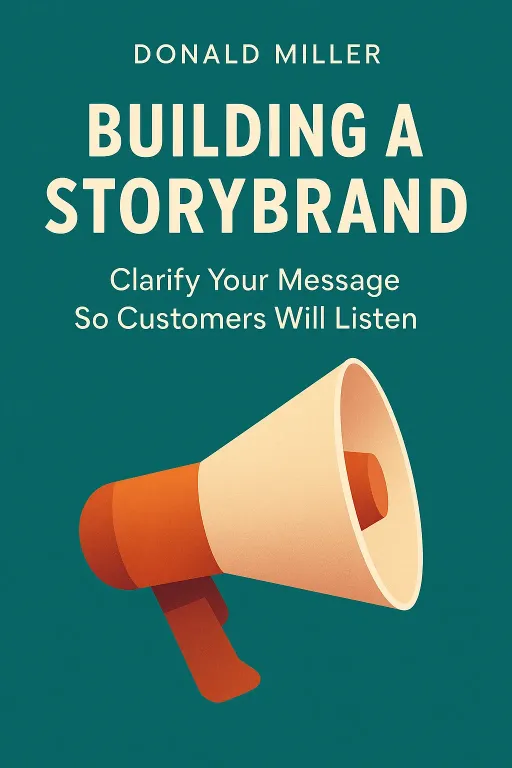
Nova: It's the story, Atlas. The narrative. And that's precisely why today we're diving into the profound insights of two seminal works: Donald Miller's "Building a StoryBrand" and Simon Sinek's "Start with Why." Both of these authors, in their own unique ways, illuminate how crafting your disruption narrative is the ultimate art of strategic storytelling. Miller, for instance, came from a background as a novelist and screenwriter, which gave him this incredible lens to see business communication not as a dry exchange of facts, but as a compelling human drama. He realized that the same narrative principles that captivate an audience in a movie theater could transform how businesses connect with their customers.
Atlas: That's a fascinating origin story for a business book. So he basically took Hollywood storytelling and applied it to… well, everything?
Nova: Exactly. He saw that if you want to disrupt, you first need to captivate. And that leads us directly into our first big idea: the narrative as the very architecture of disruption itself.
The Narrative as Architecture of Disruption
SECTION
Nova: Think about it this way: a disruptive venture isn't just a product or a service; it's a new way of seeing the world, a new solution to an old problem, or even a new problem altogether that no one realized they had. How do you convey that seismic shift without a compelling story? Miller's core insight in "Building a StoryBrand" is that clarity is kindness. He argues that most companies confuse their customers by talking about themselves, their features, their process. But customers don't care about your story; they care about story, and how you fit into it.
Atlas: So, if I'm a disruptor, I shouldn't be shouting about my innovative tech or my brilliant team? I should be talking about the customer's struggle and how I'm the guide to their success? That feels almost counterintuitive when you're so excited about what you've built.
Nova: It absolutely is, and that's the genius of it. You see, the hero of the story is always the customer. Your disruptive company is merely the wise guide, the Obi-Wan Kenobi, if you will, who helps the hero overcome their challenges. Miller breaks it down into seven universal story points: a character who wants something, encounters a problem, meets a guide, who gives them a plan, calls them to action, and helps them avoid failure and achieve success. It's a template that's been used in countless blockbusters and, he argues, should be the blueprint for your business.
Atlas: So, essentially, instead of saying, "We have the most advanced AI-powered widget," I should be saying, "Are you tired of wasting hours on X? Our widget helps you reclaim your time and focus on what truly matters." That's a huge shift in perspective.
Nova: Exactly! Let me give you a classic example, though not from Miller's book, it perfectly illustrates his point. Think about Apple in its early days. When they launched the iPod, they didn't just say, "Here's a portable digital music player with 5GB of storage." They said, "1,000 songs in your pocket." They understood the customer's desire—to carry their entire music library with them—and positioned the iPod as the magical solution. They were the guide, and the customer was the hero, suddenly empowered with endless music, anywhere. That's a disruptive narrative built on the customer's desire.
Atlas: Wow, that's incredibly powerful. It makes me think about how many incredible innovations probably died on the vine because they couldn't articulate their value in a way that resonated. It's like having the cure for a disease but not being able to explain what it does in simple terms.
Nova: Precisely. And this isn't just about external marketing. Miller emphasizes that this clear narrative is the architecture of your entire disruption. It unifies your team, too. Everyone, from the engineers to customer service, understands the core story, the hero's journey they are enabling. This internal alignment is crucial for any truly disruptive movement. It builds a shared purpose.
Atlas: So, a clear story isn't just for attracting customers, it's for rallying the troops internally. It creates a cohesive vision that everyone can buy into. That's actually a huge insight for anyone trying to build something new, especially for our listeners who are aiming to build movements, not just products.
Nova: Absolutely. And this brings us beautifully to our second core idea, which dives even deeper into that concept of shared purpose: the profound power of 'starting with why.'
Inspiring Action: The Power of 'Why'
SECTION
Nova: Simon Sinek, in "Start with Why," takes this narrative concept to another level. While Miller gives you the template for to tell your story, Sinek illuminates that story should fundamentally be about: your purpose. He introduces the Golden Circle: Why, How, What. Most companies communicate from the outside-in: they say what they do, then how they do it, and maybe, if they get around to it, why. But inspired leaders and disruptive movements communicate from the inside-out, starting with the Why.
Atlas: So he's saying that the 'what' and the 'how' are just the manifestations of a deeper 'why'? And that 'why' is what truly connects with people?
Nova: Exactly. Sinek argues that people don't buy you do; they buy you do it. Our limbic brain, which controls feelings and decision-making, responds to the 'why.' The neocortex, which handles rational thought and language, processes the 'what' and 'how.' When you start with 'why,' you're speaking directly to that deeper, emotional part of the brain that drives loyalty and inspires action. It's not about logic; it's about belief.
Atlas: That's a really profound point. It explains why some brands or leaders just resonate so deeply, even if their products aren't necessarily superior on paper. They're tapping into something more primal.
Nova: Think about Martin Luther King Jr. He didn't stand up and say, "I have a plan to change legislation." He said, "I have a dream." He articulated a powerful 'why'—a vision of equality and justice—and millions rallied behind that purpose. The 'what' became the civil rights movement, the protests, the legislative changes. But it all started with the 'why.' That's a true disruptive movement, driven by an inspiring purpose.
Atlas: That's an incredible example. It shows how the 'why' isn't just for business, it's for any kind of movement or leadership. For our listeners who are trying to build truly disruptive companies, they're not just selling a product; they're trying to sell a vision of a better future.
Nova: Precisely. And Sinek connects this to biology. He points out that when we communicate from the outside-in, we're talking to the rational part of the brain. But when we communicate from the inside-out, starting with 'why,' we're talking to the part of the brain that controls behavior. It's why we're drawn to things that align with our gut feelings. It's why some people will wait in line for hours for a new product from a company they believe in, even if a competitor offers something similar.
Atlas: So, it's about building a sense of belonging, a shared belief system, around your disruptive idea. It's not just about features and benefits; it's about values and purpose.
Nova: Absolutely. And for disruptors, this is non-negotiable. You’re asking people to step out of their comfort zones, to try something new, to abandon old ways. That requires trust and belief, which only a clear 'why' can inspire. If your internal team doesn't understand your 'why,' they'll be working towards a paycheck, not a purpose. If your external stakeholders don't get it, they'll see a product, not a movement.
Atlas: That makes perfect sense. It unifies both the internal team and the external market under one banner. It’s the ultimate strategic storytelling.
Synthesis & Takeaways
SECTION
Nova: So, bringing these two powerful ideas together, we see that crafting your disruption narrative isn't a luxury; it's a strategic imperative. Donald Miller shows us how to structure that narrative so the customer is the hero and your solution is the guide, making your message crystal clear. Simon Sinek then tells us that the heart of that narrative, the very fuel that inspires action and builds movements, must be your 'why.'
Atlas: It’s like Miller gives you the blueprint for the house, and Sinek tells you what kind of family is going to live there and what their values are. Without both, you might build something, but it won't be a home, it won't be a movement that truly resonates.
Nova: Exactly. Imagine a disruptive startup that has an incredible technical innovation, but they can't clearly articulate the customer's problem or their solution in a compelling way. They're just talking features. Then, even if they manage to get some traction, if they don't have a clear 'why'—a purpose beyond just making money—they'll struggle to inspire loyalty from their team or their early adopters. They won't build a movement; they'll just build a product.
Atlas: That's actually really inspiring. It means that even if you don't have infinite resources, if you can master your story and articulate your 'why,' you have a powerful tool for true disruption. It's not about the size of your budget; it's about the clarity and conviction of your message.
Nova: Precisely. The tiny step we recommend for our listeners is to draft a one-page 'StoryBrand' for their current venture. Clearly define their hero, their problem, their solution, and the success they offer. This simple exercise can be incredibly clarifying. And the deep question to ponder is: How effectively does your current narrative communicate your 'why' to both your internal team and external stakeholders? Is it inspiring belief, or just conveying information?
Atlas: That's a challenge everyone should take up. Because if you can't tell your story, you can't build your movement. It’s about building genuine impact, for users and for teams.
Nova: Absolutely. Understanding these principles means moving beyond just building a better mousetrap to building a better world, one compelling story at a time. It’s about igniting that passion, that purpose, and truly creating something lasting.
Atlas: That’s a powerful call to action. Take the time to craft your narrative, to find your 'why.' It's the architecture of your disruption.
Nova: This is Aibrary. Congratulations on your growth!