Strategic Resilience in Economic Volatility
Golden Hook & Introduction
SECTION
Nova: Forget everything you think you know about "growth at all costs." In today's economic landscape, true resilience isn't just about scaling up; it's about a strategic double-vision that could single-handedly save your business.
Atlas: Whoa, Nova. A strategic double-vision? That sounds like something out of a spy movie, but for my balance sheet. Are we talking about a new kind of business superpower? Because honestly, trying to grow survive in this market feels less like a superpower and more like trying to juggle flaming chainsaws.
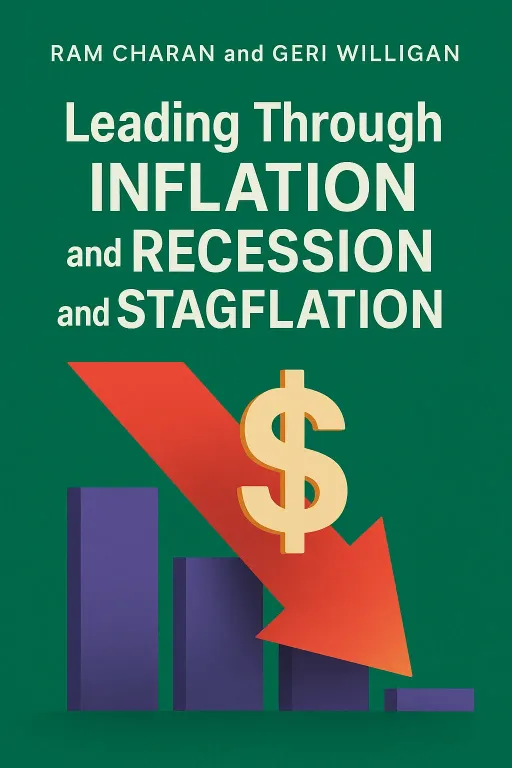
Nova: It absolutely is a superpower, Atlas, and it’s one that two incredibly insightful thinkers have laid out for us. Today, we're diving into the urgent wisdom of Ram Charan's "Leading Through Inflation and Recession and Stagflation." Charan, for those unfamiliar, is practically a household name in Fortune 500 boardrooms, a legendary advisor to CEOs who distills complex business challenges into surprisingly direct, actionable strategies. He's seen it all, and he's not one to sugarcoat.
Atlas: Right, so Charan gives us the immediate, gritty survival guide. But that's only half the story, isn't it? Because while we're fighting today's fires, the whole world is still hurtling towards tomorrow. And that's where Alan Trefler's "Build for Change" comes in. Trefler, as the founder and CEO of Pegasystems, a company that literally builds the software for business process management, knows a thing or two about the internal machinery of change. He’s arguing that if your internal processes aren't evolving faster than customer expectations, you're already behind.
Nova: Exactly! And the core takeaway, the profound insight we’re exploring, is that true resilience demands both. It’s about protecting your cash flow today while aggressively re-engineering your customer engagement for tomorrow's technology. It's a delicate, high-stakes dance.
Core Topic 1: The Cash Flow Imperative & Pricing Agility
SECTION
Nova: So, let's start with Ram Charan’s urgent message. He argues that in times of radical market shifts—think inflation, recession, stagflation—cash management and pricing agility aren't just good practices; they are the ways to survive. Many businesses are so focused on top-line growth, on expanding, that they forget the absolute bedrock: cash.
Atlas: I know that feeling. For a lot of strategists and builders, the instinct is always to push forward, to innovate, to capture market share. But what does Charan mean by "cash management" beyond just, you know, having cash in the bank? Isn’t that just being overly conservative when you should be investing for growth?
Nova: That’s a great question, Atlas, and it gets to the heart of Charan’s pragmatism. He’s not advocating for hoarding cash and doing nothing. He's advocating for understanding your cash conversion cycle with surgical precision. It's about aggressively managing working capital – your inventory, your accounts receivable, your accounts payable. He often highlights businesses that got into trouble not because they weren't profitable, but because they ran out of cash. Profit is a theory; cash is reality.
Atlas: Okay, so it’s less about being conservative and more about being incredibly efficient with every dollar flowing in and out. Can you give us an example of how a business might apply this?
Nova: Absolutely. Imagine a mid-sized manufacturing company, let's call them "Precision Parts Inc." They’ve always prided themselves on growth and market share, often taking on large inventory to meet anticipated demand, and offering generous payment terms to big clients. When inflation hits, their raw material costs skyrocket, and interest rates climb. Their traditional profit margins start to evaporate, even though sales volume is steady.
Atlas: So they’re selling more, but bleeding cash. I can see how that happens when input costs go up.
Nova: Exactly. Charan would advise Precision Parts to immediately set up a "cash-flow war room." They'd scrutinize every line item. Instead of holding three months of inventory, they'd push for just-in-time delivery, even if it means slightly higher unit costs in some cases, because the carrying cost of bloated inventory is now a killer. They'd renegotiate payment terms with suppliers and collect receivables from customers, perhaps offering early payment discounts.
Atlas: That makes sense. It’s about making the cash work harder, turning it over faster. But what about "pricing agility"? For a builder focused on scalable success, wouldn’t constantly changing prices alienate customers?
Nova: That’s the common fear, but Charan argues it’s a misunderstanding of value. Pricing agility isn't just about hiking prices across the board. It’s about understanding the true value proposition for different customer segments and being able to adjust quickly. For Precision Parts, it might mean creating tiered service levels, or introducing new, slightly different products at different price points. It’s about being able to raise prices on premium products where value is high and customers are less price-sensitive, while perhaps holding prices or even discounting for volume clients on standardized components.
Atlas: So it's not just a blanket price increase, it's a dynamic strategy based on actual value perception and cost structures. That's a crucial distinction. It protects margins without necessarily losing market share, or even increasing it for some segments. It allows you to protect your financial acumen, which is vital for sustainable growth.
Nova: Precisely. It’s a deep understanding of your cost structure and your customer’s willingness to pay, allowing you to adapt faster than your competitors. Charan’s point is that if you master this, you don't just survive; you can actually gain ground while others are floundering.
Core Topic 2: Re-engineering for Tomorrow's Customer
SECTION
Nova: But here’s the crucial pivot, Atlas. While safeguarding today's cash is absolutely critical, Charan's vision is only half the story. The other half, as Alan Trefler argues in "Build for Change," is aggressively re-engineering for tomorrow. Because even if you’re a cash-flow wizard today, if your internal systems are stuck in the past, you'll be obsolete tomorrow.
Atlas: That’s a powerful point. For someone who analyzes business models and builds efficient systems, the idea of "rewriting internal software and processes" before they become obsolete really resonates. Customer expectations are a moving target, aren't they? It feels like what was cutting-edge last year is already just "expected" today.
Nova: They're not just moving, Atlas; they're accelerating exponentially. Trefler's core premise is that the speed of technological change, combined with evolving customer demands, means businesses can no longer afford incremental improvements. You can’t just patch over old systems; you have to fundamentally rethink and rebuild your operational core.
Atlas: So, what does this radical re-engineering actually look like in practice for a company? Because "rewriting internal software" sounds like a multi-year, multi-million-dollar nightmare that could bring a company to its knees, especially if they’re simultaneously trying to manage cash flow.
Nova: That’s the challenge, and it's why Trefler emphasizes the in building for change. Think of a large, established financial institution, "Global Bank Corp." For decades, they’ve added new products and services by bolting them onto an aging, complex IT infrastructure. Their customers, however, now expect the seamless, personalized experience they get from fintech startups – instant loan approvals, hyper-customized investment advice, proactive alerts, and a single, intuitive app for everything.
Atlas: I know exactly what you mean. Their customers are comparing them not to other banks, but to Amazon or Netflix. The internal systems, though, are probably a patchwork of different programming languages and databases from the 80s and 90s.
Nova: Precisely. Global Bank Corp. realizes that their legacy systems are not just inefficient; they're a massive liability preventing them from meeting customer expectations. Instead of attempting another costly, years-long "digital transformation" project that just tries to modernize the old, Trefler would argue for a radical re-engineering. This means adopting modern low-code/no-code platforms, leveraging AI and machine learning to automate decisions, and designing processes around the rather than internal departmental silos.
Atlas: So it's not just about updating tech, it's about fundamentally redesigning the of work, the way decisions are made, and how the customer interacts with the entire system. That impacts team dynamics, too; it’s a complete cultural shift.
Nova: Absolutely. It empowers front-line employees to adapt processes on the fly, to configure solutions without needing to be expert coders. The outcome for Global Bank Corp. is that they can launch new, personalized products in weeks instead of months, offer truly proactive customer service, and deliver a seamless digital experience that not only retains existing customers but attracts a new generation. They build a competitive moat not just with their products, but with their unparalleled agility.
Atlas: That’s incredible. It's about shifting from a rigid, "this is how we've always done it" mindset to one where change is built into the very DNA of the organization. It’s building for continuous evolution, not just a one-time overhaul. And that directly fuels business model innovation and sustainable growth.
Synthesis & Takeaways
SECTION
Nova: So, you see the synergy, Atlas? Charan tells us how to keep the patient alive today, focusing on the vital signs of cash and agile pricing. Trefler tells us how to completely rebuild the patient’s internal organs so they can run a marathon tomorrow. It's the ultimate "double-vision" for strategic resilience.
Atlas: It’s not an either/or, then. You can’t re-engineer for tomorrow if you run out of cash today, and you can’t just protect cash today if you’re becoming irrelevant for tomorrow. It's a continuous, simultaneous effort. For our listeners who are strategists, builders, and visionaries, constantly seeking to innovate business models and fuel sustainable growth, what’s one concrete step they can take to start cultivating this "double-vision"?
Nova: Here’s a pragmatic one. Right now, schedule a weekly 30-minute "Double-Vision Deep Dive" with your core team. For the first 15 minutes, focus on Charan’s cash imperative: review your cash conversion cycle, identify one bottleneck in receivables or inventory, and strategize a solution. For the next 15 minutes, shift to Trefler’s vision: discuss one customer expectation that's rapidly evolving and brainstorm how your internal processes would need to radically change to meet it, not just patch it.
Atlas: That’s brilliant, Nova. It’s a structured way to embrace iterative learning and tackle strategic challenges head-on, ensuring you're not just reacting, but proactively building resilience. It’s about making sure your financial acumen is sharp, and your team dynamics are geared for change.
Nova: Exactly. Because true resilience isn't about weathering a storm; it's about being strong enough to thrive and the storm, by simultaneously protecting your present and aggressively building your future.
Atlas: That’s a powerful call to action. Thanks, Nova, for illuminating these crucial insights.
Nova: My pleasure, Atlas.
Nova: This is Aibrary. Congratulations on your growth!