

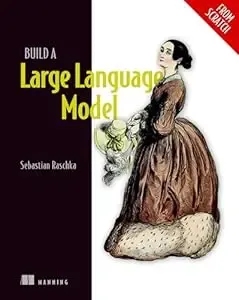
Build a Large Language Model (from Scratch)
Introduction
Nova: What if I told you that you could build your own ChatGPT — not by calling an API, not by fine-tuning someone else's model — but by coding every single component from the ground up, on your laptop, in Python? That's exactly what Sebastian Raschka's book promises: Build a Large Language Model from Scratch. And it's not just a promise. It's a 368-page guided journey that has racked up a 4.6-star rating on Goodreads from over 340 readers and spawned a GitHub repository that's been forked more than 10,000 times.
Nova: That's the beautiful misconception the book shatters. You're not building GPT-4 with its rumored 1.7 trillion parameters. You're building a GPT-2-class model — around 124 million parameters — which was the state of the art in 2019 and is still genuinely capable of producing coherent English text. And here's the key: the architecture you learn to build is fundamentally the same. Scale up the data, scale up the layers, add some engineering magic, and you're looking at the same family tree that leads to the models making headlines today.
Nova: Exactly. Raschka channels Richard Feynman's famous principle — I don't understand anything I can't build — and turns it into a relentlessly practical, code-driven curriculum. Today we're going inside this book: what it covers, who it's for, whether it actually delivers, and why in an era of instant access to massive models, anyone should still bother building their own miniature version. I'm Nova.
The Author Behind the Book
Meet Your Guide: Sebastian Raschka and the Feynman Philosophy
Nova: Before we dive into the chapters, let's talk about who wrote this thing. Sebastian Raschka is not just someone who read a few papers and decided to write a book. He has spent over a decade in machine learning and AI — he was a statistics professor at the University of Wisconsin-Madison, he's now a Staff Research Engineer at Lightning AI, and he's the author of multiple bestselling books including Machine Learning with PyTorch and Scikit-Learn. He literally lives and breathes this stuff.
Nova: He really has. His Substack newsletter Ahead of AI is widely read in the research community, he publishes these incredibly clear standalone articles — things like Self-Attention from Scratch, BPE Tokenizer from Scratch, KV Cache from Scratch — and he runs a free 48-part live-coding video series on YouTube that mirrors the book chapter by chapter. We're talking 17-plus hours of content. All freely available.
Nova: That's exactly right. And the philosophy behind all of it — the book, the videos, the code repo, the architecture concept guides — is that quote from physicist Richard Feynman: I don't understand anything I can't build. Raschka explicitly invokes this in the book's framing. His argument is that if you only interact with LLMs through APIs — you know, sending prompts to OpenAI or Anthropic — you're fundamentally treating them as magic. You don't know why they hallucinate. You don't know what attention does. You don't know what's happening during fine-tuning.
Nova: And that's the audience. Raschka is writing for the ML engineer who wants to stop being a tourist and start being a cartographer. The prerequisites are refreshingly modest: intermediate Python, some familiarity with machine learning concepts, and ideally a bit of PyTorch — though Appendix A is literally a PyTorch crash course for anyone who needs it.
Nova: Fair skepticism. But consider this: by the end of Chapter 7, you have built a model that can generate coherent paragraphs, classify spam, and follow conversational instructions — just like a miniature ChatGPT. And every single line of code that made that possible, you wrote yourself. That's not shallow. That's building the entire engine, not just kicking the tires.
What's Inside the Book
The Architecture of Understanding: Chapter by Chapter
Nova: Let's walk through what this journey actually looks like. The book has seven core chapters and five appendices, and the progression is deliberately cumulative — each chapter builds machinery that the next chapter depends on.
Nova: Chapter 1 is the aerial view. No code — just a high-level orientation to what LLMs are, how the transformer architecture works at a conceptual level, and what the full model-building path looks like. Think of it as looking at the map before you start hiking. Raschka introduces the big ideas: autoregressive generation, the decoder-only GPT architecture, pretraining versus fine-tuning.
Nova: Immediately. Chapter 2 is called Working with Text Data, and it tackles the first real engineering challenge: how do you turn raw text into something a neural network can digest? You learn about tokenization, particularly byte pair encoding — BPE — which is the same algorithm used by GPT-2 through GPT-4. You learn about text embeddings, how to construct input-target pairs for training, and you implement a data loader. It's unglamorous work, but it's the foundation everything else rests on.
Nova: Chapter 3 is arguably the heart of the entire book. It's called Coding Attention Mechanisms, and this is where readers often report the steepest learning curve — but also the biggest aha moments. You implement self-attention from scratch. Then causal attention — the version where a token can only attend to previous tokens, not future ones, which is essential for autoregressive generation. Then you scale up to multi-head attention, where the model learns to pay attention to different aspects of the input simultaneously. And finally, you assemble these into complete transformer blocks.
Nova: That's a great call-out. The book doesn't shy away from the math. You need basic linear algebra — matrix multiplication, understanding what dimensions mean. One Medium reviewer noted that on an Apple M3 Pro, some computations even produced slightly different numerical results from the book, which is a gentle reminder that floating-point precision matters at this level of detail.
Nova: Exactly. Chapter 4 is Implementing a GPT Model from Scratch. You take the transformer blocks from Chapter 3, you stack them into the full decoder-only architecture, you add layer normalization and the other architectural details that make GPT work, and you produce a complete, functioning model class. At this point you have something that structurally looks like GPT-2. It just doesn't know anything yet because it hasn't been trained.
Nova: Chapter 5: Pretraining on Unlabeled Data. This is where the magic starts. You feed the model a corpus of text — the book uses a public-domain dataset to keep things accessible — and you train it to predict the next token. You implement the loss functions, the training loop, and eventually a text generation function with different sampling strategies like temperature and top-k sampling. By the end of this chapter, your model produces actual, coherent English sentences. It's not Shakespeare, but it's not gibberish either. And importantly, you can save and load your model weights.
Nova: Yes, and this is where many readers say the book really distinguishes itself. Chapter 6 covers classification fine-tuning — you take your pretrained model and adapt it to classify text, like detecting spam. Chapter 7 is instruction fine-tuning: teaching the model to follow conversational instructions, which is what makes ChatGPT feel like a helpful assistant rather than a text-completion engine. You format prompts, you implement the training objective, and by the end you have something that genuinely behaves like a miniature chatbot.
Nova: Appendix A is your PyTorch primer. Appendix D adds practical training-loop refinements like learning-rate schedules. And Appendix E — which multiple reviewers called a must-read — covers parameter-efficient fine-tuning with LoRA, which is the technique that makes it possible to adapt large models without retraining everything from scratch. There's also a free 170-page PDF called Test Yourself with about 30 quiz questions per chapter.
Reader Experience and Prerequisites
The Honest Assessment: Who Should Read This Book and What to Expect
Nova: Let's talk candidly about who this book is actually for and what the experience is really like — because it's not for everyone, and that's important to say upfront.
Nova: If you're looking for a conceptual overview — a book that explains LLMs at the dinner-party level with analogies and no code — this is not that book. Every chapter from Chapter 2 onward requires you to read, understand, and ideally type out Python code. One reviewer on DEV Community described it as very informative but somewhat intensive and noted that because the explanations are so detailed, reading through the book may take more time than you expect given its length.
Nova: Absolutely. The book is about 368 pages, but the density of information is high. Raschka himself recommends a specific study method: read the chapter first without coding, then optionally watch the companion video, then retype and run the code, then attempt the exercises at the end. That's a serious commitment. One Medium reviewer said it took them two weeks of dedicated work to get through the whole thing.
Nova: You need comfort with basic linear algebra — matrix multiplication, understanding what tensor dimensions mean, that sort of thing. You don't need calculus or advanced probability. But the attention mechanism implementation in Chapter 3 involves some reasonably intricate tensor operations. As one reviewer put it: complex tensor multiplications could be somewhat confusing, and you should keep track of the dimension of each nn. Linear layer. It's not graduate-level math, but it's not nothing either.
Nova: It's genuinely realistic — with an asterisk. The main chapter code is designed to run on conventional laptops within a reasonable time frame. The book's companion GitHub repo explicitly says it does not require specialized hardware. However, one reviewer using a Mac M3 Pro noted that they'd recommend Google Colab or similar cloud services for a smoother experience, especially since the MPS backend on Apple silicon produced slightly different numerical results in some cases.
Nova: Exactly. And the code automatically uses GPUs if they're available, so you're not stuck on CPU if you have access to something better.
Nova: The sweet spot is the ML engineer or advanced student who's comfortable with Python, has maybe trained a neural network before, and feels frustrated by the black-box nature of modern LLMs. These are people who've used the OpenAI API, maybe fine-tuned a model through Hugging Face, and now want to understand what's actually happening under the hood. The testimonials are striking — one reader called it the best technical book I have ever studied by a large margin. Another said it was truly inspirational, motivating you to put your new skills into action.
Nova: Yes, and that's a really useful framing. One reviewer described the book as a condensed remix of Karpathy's series — but with the crucial addition of the fine-tuning chapters, including instruction fine-tuning and LoRA, which Karpathy hasn't covered. If you've watched Karpathy's videos and want the same material in a structured, written format with exercises and solutions, this book is essentially that. Plus it goes further.
Nova: That's what makes this unusual as a book purchase. You're not just buying 368 pages. You're buying access to a GitHub repository with all the code, a 17-hour video course, a 170-page test-yourself PDF, and a whole set of architecture concept guides that connect the book's simplified implementation to real production architectures — things like grouped-query attention, mixture of experts, sliding-window attention, and modern models like Llama 3.2, Qwen3, and Gemma 3. Raschka has essentially built a curriculum that keeps expanding.
The Bigger Argument
Why Build When You Can Download? The Case for From-Scratch Learning
Nova: There's a deeper question lurking beneath this whole conversation, and I think we should tackle it head-on. In a world where you can download Llama 3 or Mistral or Qwen with a single command, where Hugging Face gives you thousands of pretrained models, and where you can fine-tune with a dozen lines of code — why would anyone spend weeks building a tiny GPT-2 clone from scratch?
Nova: And yet the people who do it report something transformative. Let me read you a quote from a reader: I got a serious closeup look at what goes on inside an LLM. Another said: If you want to become a top-tier ML AI Engineer, you need to understand what's going on under the hood.
Nova: Several things. First, debugging intuition. When you've implemented attention yourself, you know exactly why a model might produce nonsensical output at certain sequence lengths. You know what the KV cache actually stores and why it matters for inference speed. You understand why certain tokenization choices lead to certain failure modes. These aren't theoretical insights — they're earned through the frustration of making things work.
Nova: Exactly. Second, it demystifies the hype. When you've built a transformer, you realize that an LLM is not a thinking entity. It's a next-token prediction machine with a clever architecture and a lot of data. That clarity is valuable when you're making engineering decisions — you stop anthropomorphizing the model and start reasoning about it as a system.
Nova: Third, and this is where the book really shines, you learn the full pipeline. Most ML education focuses on model architecture in isolation. Raschka forces you to do the unglamorous work: data preparation, tokenization, constructing input-target pairs, designing the training loop, implementing loss functions, handling sampling strategies during generation. These are the parts that matter in production and that API-only users never touch.
Nova: And Raschka has explicitly built bridges to those modern variants. The book's companion website has concept guides that explain how the simplified implementation connects to grouped-query attention, multi-head latent attention, sliding-window attention, and mixture-of-experts layers. He even has from-scratch implementations of Llama 3.2 and Qwen3 in the bonus materials.
Nova: That's exactly how he frames it. After finishing the book, Raschka points readers to his follow-up: Build a Reasoning Model from Scratch, which covers inference-time scaling, reinforcement learning, and distillation. The idea is that you understand the base model first, then you learn how to make it reason. It's a deliberate, cumulative curriculum.
Nova: One reviewer called it eminently satisfying, and I think that's exactly right. There's a difference between using a tool and understanding the tool. Raschka's book is for people who want the latter.
Conclusion
Nova: So let's pull the threads together. Sebastian Raschka's Build a Large Language Model from Scratch is not a casual read. It's a demanding, hands-on, code-heavy journey that asks you to build a GPT-2-class model piece by piece — from tokenization through attention through pretraining through instruction fine-tuning. If you show up and do the work, you walk away with something rare: genuine, first-principles understanding of how modern language models function.
Nova: The Feynman principle at the core — I don't understand anything I can't build — turns out to be more than a slogan. It's a methodology. And in an era where AI is increasingly treated as a service you subscribe to rather than a technology you understand, that methodology feels almost radical. Building your own LLM is an act of intellectual independence.
Nova: Second, use the full ecosystem. Don't just read the book — follow the study guide. Read a chapter, watch the companion video, type out the code, attempt the exercises. The GitHub repo, the test-yourself PDF, and the architecture concept guides are not optional extras. They're the difference between passive reading and active learning.
Nova: And perhaps the biggest takeaway: understanding matters. In a field that moves as fast as AI, specific frameworks and APIs come and go. But if you understand attention, if you understand pretraining dynamics, if you understand what happens during fine-tuning — those are permanent assets. You're not learning a product. You're learning principles.
Nova: This is Aibrary. Congratulations on your growth!