

Neuroscience for L&D: Brain-Friendly Learning
Golden Hook & Introduction
SECTION
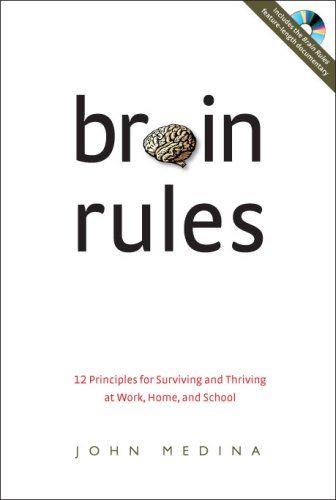
Nova: Atlas, I’ve got a challenge for you. We’re diving into a book today that has profoundly shaped our understanding of learning. If you had to review John Medina’s Brain Rules: 12 Principles for Surviving and Thriving at Work, Home, and School in exactly five words, what would they be?
Atlas: Ooh, five words? That’s tough for something so comprehensive. Okay, I’ve got it: "Your brain's secret owner's manual."
Nova: Your brain’s secret owner’s manual! I love that. It perfectly captures what Medina set out to do. For those unfamiliar, John Medina is a developmental molecular biologist, and he’s got this incredible knack for taking complex neuroscience and making it not just digestible, but genuinely entertaining. He’s often compared to a stand-up comedian for his lively presentation style, and that energy absolutely pours into his writing.
Atlas: He really does. He makes you realize that our brains aren't just these squishy, mysterious organs; they have rules, a clear operating system. And for far too long, we've been designing our learning environments, our workplaces, even our homes, against that very system. No wonder we're all so frustrated sometimes!
Nova: Exactly! It’s like buying a high-performance sports car but trying to fuel it with diesel. You’re missing out on its true potential. And that brings us to our first deep dive today: "Brain Rules: The Operating System of Learning." It's about understanding how our brains are fundamentally wired for wisdom.
Brain Rules: The Operating System of Learning
SECTION
Nova: So, let’s start with this concept of "Wiring for Wisdom." Medina argues that our brains aren't passive receptacles for information. They have a natural, evolutionary design that dictates how we best learn, remember, and pay attention. He distills this into a set of principles, and honestly, many of them fly in the face of traditional educational practices.
Atlas: That’s fascinating. I imagine a lot of our listeners, especially those building learning programs, are constantly thinking about information delivery. But how often do we actually stop to consider the of that information – the brain itself? What’s one of these foundational "rules" that you think is most commonly ignored?
Nova: A huge one, and it’s almost painfully simple, is the brain’s need for movement. Medina dedicates a significant portion to the idea that exercise boosts brain power. He points to research showing that even short bursts of physical activity can improve cognitive function, memory, and problem-solving. Think about our ancestors—they were constantly moving, foraging, hunting. Our brains evolved in that context.
Atlas: Wait, so you’re saying that sitting still in a boardroom for an eight-hour training session is literally sabotaging our ability to learn? That sounds rough for anyone in a corporate environment. We’re often told to, to.
Nova: Precisely! That’s the clash. We’re telling our brains to do something they’re not naturally optimized for. Medina gives this compelling example of a school that integrated regular, short bursts of physical activity into their curriculum. Kids who had daily 20-minute exercise breaks, often just simple playground games, showed significant improvements in academic performance, attention span, and even reduced behavioral issues compared to those in traditional sedentary classrooms. The children weren't just burning off energy; they were actively priming their brains for better learning. It’s a direct cause-and-effect: movement increases blood flow to the brain, delivering oxygen and nutrients, and stimulating the production of brain-derived neurotrophic factor, or BDNF, which is like Miracle-Gro for your neurons.
Atlas: So, it’s not just about feeling good, it’s about actual biological enhancement of learning capacity. That makes me wonder, for someone designing something like an ERP training – which is often complex, technical, and requires deep concentration – how do you integrate "movement" without it feeling like a distraction or a forced, awkward break?
Nova: That’s where the "design" part comes in. It’s not about doing jumping jacks in the middle of a spreadsheet tutorial. It's about respecting the brain's natural rhythms. Our attention spans are typically much shorter than we assume, often peaking around 10-20 minutes. So, a tiny step could be simply integrating active breaks. Not just coffee breaks, but structured moments for physical movement, a quick stretch, a walk to get water, or even a short guided mindfulness exercise that shifts mental gears. It acknowledges that the brain needs varied stimulation to stay engaged. The "why" is clear: you're not just letting people rest, you're actively re-engaging their cognitive machinery for the next learning chunk.
Designing for Engagement: Unleashing Cognitive Potential
SECTION
Atlas: That makes sense, but it still feels like a small piece of the puzzle, especially when dealing with dense, technical information like an ERP system. How do you go beyond just breaks and actually make complex data and? Because for many, ERP training can feel like a necessary evil, devoid of any real connection.
Nova: You've hit on one of Medina's most profound insights, and it leads us directly to our second core topic: "Designing for Engagement: Unleashing Cognitive Potential." This is where we move from understanding the brain to actively leveraging its needs to make learning stick. The deep question Medina poses is: How can you design training to explicitly leverage the brain's need for meaning and emotional connection?
Atlas: Meaning and emotional connection for ERP training? That sounds like a tall order. I mean, we're talking about process flows and data entry, not a heartwarming drama. What do you mean by meaning and emotion in this context?
Nova: It’s not about making people cry over a new software update! It’s about tapping into the brain’s intrinsic motivators. Our brains are incredibly efficient story processors. We remember things that are emotionally charged or have a clear, personal relevance. If information lacks meaning or emotional connection, our brains simply discard it as irrelevant noise. Think of it this way: if you're learning an ERP system, and it's presented as a series of disconnected steps, your brain struggles to form a coherent narrative. It's just facts.
Atlas: So basically, you’re saying that if I’m an end-user, and I don’t understand this new system matters to daily work, or how it solves problems, then it’s just a burden, not a tool?
Nova: Exactly! That's the "meaning" part. Instead of just showing to input data, start with the "why." How does this specific module impact customer satisfaction? How does accurate data entry prevent a major headache for another department? What's the real-world consequence of a mistake, and the benefit of doing it right? Frame it as a narrative: "Here's the challenge we faced, here’s how the old system failed us, and here's how this new ERP feature is the hero that solves that problem, making your job easier and more impactful."
Atlas: That’s a great way to put it. It’s about building a story around the functionality, not just listing features. It makes me think of Medina’s broader point that our brains respond to stories because they’re inherently more memorable than bullet points.
Nova: Absolutely. And the "emotional connection" can be subtle. It could be the relief of streamlining a tedious task, the satisfaction of a perfect report, or the pride in contributing to a larger organizational goal. When trainers use real-world scenarios, even small case studies of success or failure, they tap into those emotions. They create a scenario where the learner the impact of the information, not just intellectually understands it. Medina argues that emotion acts like a Post-it note for memory, making information stick. So, by weaving in relevance, impact, and even a touch of shared challenge and triumph, you're not just teaching software; you're teaching its purpose and value.
Synthesis & Takeaways
SECTION
Nova: So, whether we're talking about the need for movement or the power of meaning and emotion, Medina’s Brain Rules really drive home one crucial point: we have to design learning the brain, not against it. It’s about understanding its natural operating system and then optimizing our environments to match.
Atlas: I guess that makes sense. For anyone out there building bridges between complex systems and human understanding, the ultimate takeaway has to be this: stop fighting the brain. If you want to unleash cognitive potential, you have to work with its inherent design. What’s one big thing you hope our listeners start thinking about after this episode?
Nova: I hope they start seeing every learning situation, from a formal training session to a casual team meeting, as an opportunity to apply these principles. It's not just about efficiency; it's about making learning genuinely enjoyable, sustainable, and deeply impactful. When we design for the brain, we're designing for humans.
Atlas: That’s actually really inspiring. It redefines what "effective learning" truly means. It’s not just about what you teach, but how you ensure the brain is ready and willing to receive it.
Nova: Exactly. So, what small step could take this week to align your learning design with your brain's natural wiring?
Atlas: I'll definitely be looking for more opportunities to inject those short, active breaks into my day, and probably into my team's meetings too.
Nova: Fantastic. This is Aibrary. Congratulations on your growth!