

The Strategic Line: Scaling Businesses and Protecting Selves Through the Power of Boundaries
Golden Hook & Introduction
SECTION
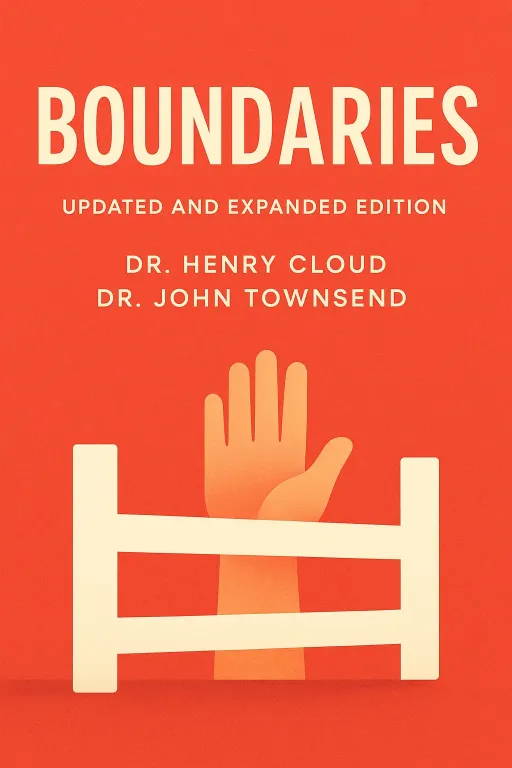
Nova: Imagine running a business where the engineering team is suddenly doing marketing, the sales team is writing code, and the CEO is cleaning the breakroom. It sounds like absolute chaos, right? In the business world, we call this a total failure of organizational design and scope definition. Yet, so many of us run our personal lives exactly like this—taking on everyone else's emergencies while neglecting our own core operations. Today, we're diving into the classic book Boundaries by Dr. Henry Cloud and Dr. John Townsend to figure out how to draw the lines that actually set us free. And I am absolutely thrilled to have Business Analyst Kehinde Olayiwola here with us today. Kehinde, welcome to the show!
Kehinde Olayiwola: Thanks, Nova! It is great to be here. You know, when you opened with that organizational design analogy, it immediately clicked for me. In business analysis, we spend so much time defining project scope, setting requirements, and making sure resources aren't wasted. But when it comes to our personal lives, and even our professional careers, we often let those scope lines blur completely. As an INFJ, I tend to naturally want to help and connect with people, but without a clear strategy, that empathy can lead straight to burnout. This book is essentially a masterclass in personal operations management.
Nova: I love that term—personal operations management! It is so true. We talk about boundaries as if they are these rigid, defensive walls, but Cloud and Townsend describe them more like property lines. They define where you end and another person begins. Today, we're going to tackle this book from three different angles. First, we'll explore the fundamental architecture of boundaries—defining what is "me" and what is "not me." Then, we'll tackle the real-world friction of boundary problems in the workplace, especially in our hyper-connected digital age. And finally, we'll focus on practical, strategic steps to measure our success and reclaim our personal agency. So, Kehinde, let's start with that first piece: the architecture of the self. What does a boundary actually look like in practice?
Deep Dive into Core Topic 1
SECTION
Kehinde Olayiwola: Well, Nova, the authors use a brilliant distinction that I think is highly analytical. They talk about the difference between being responsible "to" someone versus being responsible "for" someone. They use the biblical metaphors of "boulders" and "knapsacks" from the book of Galatians. A boulder is an overwhelming crisis—something too heavy for one person to carry alone. We are responsible "to" help others with their boulders. But a knapsack is our daily load—our own feelings, attitudes, behaviors, and choices. We are responsible "for" carrying our own knapsack. The problem is, we often swap them. We try to carry other people's knapsacks, which makes them irresponsible, and we expect others to carry our boulders, which makes us dependent.
Nova: That is such a clear way to put it. And the book illustrates this so vividly with the story of Sarah. She was this incredibly kind-hearted volunteer at an animal shelter in Ohio back in the summer of 2022. She started out just wanting to help the animals for a few hours a week. But because she couldn't say no, the shelter director kept piling on more. Soon, she was cleaning all the dog kennels by herself, skipping her lunch breaks, and even missing her close friend's birthday party to cover extra shifts. She was losing sleep, feeling irritable, and secretly resenting the very place she loved. She was carrying the shelter's operational "boulders" while the director and other volunteers shirked their own "knapsacks."
Kehinde Olayiwola: Exactly! And what is fascinating about Sarah's story is that her resentment was actually an early warning system. Resentment is like a dashboard indicator light telling us that our boundaries are being violated. In business, if a system is overloaded, it starts to fail. Sarah was experiencing system failure because she was taking ownership of things that were not on her "property." The authors point out that boundaries are not about controlling others; they are about self-regulation. Sarah couldn't force the director to stop asking, but she had the power to say, "No, I cannot cover that shift."
Nova: Right, it is about self-control, not other-control. But it is so hard when we feel guilty, isn't it? We think setting boundaries is selfish. The book actually addresses this as one of the major myths. They argue that setting boundaries is actually an act of stewardship. We are managing the resources—our time, energy, and talents—that God has entrusted to us. If we let others deplete those resources, we can't do the work we were actually meant to do.
Kehinde Olayiwola: That is a profound shift in perspective. It is about resource optimization. If you are a consultant advising a business, you wouldn't tell them to give away all their inventory for free until they go bankrupt. That is not charity; that is bad management. The same applies to our lives. There is another powerful story in the book about a couple who came to see Henry, the counselor, because of their twenty-five-year-old son, Joshua. Joshua was struggling with drug use, couldn't stay in school, and couldn't hold down a job. His parents were constantly bailing him out, paying his rent, and covering his debts, hoping it would help him get on his feet. Henry shocked them by saying, "Joshua doesn't have a problem. You do. You are watering his lawn."
Nova: Oh, the sprinkler analogy! That one really stuck with me. Can you explain that?
Kehinde Olayiwola: Yes! Henry explained that it is like having a sprinkler system on your lawn, but the water is spraying onto your neighbor's yard. Your neighbor's grass is green and beautiful, while your yard is dying. But because the neighbor's grass is watered, they have no motivation to fix their own system. By shielding Joshua from the natural consequences of his actions, his parents were preventing him from feeling the "hunger" that would motivate him to change. The Bible says in Galatians that we reap what we sow. But if we step in and interrupt the Law of Sowing and Reaping, we are enabling irresponsibility.
Nova: Wow. So by carrying his knapsack, they were actually harming him, not helping him. It is a complete reversal of what we think "love" is. True love sometimes means letting someone experience the pain of their own choices so they can grow.
Kehinde Olayiwola: Precisely. From a strategic standpoint, boundaries create a feedback loop. Without consequences, there is no feedback, and without feedback, there is no learning or optimization. This is just as true in the workplace as it is in parenting or volunteering.
Deep Dive into Core Topic 2
SECTION
Nova: And that naturally leads us to our second key area: boundaries in the workplace and the digital age. This is where so many of us, especially in the tech industry, really struggle. We live in this "always-on," on-call culture. Kehinde, how does this play out professionally?
Kehinde Olayiwola: It is a massive issue, Nova. In the tech sector and consulting, there is this unspoken expectation of constant availability. We have Slack, Teams, email, and WhatsApp buzzing on our phones twenty-four-seven. It creates what the authors call an "on-call" life. They contrast this with a story from Henry's childhood. He used to play golf and would see a doctor on the course who had a pager. The doctor was "on-call" for emergency surgeries. That was rare back then. But today, because of smartphones, is on-call for, even if it is just a non-urgent email about a spreadsheet.
Nova: Yes! It is like we are all emergency room doctors now, but for minor administrative tasks. And it leads to serious boundary problems. The book categorizes these problems into four types: Compliants, who say yes to the bad; Avoidants, who say no to the good; Controllers, who don't respect others' limits; and Nonresponsives, who don't hear the needs of others. In the workplace, you often get this toxic pairing of a Compliant employee and a Controlling boss.
Kehinde Olayiwola: Oh, absolutely. We see this in the story of Hannah and Jack. Hannah was an administrative assistant who was eager to please. Her coworker, Jack, was responsible for setting up training facilities, but he started gradually shifting his tasks onto Hannah—asking her to bring materials, organize the food, and handle the setup. Hannah felt overwhelmed and resentful but kept saying yes because she feared conflict. Eventually, a colleague named Lynda advised her to set a boundary. The next time Jack asked, Hannah simply said, "No, that is your responsibility."
Nova: And what happened? Didn't the system temporarily break down?
Kehinde Olayiwola: It did! And this is a crucial point for anyone setting boundaries: there will be resistance. When Hannah said no, Jack didn't do the work, and the trainers and customers complained because the setup was a mess. But because Hannah stood her ground, the boss tracked the problem back to its actual source—Jack. The boss confronted Jack, and Jack was forced to take responsibility. If Hannah had kept rescuing him, the boss would have never known there was a problem, and Hannah would have eventually burned out and quit.
Nova: That is a classic case of "scope creep" in action! By defining her role and refusing to take on Jack's "scope," she forced the system to correct itself. It is also a great example of how boundaries actually improve organizational efficiency.
Kehinde Olayiwola: Yes, and it also applies to managing up. There is another great story about Laurie, who was hired by Henry to run his office for twenty hours a week. On her second day, Henry handed her a massive pile of tasks that would easily take forty hours to complete. Now, a compliant person would have stayed late, worked unpaid overtime, and grumbled about it. But Laurie had excellent boundaries. She walked into Henry's office, laid out the work, and said, "Henry, you hired me for twenty hours. This is forty hours of work. Which twenty hours do you want me to prioritize?"
Nova: That is so empowering! She didn't get angry or emotional; she just presented the data. She made the constraint visible.
Kehinde Olayiwola: Exactly! She put the responsibility of prioritization back on the boss, where it belonged. In business analysis, we call this managing constraints. You can't have a fixed budget, a fixed timeline, and an infinite scope. Something has to give. Laurie forced Henry to realize his poor planning was not her emergency.
Nova: "Poor planning on your part does not constitute an emergency on my part." I think we need to print that on a t-shirt! But what about the digital side of things? How do we set boundaries with our devices when the temptation to check is so strong? The book mentions that overuse of technology can actually exhibit qualities similar to addiction.
Kehinde Olayiwola: It really does. We get these micro-doses of dopamine every time we check a notification. The authors suggest a very practical rule: "Find the misery and make a rule." If checking your email at nine p. m. is causing you anxiety and ruining your sleep, make a personal rule to turn off notifications at seven p. m. The Sabbath was made for man, not man for the Sabbath. Rules and technology should serve us, not master us. We have to default to face-to-face, synchronous communication for real connection.
Nova: Yes, the book emphasizes that digital connection is ultimately inferior to face-to-face interaction when it comes to building true intimacy and trust. There is that funny story about John's son, Benny, who jokingly said, "Google is my real father!" because whenever he asked a question, John told him to Google it. It is a lighthearted joke, but it points to a deeper truth: we cannot outsource our relational needs to technology.
Kehinde Olayiwola: Absolutely. And that brings us to the concept of FoMO—the Fear of Missing Out. FoMO is often driven by an underlying emptiness or lack of secure attachment. When we are securely connected to safe people, that anxiety dissipates. We don't need to be constantly plugged into the digital world because our real-world "yard" is full and meaningful.
Synthesis & Takeaways
SECTION
Nova: This has been such an incredibly rich conversation, Kehinde. We've covered the architecture of boundaries, the difference between "to" and "for," and how to manage scope creep in both our personal lives and our careers. As we wrap up, how do we actually measure our success with boundaries? The book outlines several steps, starting with recognizing resentment and moving toward what they call "baby nos."
Kehinde Olayiwola: Yes, the progression is very logical. It starts with feeling that resentment and realizing you have a boundary problem. Then, you start becoming attracted to "boundary-lovers"—people who can hear your "no" without shaming you. Next, you join a supportive community, because boundaries cannot be built in a vacuum. You need safe people to practice on. And then you start practicing "baby nos."
Nova: Like the story of Shareen in the therapy group! She was terrified of conflict, but she finally set a tiny boundary by telling another member, Carolyn, that it bothered her when Carolyn always took the "good chair" in the room. It was a small thing, but Carolyn responded positively, and it gave Shareen the confidence to start setting bigger limits.
Kehinde Olayiwola: Exactly. It is like physical therapy—you start with light weights. And as you progress, you will actually experience a phase of "guilty nos" where you feel terrible for saying no, but you do it anyway. The authors say we should actually in those guilty feelings because they mean we are challenging our old, compliant programming. Eventually, the guilt fades, and you reach a point where your "no" is just as free as your "yes." You are no longer acting out of fear or obligation, but out of love and free choice.
Nova: That is the ultimate goal, isn't it? Freedom to love and serve from a place of abundance, not deficit.
Kehinde Olayiwola: Yes, and it leads to value-driven goal setting. Instead of being reactive, constantly putting out other people's fires, you become proactive. You take control of the life and resources God has given you stewardship over.
Nova: Well, Kehinde, if you had to leave our listeners with one actionable, strategic takeaway from today's discussion, what would it be?
Kehinde Olayiwola: I would challenge everyone to look at their lives this week and identify one area of "misery" or resentment. Is there a project at work that is suffering from scope creep? Is there a relationship where you are watering someone else's lawn while your own is dying? Find that one area, and practice a "baby no." Remember, saying no to what is "not you" is the only way you can truly say a wholehearted, impactful "yes" to what is "you."
Nova: What a powerful note to end on. Kehinde, thank you so much for sharing your analytical insights and strategic perspective with us today. This has been absolutely fantastic.
Kehinde Olayiwola: Thank you, Nova. It was a pleasure!
Nova: And to our listeners, thank you for tuning in. Go out there, define your property lines, and start managing your personal operations with freedom and grace. Until next time!









