

Personalized Podcast
Golden Hook & Introduction
SECTION
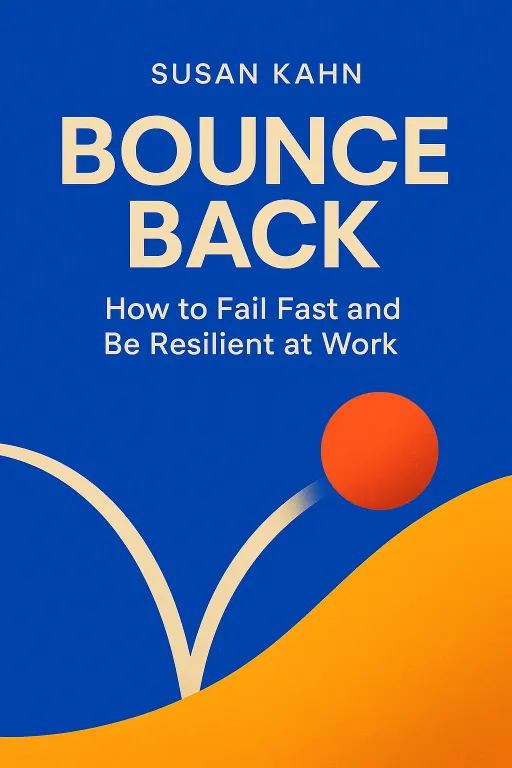
Orion: Imagine planting a rare, organic crop, tending to it for months, only to watch an unseasonal frost wipe out the entire yield overnight. In both agriculture and entrepreneurship, the environment is highly volatile, and failure isn't just a possibility; it's an absolute certainty. The real question is, how do you recover when the ground collapses beneath your feet? Today, we are diving deep into Dr. Susan Kahn's insightful book,. We're going to tackle this masterclass on resilience from three distinct angles. First, we will explore the concept of failing fast and why rapid experimentation is the ultimate survival mechanism. Second, we will look at the profound connection between the brain and the physical body, examining how somatic intelligence protects us from burnout. And finally, we will outline a concrete, immediate action plan on how you can start building your own resilience reserves today. Joining me is Belinda Bright, an entrepreneur in the agricultural and environmental sector. Belinda, welcome.
Belinda_Bright: Thanks, Orion. It's wonderful to be here. You know, that opening analogy of the frost really hits home. In my line of work, you quickly realize that you can't control the weather, but you can absolutely control how you prepare for and adapt to it. Dr. Kahn's book is such a breath of fresh air because it reframes resilience. It's not this static, innate trait that you either have or you don't. It's a dynamic, malleable skill. It's like soil health; you can actively cultivate, enrich, and restore it over time.
Orion: That is an excellent way to frame it. Let's establish a clear definition to start. Dr. Kahn points out that the word resilience comes from the Latin, which literally means to bounce back, to rebound, or to get back on track. It is the capacity to deal with difficult situations, recover quickly, and maintain a constructive mindset.
Belinda_Bright: Exactly. And as an entrepreneur, especially in the early stages, you realize very quickly that your business plan is basically a hypothesis. The market, much like nature, is a complex, living system. If you treat every setback as a personal identity crisis, you won't survive the first year. You have to learn to separate your self-worth from the immediate outcome of your projects.
Deep Dive into Core Topic 1
SECTION
Orion: Let's transition into our first core topic: the philosophy of failing fast. Dr. Kahn argues that failure is a common, inevitable experience that should not be viewed solely as a negative outcome. In fact, in the startup world, a history of failures is often seen as a badge of honor, a sign of expansive, original thinking. To illustrate this, she points to the famous design firm IDEO and their shopping cart project in the late 1990s. The client wanted a safer, more user-friendly cart. IDEO didn't just sit in a room and theorize. They used a methodology of rapid prototyping. They built dozens of unconventional, sometimes outright crazy prototypes. Some were unstable, some were too heavy, and some failed spectacularly during testing in a simulated grocery store. But here is the key: each failure gave them immediate, high-value data. They learned exactly what didn't work, which paved the way for a highly successful, revolutionary final design.
Belinda_Bright: I love that story because it highlights that failure is actually a form of active learning. In agriculture, we do this all the time with trial plots. You don't plant your entire acreage with a new, untested seed variety. You test it on a small, controlled patch first. If it fails, you fail fast, you fail cheap, and you learn what the soil or the microclimate actually needs. But historically, human society hasn't been very kind to failure, has it?
Orion: No, not at all. Dr. Kahn provides some fascinating, albeit harsh, historical context on this. If we look back to ancient Greece around 800 BC, failed merchants were forced to sit in the public marketplace with baskets over their heads, subjected to intense ridicule. In premodern Italy, bankrupt business owners were paraded completely naked through town squares while crowds jeered. And in seventeenth-century France, a merchant's business collapse was publicly announced, and they were legally forced to wear a bright green bonnet to avoid immediate imprisonment. This deep-seated, historical association of failure with public humiliation and social ostracization is why we have a natural, almost biological fear of it today. It's a survival instinct.
Belinda_Bright: Wow, a green bonnet. That really puts our modern fear of a bad pitch meeting into perspective, doesn't it? But it explains so much. We carry this ancestral dread of being cast out of the tribe for making a mistake. Yet, if we let that fear dictate our actions, we end up paralyzed. We stick to the safe, traditional paths, even when those paths are leading to stagnation. Think about Thomas Edison. When he was trying to invent the incandescent light bulb, he and his team tested thousands of different materials for the filament, including carbonized bamboo and even beard hair. When people asked him why he kept going after so many failures, he famously said, "I have not failed. I've just found ten thousand ways that won't work." That is the ultimate resilient mindset. He viewed each failed material not as a defeat, but as a successful elimination of an incorrect variable.
Orion: Yes, it's about information gathering. But let's be realistic here. It's easy to talk about Edison's optimism in hindsight, but when you are in the middle of a business crisis, it hurts. Dr. Kahn tells the story of Dame Inga Beale, who was brought in as the CEO of a major Swiss reinsurance company to turn it around. Just as she was getting her bearings, the company became the target of a hostile takeover. She was completely devastated. But instead of panicking or denying the reality, she did something highly resilient: she gave herself permission to feel the shock, to accept the gravity of the situation, and then she stood up, rallied her team, and fought the takeover. She used the crisis as a learning opportunity to understand the company's vulnerabilities.
Belinda_Bright: That's a crucial point, Orion. Resilience isn't about wearing a fake, happy mask and pretending everything is fine. That's toxic positivity, and it actually drains your energy. True resilience, as Dr. Kahn describes, involves acknowledging the pain, the anger, or the disappointment, but not letting those emotions hijack your rational brain. It's like observing a storm from a sturdy shelter. You acknowledge the storm is happening, you respect its power, but you don't stand out in the rain screaming at the clouds. You wait, you assess the damage, and then you start rebuilding.
Deep Dive into Core Topic 2
SECTION
Orion: That leads us directly to our second core topic: the connection between the brain and the physical body. Dr. Kahn emphasizes that resilience is not a purely cognitive exercise. It is deeply somatic. Our physical health directly dictates our emotional regulation and cognitive capacity. Let's look at the difference between pressure and stress, which Orion likes to define clearly. Pressure is an external demand that can actually enhance focus, creativity, and decision-making, leading to optimal performance. Stress, however, is our internal, negative reaction to that pressure. It narrows our focus, impairs concentration, and induces physical anxiety and self-doubt. When we are chronically stressed, our brain's amygdala triggers a constant fight-or-flight response, which literally shuts down the prefrontal cortex, the area responsible for rational decision-making and creative problem-solving.
Belinda_Bright: This is so true. In farming, physical stamina is everything. If you are sleep-deprived, malnourished, and running on pure adrenaline, your decision-making completely deteriorates. You make silly mistakes, you miscalculate measurements, and you lose your temper with your team. Dr. Kahn references a striking report by the World Health Organization that calls sleep loss a global epidemic in industrialized nations, even linking nighttime shift work to severe health risks. Sleep is literally the most effective, free, and accessible way to reset our brains and bodies to a healthy baseline every single day.
Orion: Absolutely. Sleep is non-negotiable for cognitive restoration. Dr. Kahn also introduces the concept of somatic intelligence, which is the ability to recognize how your body physically registers stress and using that physical awareness to soothe your nervous system. For example, think of a newly promoted manager who is about to chair their very first team meeting. They are incredibly anxious, especially because one of the attendees is a colleague who was passed over for the promotion. The manager's heart is racing, their palms are sweaty, and their throat feels tight. That is a somatic trigger. If they ignore it, they might stumble through the meeting or react defensively. But if they use somatic intelligence, they can pause, take a deep breath, recognize that their body is reacting to a perceived threat, and internally repeat reassuring affirmations like, "You are okay. You were chosen for this job because you are qualified."
Belinda_Bright: I love that. It's about tuning into your body's early warning systems. It's like checking the dashboard of your tractor. If the oil light comes on, you don't put a piece of tape over it and keep driving; you stop and address the engine. For me, when I feel my shoulders creeping up to my ears and my breathing getting shallow, I know I'm entering that high-stress zone. I have to step away, go outside, walk on the grass, and just ground myself. Dr. Kahn also talks about the brain's default mode network. This is the network that activates when we are not focused on a specific task, when we are daydreaming or letting our minds wander. This is why our best, most innovative ideas often come to us in the shower, or while weeding the garden, or during a walk. Google famously utilized this by allowing their engineers twenty percent of their time to work on whatever they wanted. That unstructured, low-pressure time led to the creation of Gmail and Google Maps.
Orion: Yes, detachment is a prerequisite for breakthrough innovation. If your mind is constantly occupied by immediate, high-stress tasks, you leave no room for the default mode network to connect disparate pieces of information and find creative solutions. It's a paradox: to solve a difficult problem, you often have to stop trying to solve it.
Synthesis & Takeaways
SECTION
Belinda_Bright: It really is a paradox. And that brings us to the customized theme for today's episode: how to start now. If someone is listening to this and feeling completely overwhelmed by their current business challenges, what is the very first step they should take today to build their resilience?
Orion: Dr. Kahn provides a brilliant, structured framework called the ABC of resilience. Let's define it. A stands for Adversity: identify the specific challenge you are facing. B stands for Beliefs: examine the internal narrative you are telling yourself about this challenge. Are you telling yourself, "I'm a failure and this is the end of my business"? C stands for Consequences: recognize the emotional and behavioral results of those beliefs. If you believe you are a failure, the consequence is that you will stop trying. By changing B, your beliefs, you completely transform C, the consequences. You can reframe the adversity from a dead-end into a temporary detour.
Belinda_Bright: That is incredibly powerful. It's about taking control of the narrative. Dr. Kahn also talks about the importance of finding your "tribe." She dedicates her book to "all the vulnerable at work," and in her acknowledgments, she expresses deep gratitude to her own tribe, stating she would take a bullet for them. We cannot build resilience in isolation. We need a supportive network of mentors, peers, and friends who allow us to be vulnerable, who listen without judgment, and who can offer an objective perspective when we are stuck in our own heads.
Orion: Yes, social support is a massive buffer against stress. Another immediate action step is to practice what Dr. Kahn calls "negative visualization," a concept borrowed from Stoic philosophy. Instead of constantly forcing yourself to think positively, take a moment to calmly contemplate the absolute worst-case scenario. Ask yourself, "If this project fails completely, what will actually happen?" Usually, the worst-case scenario is not fatal. You might lose some money, you might have to pivot, but you will survive. Once you confront and accept the worst-case scenario, the fear loses its power over you, and you can act with clarity and courage.
Belinda_Bright: That is so liberating. It's like doing a risk assessment on a farm. Once you know where the hazards are, you can put safety measures in place, and then you can work with confidence. To start today, I would encourage everyone to do a quick resilience self-assessment. Rate your own resilience on a scale of one to ten. Then, ask a trusted colleague, a mentor, or a friend to rate you as well. Often, we are much harder on ourselves than others are, and seeing that disparity can be a wonderful eye-opener.
Orion: Excellent advice. Let's summarize the key takeaways from today's discussion. First, embrace failure as a necessary, data-rich part of the growth process; fail fast, learn fast, and keep moving. Second, prioritize your physical body; protect your sleep, listen to your somatic triggers, and give your brain the unstructured downtime it needs to innovate. And third, start today by examining your internal beliefs, building your supportive tribe, and confronting your fears through realistic planning.
Belinda_Bright: Beautifully summarized, Orion. I want to leave our listeners with a powerful quote from the book, attributed to Brené Brown, that perfectly captures this journey: "When we own our stories, we get to write the ending." No matter what setbacks you are facing in your career or your business today, remember that this is just a chapter, not the whole book. You have the tools, the capacity, and the power to bounce back and write a spectacular ending.
Orion: Thank you, Belinda, for sharing your incredible insights today. And thank you to our listeners. Go out there, cultivate your resilience, and we will see you next time.









