

Architect of Absurdity
Golden Hook & Introduction
SECTION
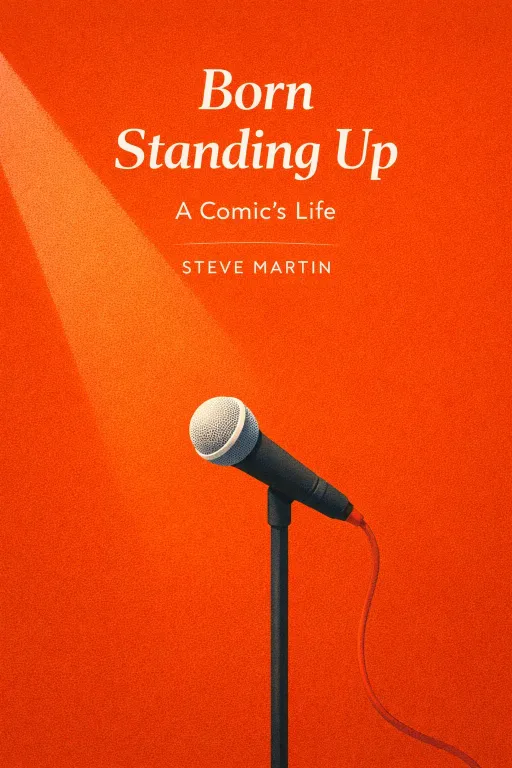
Olivia: The biggest myth about creative genius is that it's a gift. That people like Steve Martin were just 'born funny.' Today, we're going to dismantle that myth. His story proves that genius isn't a gift; it's a strategy, and a brutal one at that. Jackson: I love that. We have this image of the effortless artist, but the reality is so often just grueling, deliberate work. It’s comforting, in a way. It means it’s not just magic. Olivia: Exactly. And that entire strategy is laid bare in his incredible memoir, Born Standing Up: A Comic's Life by Steve Martin. Jackson: Which is such a fascinating read. It's been widely praised, and what's interesting is that it's not for being a joke-a-minute book. Readers love it for its raw honesty about the process. It’s a look under the hood of a comedic engine. Olivia: It’s a biography of an idea, as much as a person. And that idea begins with a young Steve Martin deciding to break every single rule of comedy. Jackson: Okay, what do you mean 'break every rule'? I thought a comedian's job was to tell jokes, get laughs, and get off stage. What rules are there to break?
The Architect of Absurdity: Inventing a New Comedy
SECTION
Olivia: Well, that’s the central assumption he questioned. In his college years, studying philosophy and logic, he had this profound realization. He started asking himself, "What if there were no punch lines? What if I created tension and never released it? What would the audience do with all that tension?" Jackson: Wait, hold on. A comedian intentionally not telling jokes? That sounds like professional suicide. How does that even work? Wouldn't the audience just get angry and leave? Olivia: They were definitely confused at first. He wasn't a natural. He says it himself in the book: "I was not a natural. I was a fast study, practiced, and interested." He treated comedy like a science experiment. He had this theory that if he withheld the punchline long enough, the audience would get so desperate for a release that they would eventually choose their own moment to laugh. Jackson: That is brilliantly twisted. He’s making the audience do the work. He's not handing them the punchline; he’s making them find it. Can you give me an example? Olivia: Oh, the perfect one is his "Nose on Microphone routine." He’d go on stage and build it up, telling the audience this was a huge bit, a classic that was always funny. He’d create all this anticipation. Then, he would just lean in, place his nose on the microphone for a few seconds, step back, take several bows, and say, "Thank you very much." Jackson: And that was it? Olivia: That was it. And there would be this moment of dead silence. Then, as the audience realized that was the entire 'joke,' a wave of laughter would erupt. It wasn't laughter at a punchline; it was laughter at the sheer absurdity of the situation. He had successfully created a joke with no joke. Jackson: Wow. That takes an incredible amount of confidence. To stand there in silence, trusting that the laugh will eventually come. Where did he get that from? Olivia: The book suggests it came from a deep, almost academic place, but also from his childhood. He had a very difficult, strained relationship with his father, who was critical and emotionally distant. There's a devastating line at the end of one chapter where, after detailing this painful upbringing, he says, "I tell you this story of my father and me to let you know I am qualified to be a comedian." Jackson: Huh. So he’s saying that a complicated childhood, that feeling of being an outsider in your own home, is a kind of qualification. It gives you a different lens on the world, one that sees the absurdity in everything. Olivia: Precisely. His early act was a hodgepodge of magic, banjo, and juggling. He performed at a San Francisco club called 'Coffee and Confusion' in the 60s. He describes performing this bizarre song his 'grandmother' taught him. It starts with sweet advice like "Be courteous, kind, and forgiving," but then descends into "Be obsequious, purple, and clairvoyant... Be oblong and have your knees removed." Jackson: (laughing) Okay, I'm starting to get it. It's the whiplash between the expected and the completely nonsensical. He’s playing with the form of comedy itself. Olivia: He was. He even said, "My act... was becoming a parody of comedy. I was an entertainer who was playing an entertainer, a not so good one." He was building a persona that was in on a joke the audience wasn't even sure existed yet. Jackson: That’s a radical idea. But a theory is one thing. Taking that act out on the road to clubs that are expecting traditional jokes… that sounds like a recipe for disaster.
The Crucible of the Road: Forging a Star Through Failure
SECTION
Olivia: It often was. After a brief stint writing for television, he committed fully to stand-up, and the next few years were what he called "The Road." He describes his touring schedule as an "itinerary designed by the Marquis de Sade." He was completely isolated, traveling alone to small, often hostile clubs across the country. Jackson: That sounds absolutely brutal. What kind of failures are we talking about? Olivia: The book is full of them. He recounts playing the Metro club in Greenwich Village where, for two nights in a row, literally no one showed up to see him. He had to offer to break his own contract. Jackson: Oh, man. That’s every performer’s nightmare. Olivia: It gets worse. He was booked at the San Francisco Playboy Club for a great fee. The first night, the room was packed, but it was all Japanese tourists on a bus tour who didn't speak English. His visual gags, like making balloon animals, worked okay. But the next night, with a regular, English-speaking crowd? He called it "Comedy Death." Just dead silence. Jackson: Wow. And I read he even got robbed there? Olivia: He did. When he went back to his dressing room to pack up after quitting the gig, all his clothes had been stolen. He was so broke he had to take out a five-thousand-dollar bank loan just to survive. His diary entries from that time are heartbreaking. He wrote, "My new material is hopelessly poor. My act is simply not good enough—it’s not even bad." Jackson: That’s a special kind of low, when your work isn't even bad enough to be interesting. What kept him going through all that? Most people would have packed it in and gotten a real estate license like his dad. Olivia: He developed a powerful philosophy. He writes, "It was easy to be great. Every entertainer has a night when everything is clicking... What was hard was to be good, consistently good, night after night, no matter what the abominable circumstances." The road was his crucible. It burned away everything that didn't work and forced him to build an act that was so tight, so practiced, it could survive any room. Jackson: It’s the 10,000-hour rule in its most punishing form. He wasn't just practicing; he was practicing under fire, night after night. Olivia: And it led to this incredible moment of improvisation at Vanderbilt University. The audience was so into his weird, meta-style that after the show ended, they refused to leave, thinking it was part of the act. He had no exit but through the crowd, so he just kept talking, leading them out of the building, across campus, and into a drained swimming pool. Jackson: He led them into a swimming pool? What did they do? Olivia: They got in! He then told them he was going to "swim" across them, and they passed him, hand-over-hand, across the top of the crowd. He said in that moment, he felt he had "entered new comic territory," where a show could be completely free and unpredictable. All that failure had taught him how to turn a potentially awkward moment into a piece of performance art. Jackson: So the failures weren't just obstacles; they were the curriculum. They taught him how to be bulletproof. Olivia: Exactly. And that bulletproof act, honed over years of misery, finally found its audience. He headlined at The Boarding House in San Francisco, and everything clicked. He got a rave review, a huge cash payout, and his career finally exploded. He went from playing to empty rooms to being the biggest concert comedian in the world. Jackson: And that’s when everything gets easy and he lives happily ever after, right? Olivia: (A knowing, small laugh) That’s what you’d think. But that brings us to the most counter-intuitive and, I think, the most profound part of his story.
Standing Down: The Wisdom of Quitting at the Top
SECTION
Jackson: You’re talking about the fact that he quit. At the absolute peak. I mean, the numbers are insane. He was selling out arenas—we're talking 45,000 people for a comedy show. That's a rock concert. Why on earth would you walk away from that? That's the dream! Olivia: Because the dream became a prison. He describes how the act, which was once so experimental and alive, became "automatic choreography." The laughs were so huge and predictable they were like "waves created far out at sea." In a 20,000-seat arena, you can't try out a weird new bit. You have a "huge responsibility not to let people down." The performance was no longer an act of discovery; it was an act of fulfillment. Jackson: So the very thing that made him a star—that massive audience—was the thing that was killing his creativity. Olivia: It was killing him, period. He calls it "the loneliest period of my life." The fame was isolating. He tells this unbelievable story about performing in a 120-degree gymnasium, having a panic attack, and being rushed to the hospital. He's on a gurney, convinced he's dying, and a nurse comes up and asks him to autograph the EKG printout of his erratic heartbeat. Jackson: Come on. That can't be real. Olivia: It's in the book. That was the moment he realized his privacy was gone. He wasn't a person anymore; he was a "commercial artifact." His on-stage persona was so powerful that people couldn't see the man behind it. Even his father, after the premiere of The Jerk, his only comment was, "Well, he’s no Charlie Chaplin." Jackson: That's just brutal. But it all leads to this decision to "stand down." How did he justify it to himself? To just… stop? Olivia: He found the answer in a conversation with the painter Eric Fischl. Fischl told him, "There is a fundamental difference between [psychoanalysis and art]. In psychoanalysis, you try to retain a discovery; in art, once the thing is made, you let it go." Jackson: Wow. Okay. Let me sit with that. "In art, once the thing is made, you let it go." So for him, the stand-up act, this whole revolutionary form of comedy he had built from scratch, was a finished piece of art. It was done. Olivia: It was done. He realized he was no longer a comedian doing comedy. He was, in his words, a "party host" presiding over a "celebratory bash." The art was complete. To keep doing it would be like a painter adding brushstrokes to a finished canvas. It wouldn't improve it; it would ruin it. And so, in 1981, he just stopped. No farewell tour, no grand announcement. He just… stood down. Jackson: He wasn't a brand to be managed; he was an artist who had finished a project. That’s a level of artistic integrity that is almost unheard of, especially today. Olivia: And it led to this incredible reconciliation with his father. Years later, on his deathbed, his father finally broke down. He told Steve, "You did everything I wanted to do." And Steve, in that moment, confessed, "I did it for you." He writes that he was glad he didn't say the more complicated truth, which was, "I did it because of you." Jackson: That gives me chills. The whole lifelong quest for approval, the anger, the distance… all of it was fuel. It all came out in that one moment.
Synthesis & Takeaways
SECTION
Olivia: It really did. And that’s the whole arc of the book. It’s a story about a man who, driven by a complex need for approval, approaches comedy with the mind of a philosopher. He builds this incredible, intricate, absurd machine. Jackson: Then he takes that machine into the most hostile environments imaginable and tempers it in the fire of failure until it's perfect. He becomes a master craftsman. Olivia: And then, once the machine is perfected and celebrated by millions, he has the wisdom and the courage to recognize that the work is finished. He turns it off and walks away to build something new. It’s a complete artistic life cycle in one career. Jackson: It’s a powerful lesson. It makes you wonder, what 'art' in our own lives—a job, a relationship, an identity—is actually finished, but we're too afraid to let it go because it’s successful or comfortable? Olivia: That is the question, isn't it? It’s a challenge to all of us to know when our work is done. We’d love to hear your thoughts on that. Does an artist have a responsibility to keep going for their fans, or is their only duty to the art itself? Let us know what you think. Jackson: This was an amazing look into the mind of a genius. A made genius, not a born one. Olivia: This is Aibrary, signing off.