

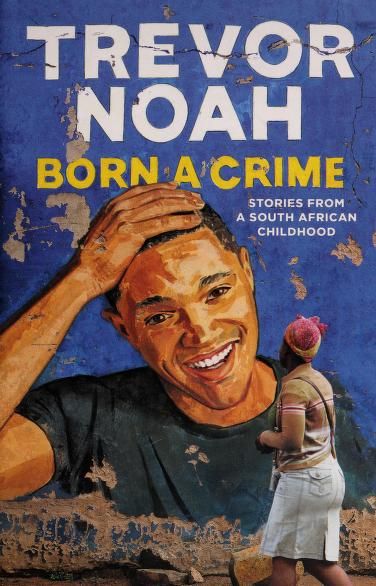
Born a Crime
Stories from a South African Childhood
Introduction: The Title That Says It All
Introduction: The Title That Says It All
Nova: Welcome back to 'Deep Dive Dialogue.' Today, we are peeling back the layers of a memoir that is as hilarious as it is heartbreaking: Trevor Noah's "Born a Crime: Stories from a South African Childhood."
Nova: : That title alone is a gut punch, Nova. It’s not hyperbole; his very existence was illegal. I think that’s the perfect place to start. What exactly was the 'crime' he was born into?
Nova: Exactly. The crime wasn't something he, it was something he. He was born in 1984, deep in the throes of apartheid in South Africa. His mother, Patricia Nombuyiselo Noah, is Black Xhosa, and his father is White Swiss-German. Under the Immorality Act and the broader system of racial classification, that union was strictly forbidden. His birth certificate literally listed his race as 'White,' which was a bureaucratic attempt to classify him as white to protect him, but it was a lie that defined his early life.
Nova: : A lie on a birth certificate—that’s a chilling metaphor for the entire system. It sounds like his life began as an act of defiance, whether he knew it or not.
Nova: It was. And what makes the book so compelling is that Noah doesn't just present the historical facts; he weaves them into these incredibly personal, often absurdly funny, vignettes. He’s taking this heavy, oppressive history and filtering it through the lens of a mischievous, curious kid trying to figure out the rules of a game that was rigged against him from the start.
Nova: : So, we’re not just getting a history lesson on apartheid, we’re getting a masterclass in survival told through comedy. Why do you think this particular memoir resonated so deeply with audiences globally, hitting the New York Times bestseller list and staying there?
Nova: I think it’s the universality of the struggle for identity, wrapped in a uniquely South African package. Everyone, at some point, has felt like they didn't quite belong, or that they had to code-switch to fit in. Noah just experienced that feeling under the most extreme, state-sanctioned pressure imaginable. It’s a story about finding your voice when the world tries to silence you.
Nova: : That makes perfect sense. It sounds like the key to unlocking his entire narrative lies with his mother. Should we dive into the force that made his survival possible?
Nova: Absolutely. Let’s move from the crime itself to the architect of his resilience: Patricia Noah.
Key Insight 1: Resilience Through Radical Love
The Mother's Shield: Patricia Noah's Unconventional Faith
Nova: If "Born a Crime" has a central hero, it is undoubtedly Patricia Noah. She was a fiercely religious woman, deeply rooted in the Zion Christian Church, yet she was also a radical rule-breaker who defied the state to have the child she wanted.
Nova: : That contrast is fascinating. How did her deep faith coexist with such blatant civil disobedience? Most people associate religious adherence with following the established order, not breaking the most fundamental laws of the land.
Nova: That’s the genius of her character. Noah describes her faith not as a set of restrictive rules, but as a source of profound, active strength. She believed God gave her a child, and therefore, no human law could supersede that divine mandate. She literally used her faith as armor against the apartheid state.
Nova: : I remember reading about how she protected him. Because he looked lighter-skinned, she had to be incredibly careful about how they presented themselves in public, especially when interacting with the police or authorities.
Nova: Precisely. There’s a famous anecdote where, as a young boy, Trevor was playing in the street, and a police officer stopped him. The officer, seeing a light-skinned child, assumed he was white and started speaking Afrikaans to him. Trevor, having no idea what the officer was saying, just stared blankly. Patricia swooped in, spoke rapid-fire Xhosa, and essentially claimed him so forcefully that the officer backed off, confused by the linguistic chaos.
Nova: : That’s a life-or-death performance! It highlights how language itself became a tool of evasion. But beyond the immediate danger, how did her parenting style shape his worldview? She raised him without the typical structure of a two-parent household under oppressive rule.
Nova: She was incredibly intentional. She didn't shelter him from the reality of apartheid, but she also refused to let it define his potential. She taught him that the world was dangerous, but that he possessed the tools—his mind, his voice, his faith—to navigate it. She famously told him, 'You don't get to choose what happens to you, but you do get to choose what you do with what happens to you.' That’s the core thesis of the book, right there.
Nova: : That quote is powerful. It’s the difference between being a victim of circumstance and being an agent of your own life, even when the circumstances are horrific. It sounds like she gave him permission to be complex, which is crucial when the state demands you be simple—either Black or White.
Nova: Absolutely. And she also instilled in him a sense of responsibility. When he was older and started getting into trouble, she didn't just punish him; she made him understand the of his actions within the larger social fabric. She was tough, but her toughness was rooted in an unwavering, almost defiant, love.
Nova: : It’s a testament to her strength that he grew up to be a global figure, rather than someone broken by that environment. It really makes you appreciate the sheer willpower it took for her to raise a mixed-race child in that climate.
Key Insight 2: Identity Through Language
Navigating the Color Lines: The Art of Code-Switching
Nova: Moving beyond his mother's influence, let's talk about the practical reality of being 'born a crime.' Trevor Noah was a chameleon by necessity. He had to learn to navigate the rigid racial lines of South Africa, which were constantly shifting based on who was looking at him.
Nova: : He famously mentions that his existence was a constant state of 'in-between.' If he was with his Black friends, he had to be Black. If he was with his White friends, he had to be White. How did he manage that constant mental gymnastics?
Nova: It all came down to language. Noah is a linguistic prodigy in the book. He speaks nine languages, including Xhosa, Zulu, Tswana, Sotho, English, Afrikaans, and even some rudimentary German from his father. He explains that language was his primary tool for code-switching.
Nova: : So, if he spoke Afrikaans, he was perceived one way, and if he spoke English, another? What was the social currency of each language under apartheid?
Nova: Afrikaans, the language of the oppressor, was often the language of the police and the government bureaucracy. Speaking it fluently, even with a slight accent, could sometimes buy him time or access. English was the language of the educated elite and the international world, which gave him a different kind of social mobility. But when he was with his Xhosa-speaking family and community, that was his true cultural anchor.
Nova: : He describes being an outsider in every group, doesn't he? Too white for the Black kids, too Black for the White kids. It sounds incredibly isolating.
Nova: It was. He uses the analogy of being a tourist everywhere he went. He could visit the Black townships, but he wasn't truly the township in the same way his peers were, because his life experiences—his access to certain opportunities, his relationship with his father—were different. Conversely, he could never truly integrate into the White world because the law forbade it, and his appearance betrayed him.
Nova: : That feeling of being perpetually on the threshold, never fully inside, must have been exhausting. Did he ever find a place where he felt completely whole?
Nova: The closest he got was through comedy and, surprisingly, through the sheer act of observation. Because he was always on the outside looking in, he became an expert observer of human behavior, social cues, and hypocrisy. He could see the absurdity in the system because he wasn't fully invested in any single side of the racial divide. He was a neutral party by force of law.
Nova: : That’s a brilliant pivot. The very thing that made him an outcast—his mixed identity—became the foundation for his future career. It’s the ultimate turning of the tables.
Nova: It is. And it leads us perfectly into the next chapter: how he weaponized that observational skill into the art form that defined his adulthood.
Key Insight 3: Finding the Funny in the Fear
Comedy as a Survival Mechanism
Nova: We’ve established the danger, the poverty, and the identity crisis. Now, let’s talk about the tool he used to process it all: stand-up comedy. Noah often states that in South Africa, you either laughed or you cried, and he chose laughter.
Nova: : It’s a classic coping mechanism, but for him, it became a profession built on the most painful memories. What specific moments did he mine for comedy that really stuck with you?
Nova: One of the most striking examples is his description of the sheer terror of the Flying Squad—the police response unit. He recounts a time when he was a teenager, and he and his friends were caught doing something minor, and the police were roughing them up. Instead of panicking, Noah started making jokes about the officer’s mustache or his cheap shoes.
Nova: : And that actually worked? Did the officer laugh, or did it just confuse him enough to de-escalate?
Nova: It did both. The officer was so taken aback by the audacity of a young Black kid making light of a life-threatening situation that the aggression momentarily broke. Noah realized in that moment: if you can make the oppressor laugh, you have momentarily disarmed them. You’ve taken control of the narrative, even if just for a second.
Nova: : That’s incredible psychological warfare disguised as a punchline. It’s not just telling jokes; it’s using humor as a shield and a sword simultaneously.
Nova: Exactly. He learned that comedy is about pointing out the absurdity of a situation. And what is apartheid, if not the ultimate, state-sponsored absurdity? He points out the ridiculousness of the laws—like the fact that he could be arrested for being in the wrong place at the wrong time, or the bizarre rules about who could sit where on a bus.
Nova: : He also talks about the transition from making his friends laugh to realizing he could make laugh, which is the leap to professional comedy. Was that transition seamless?
Nova: Not at all. He details his early days performing in dingy clubs, often bombing, or performing for audiences who didn't understand his context. He had to learn to translate the specific South African experience into universal humor. He had to learn that a joke about the Immorality Act might land differently in Johannesburg than it would in London or New York.
Nova: : That’s the challenge of any comedian who deals with heavy material—finding the balance. He has to honor the pain of his past while still delivering a laugh that doesn't feel exploitative or dismissive of that pain.
Nova: And he does it by always centering the story on his own vulnerability and his mother’s wisdom. The humor never punches down; it always punches up at the system, or sometimes, gently at his own youthful mistakes. He’s using comedy to build bridges where the government built walls.
Nova: : It sounds like the book itself is structured like a stand-up set—a series of tightly written, perfectly timed stories that build to a larger, profound point.
Key Insight 4: The Long Shadow of Injustice
The Aftermath and Legacy: Moving Beyond Apartheid
Nova: While the book is largely focused on his childhood, the later chapters deal with the aftermath—the end of apartheid, his brief stint in the real world of crime, and his eventual departure for America. What does he say about the legacy of that era?
Nova: : He doesn't paint a picture of a perfect, post-apartheid South Africa, does he? It sounds like the structures of inequality remained long after the laws were repealed.
Nova: Not at all. He’s very clear that the end of apartheid in 1994 was a political victory, but not an immediate social or economic one. He describes the lingering poverty, the crime, and the deep-seated resentment that still exists. He notes that the system was dismantled, but the habits and prejudices it created are much harder to erase.
Nova: : He even talks about his own brush with the criminal element, right? I recall a story about him selling pirated CDs or getting involved in something risky.
Nova: Yes, that’s a crucial part of his journey to self-sufficiency. He got involved in petty crime, selling pirated CDs and later, even getting arrested for stealing a car stereo. This wasn't the grand rebellion of his mother; this was the desperation of a young man who saw opportunity but lacked the legitimate pathways to reach it. It was a direct consequence of the system that limited his legal options.
Nova: : And how did he pull himself out of that cycle? Was it another intervention from his mother, or was it the realization that he was repeating the very chaos he was trying to escape?
Nova: It was a combination. His mother’s lessons about agency were always there, but the wake-up call was stark. He realized that while his birth was a crime, to commit crimes as an adult was a choice he control. He decided to double down on the one thing that always worked: his ability to communicate and entertain. He started focusing entirely on comedy, realizing that was his true, legal, and sustainable path out.
Nova: : It’s fascinating how his journey mirrors the country’s transition—from illegal existence to navigating the messy, imperfect freedom that followed. What does he hope readers take away about modern South Africa from his stories?
Nova: He wants people to understand that history isn't just something that happened in the past; it’s the foundation we stand on. The struggles he faced—racism, poverty, sexism—they didn't vanish overnight. He uses his platform to advocate for understanding, not just forgiveness. He shows that resilience isn't about forgetting the pain; it’s about integrating it into a narrative of forward momentum.
Nova: : So, the book serves as both a historical document and a personal roadmap for overcoming systemic barriers. It’s a powerful legacy for his mother’s sacrifices.
Conclusion: The Universal Language of Survival
Conclusion: The Universal Language of Survival
Nova: We’ve covered the literal crime of his birth, the radical love of his mother, the linguistic acrobatics required to survive apartheid, and the use of comedy as a tool for liberation. What is the single biggest takeaway you have from diving into "Born a Crime" today?
Nova: : For me, it’s the idea that identity is not a fixed point assigned by the state, but a fluid, active creation. Noah’s entire life was spent proving that the categories they tried to force him into—Black, White, criminal, comedian—were all insufficient labels for the complex human being he was.
Nova: I agree completely. And I’d add that the book is a masterclass in perspective. It forces us to look at our own lives and ask: What are the invisible walls we’ve built around ourselves, or that others have built around us? And what is the one unique skill—our language, our humor, our faith—that we can use to climb over them?
Nova: : It’s a reminder that even in the darkest, most oppressive circumstances, human ingenuity and the bond between a parent and child can forge a path forward. The book is a celebration of that defiant human spirit.
Nova: It truly is. It’s a story that proves that sometimes, the most illegal things—like love, or a mixed-race child—are the most necessary for a better future. If you haven't read it, pick it up. It’s educational, it’s moving, and yes, it is genuinely hilarious.
Nova: : A perfect blend of tragedy and triumph. Thank you, Nova, for guiding us through this incredible memoir.
Nova: My pleasure. And to our listeners, keep questioning the labels, keep honing your unique tools, and keep seeking the truth hidden beneath the surface.
Nova: This is Aibrary. Congratulations on your growth!