

The Quiet Mind of the Strategic Leader
Golden Hook & Introduction
SECTION
Atlas: I watched a guy in the coffee shop line today pull out his phone before he’d even finished ordering his latte. He didn't even wait for the barista to finish the transaction. He just hit the screen, scrolled for three seconds, pocketed it, and then stood there staring at the ceiling for the next minute while he waited.
Nova: That is the modern reflex, isn't it? The instant-gratification loop. We treat silence like a glitch in the software that needs to be patched immediately with incoming data.
Atlas: It is. But I have to admit, I do the same thing. It feels like if I’m not consuming something, I’m wasting time. But I get the sneaking suspicion that this constant input is actually making me less sharp, not more.
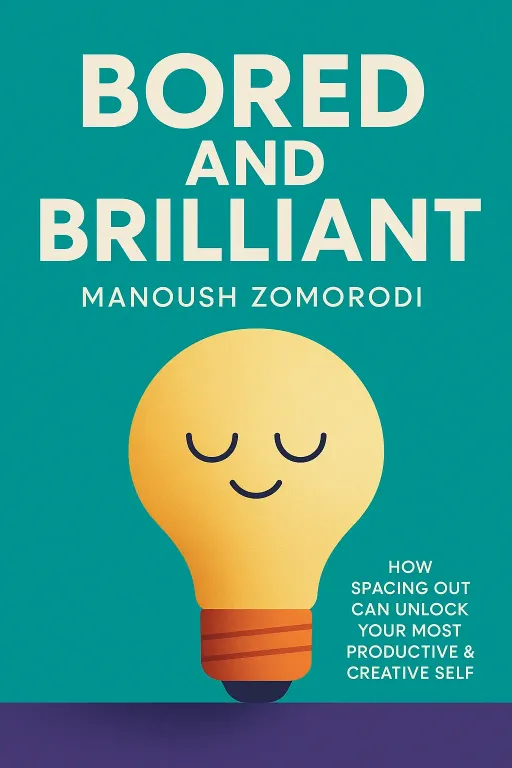
Nova: You are onto something vital. That feeling of wasting time is actually the feeling of your brain trying to enter a state of high-level problem solving. Today, we are looking at how to reclaim that space. We are diving into the science of boredom from Manoush Zomorodi’s work in Bored and Brilliant, and pairing it with the deep leadership philosophy of Kevin Cashman in Leadership from the Inside Out.
Atlas: Two different worlds, really. One is about cognitive science and the other is about executive development. How do those two connect?
Nova: They collide on one specific point: the necessity of the pause. Zomorodi shows us how our brains biologically require downtime to be creative, and Cashman argues that the only way to lead effectively is to master your internal state before you try to influence the external world. It is the ultimate productivity hack, but it involves doing absolutely nothing.
The Science of the Default Mode Network
SECTION
Atlas: Doing nothing sounds like a luxury, not a strategy. I am a pragmatic learner, Nova. If I sit there for fifteen minutes doing nothing, my brain just starts listing all the emails I haven't answered. How is that creative?
Nova: That is the initial hurdle. What you are describing is the brain’s habitual reaction to a lack of stimulation. But if you push past that, you hit what scientists call the Default Mode Network. When you are focused on a task, your brain uses a specific set of neural pathways. But when you disengage—when you are bored—your brain doesn't shut down. It switches. It starts connecting disparate ideas, processing memories, and making sense of the complex problems you have been wrestling with all day.
Atlas: Okay, so it is like a computer background process? When the screen is idle, it finally gets a chance to run the disk defragmenter and clean up the registry?
Nova: That is a perfect analogy. Think about when you have a creative breakthrough. It never happens when you are staring at a spreadsheet, right? It happens in the shower, or while driving, or while walking. That is because your conscious brain is occupied by the mundane, allowing the Default Mode Network to bubble up the solution to the surface. Zomorodi’s research highlights that by constantly interrupting this process with screens and notifications, we are essentially cutting the power to our own creative engines. We are never letting the defragmentation finish.
Atlas: I see the logic, but the friction here is that we are conditioned to fear that boredom. If I am standing in line and I am not scrolling, I feel like I am missing out on news, or I am falling behind on updates. It feels like a competitive disadvantage to be bored.
Nova: That is the trap. We think we are falling behind, but we are actually just trading long-term strategic depth for short-term information consumption. When you allow yourself to be bored, you are not being unproductive. You are preparing your mind for the next high-stakes decision. The most strategic leaders I have studied are not the ones who are the most "connected" at every second. They are the ones who have carved out the capacity to think clearly when the pressure is highest.
Atlas: So, you are suggesting that by constantly filling the gaps, we are actually eroding our ability to think strategically?
Nova: Precisely. We are training our brains to be reactive. We are building a neural architecture that is fantastic at processing alerts but terrible at synthesis. If you want to be a strategic leader, you have to be able to sit with a complex problem, let it simmer, and allow your subconscious to work on it. If you constantly interrupt that process, you are essentially limiting your own intelligence.
Leadership from the Inside Out
SECTION
Atlas: That brings me to the second piece of the puzzle you mentioned, the Kevin Cashman perspective. If the first part is about the brain needing to defrag, the second part sounds like it is about the "operator" of the machine.
Nova: Exactly. Kevin Cashman’s work in Leadership from the Inside Out is profound because he flips the script on leadership. Most people think leadership is about external metrics: revenue, headcount, output, strategy execution. But Cashman argues that all of that is secondary. He posits that external leadership is just a reflection of personal mastery. If you are chaotic on the inside, your leadership will be chaotic on the outside.
Atlas: I have seen this in real life. I have worked with managers who are technically brilliant, but because they are constantly reactive and stressed, their teams are a mess. They are firefighting, not leading.
Nova: That is a classic example of a leader who has skipped the internal work. Cashman calls for intentional pauses to align action with core values. If you don't take the time to pause and reflect, you are just executing on autopilot. You are repeating patterns that might not even be serving you or your team anymore. The pause is where the alignment happens. It is the moment where you ask, "Is what I am doing right now actually moving the needle on what matters, or am I just busy to feel important?"
Atlas: It sounds like a discipline issue. Most people want to be busy because it is easier than being reflective. Reflection is uncomfortable. You have to face your own thoughts, your own shortcomings, and the reality of your situation.
Nova: You hit the nail on the head. It is much easier to send fifty emails than to sit for twenty minutes and ask if your current strategy is actually working. The discomfort of the pause is where the growth is. Cashman’s point is that if you cannot master your own attention and your own internal narrative, you have no chance of mastering a team or a business. You are just a passenger in your own career.
Atlas: I find this fascinating because it links back to the boredom concept. If I am always scrolling, I am avoiding the discomfort of my own thoughts. I am outsourcing my inner life to the algorithm.
Nova: That is exactly right. When you are bored, you are alone with yourself. When you are busy, you are drowning out your own voice with external noise. By reclaiming that boredom, you are not just getting more creative; you are getting more self-aware. You are creating the space to hear what your own intuition is telling you about your leadership, your career, and your life.
The Zero-Device Strategy
SECTION
Atlas: Okay, I am sold on the theory. But let’s get down to the brass tacks. I am a busy person. I have a full calendar. I cannot just sit around being bored for hours. How do we turn this into a system?
Nova: The beauty of this is that it does not require hours. You do not need to go on a silent retreat. The takeaway here is incredibly tactical and requires only fifteen minutes.
Atlas: Fifteen minutes. That is manageable.
Nova: It is, but it has to be a specific kind of fifteen minutes. You need to schedule a zero-device block during your workday. Treat it like a high-stakes meeting with your most important client.
Atlas: A meeting with myself.
Nova: Exactly. And the rule is simple: no phone, no laptop, no tablet, no podcast, no music. You are literally just sitting there, or walking, or staring out a window. You are allowing your mind to wander. You are not trying to solve a specific problem. You are not trying to meditate. You are just letting the Default Mode Network take the wheel.
Atlas: What if I start getting anxious? My brain is going to scream for a notification. It is going to want to check if there is an urgent email.
Nova: That is the withdrawal symptom. That is the proof that you need this. When that anxiety hits, label it. Acknowledge that your brain is just looking for a hit of dopamine, and then let it pass. The goal is not to empty your mind—that is a common misconception about this practice—the goal is to let your mind wander freely. If you start thinking about a project, let it flow. If you start thinking about what to have for dinner, that is fine too. The point is to let go of the steering wheel and see where your brain takes you.
Atlas: And the expectation is that this will help me think more strategically?
Nova: The expectation is that you will return to your work with a clearer perspective. You will find that the problems that felt insurmountable before the break seem manageable, or that you have a new angle on a difficult conversation, or that you have identified a flaw in your current approach that you were too close to see. It is the reset button for your cognitive capacity.
Atlas: I can see how that would be a competitive advantage. While everyone else is burning out, responding to notifications, and operating on low-level reactive energy, you are taking the time to let your brain do the high-level heavy lifting.
Nova: It is the ultimate efficiency. You are putting in fifteen minutes to save hours of wasted, unfocused effort later in the day. It is the difference between working hard and working with clarity.
Synthesis & Takeaways
SECTION
Atlas: We have covered a lot of ground today. We started with the neuroscience of boredom, looking at how the brain actually needs that downtime to function at its peak, and we moved into the leadership philosophy of needing to cultivate internal mastery before you can lead others. It really comes down to the idea that the most productive thing you can do is sometimes the thing that looks like nothing.
Nova: That is the core of it. We often confuse movement with progress. We think that because we are active, we are achieving. But the real breakthroughs, the real strategic leaps, happen in the stillness. When you embrace that zero-device block, you are not just taking a break; you are sharpening your most valuable asset: your own mind.
Atlas: I think I am going to try this. I have a gap in my schedule tomorrow afternoon between two meetings. Instead of checking my notifications, I am going to find a quiet corner and just let my mind wander.
Nova: That is the perfect time to start. Don't worry if it feels awkward at first. It will. But stick with it. The payoff is not just a better strategy; it is a better version of yourself.
Atlas: That is a great way to put it. It is about reclaiming your autonomy from the noise.
Nova: Exactly. Our time is scarce, and our attention is the most valuable currency we have. Don't spend it on random notifications. Invest it in your own capacity to think, to lead, and to create.
Atlas: I think that is a perfect place to leave our listeners. If you want to make an impact, sometimes you have to step back to move forward.
Nova: It has been a pleasure diving into this with you, Atlas. And to everyone listening, remember that your brain is a brilliant tool, but it needs the space to operate. Give it that space today.
Atlas: This is Aibrary. Congratulations on your growth!









