

The Attention Economy: Reclaiming Your Creative Focus in a Distracted World
Golden Hook & Introduction
SECTION
Nova: If you added up the time you spent mindlessly refreshing your feed this week, you would probably have enough hours to learn a new language, finish that project you have been putting off, or maybe even write a book. But here we are, scrolling.
Atlas: That is a painful thought to start with. It hits home. We treat our attention like it is infinite, but the reality is that it is the most finite resource we have. It is basically the currency of our entire lives.
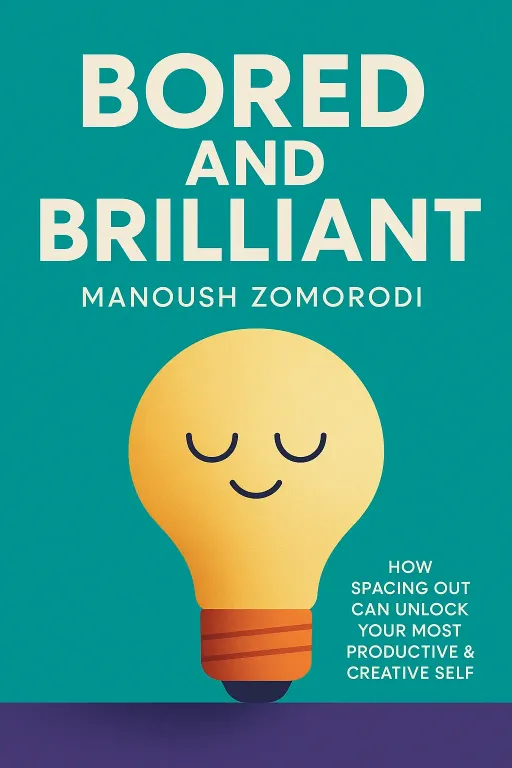
Nova: Exactly. And the problem is that we are spending that currency on things that do not give us any return on investment. Today, we are diving into two incredible books that explain why this happens and how to take that control back. We are looking at by Manoush Zomorodi and by Adam Alter.
Atlas: I have heard of both. Zomorodi is a journalist who really dove into the connection between our digital habits and our creative output, right? She did a lot of work around how we are essentially turning off our own brain's best features.
Nova: That is the core of it. Manoush Zomorodi wrote this after she realized her own life was becoming a series of digital interruptions, and she turned that observation into a massive, crowdsourced experiment about reconnecting with our own minds. And then you have Adam Alter, who is a professor at NYU. His work in is almost like an autopsy of the digital world. He explains exactly how tech companies use behavioral psychology to turn their apps into digital casinos.
Atlas: It sounds like a perfect pairing. One book explains what we are losing, and the other explains who is taking it. Let’s get into it.
The Default Mode Network and the Creative Cost
SECTION
Nova: Let’s start with the creative cost. Most people think of boredom as a waste of time. We assume that if we are not actively consuming information or working, we are losing out. But Zomorodi argues the exact opposite. She highlights a specific part of our brain called the Default Mode Network.
Atlas: I have heard that term, but I feel like it sounds like some kind of power-saving mode on a computer. Is it basically our brain going to sleep?
Nova: It is actually the opposite. The Default Mode Network is what kicks in when we stop focusing on a specific task. Think about when you are in the shower, or taking a long walk, or staring out the window on a train. That is when your brain is most active in terms of connecting dots. It is reviewing memories, planning for the future, and making sense of your experiences. That is where creativity lives.
Atlas: So, when I am in the shower and I suddenly have a solution to a problem I was stuck on for three hours at my desk, that is the Default Mode Network doing the heavy lifting?
Nova: Precisely. Your conscious brain was stuck in a loop, but once you stepped back and let your mind wander, your subconscious took over and solved it. The issue is that we have effectively killed this network. We do not let our minds wander anymore. The second we have a moment of downtime—standing in line for coffee, waiting for an elevator—we pull out our phones. We are constantly feeding our brains external stimulation, which keeps the Default Mode Network from ever turning on.
Atlas: That is a staggering way to put it. We are essentially starving our own creativity by being too busy. It feels like we are treating our brains like a machine that only works when it is fed input, but you are saying the machine actually does its best work when it is left alone.
Nova: That is the perfect analogy. We have become allergic to the void. We think that if we are not doing something, we are failing. But by constantly filling every gap with content, we are preventing the brain from doing the background processing that is necessary for deep reflection and original thought.
Atlas: I can see why this would be a massive issue for someone who wants to lead or build something meaningful. If you are constantly reactive, constantly consuming, you never actually get to the creative problem-solving part of leadership. You are just managing the noise.
Nova: You hit the nail on the head. If you are always reacting to external signals, you are not generating your own signals. You are just a processor for everyone else's content. And Zomorodi’s point is that by reclaiming that boredom, you are reclaiming your ability to be a producer, not just a consumer.
The Engineering of Distraction
SECTION
Atlas: Okay, so we know why we need to stop the constant input. But I have to play devil's advocate here. It is not just that we are bored and want entertainment. These apps are designed to be addictive. I feel like I am fighting a losing battle against a machine that knows exactly how to hook me.
Nova: You are not wrong. That is where Adam Alter’s work in is so crucial. He explains that this is not just about willpower. It is about the psychology of feedback loops. Tech companies have essentially applied the same principles that casinos use to keep gamblers playing slot machines to the apps on your phone.
Atlas: That is a chilling comparison, but it makes so much sense. In a casino, you do not win every time. You win just enough to keep you coming back.
Nova: Exactly. It is called a variable reward schedule. If you knew exactly when you would get a notification, or exactly what you would see when you refresh your feed, you would get bored. But because you do not know—because it is random—your brain releases dopamine in anticipation. You pull the lever, you get a reward, or you don't. You pull it again. That is the feedback loop.
Atlas: So, when I check my email or my social media, I am basically pulling a slot machine lever.
Nova: Every single time. And the designers of these platforms are experts at keeping that loop tight. They engineer the interface to be frictionless. They make it easier to scroll than to stop. They use infinite scroll features so there is never a natural stopping point where you can say, "Okay, I am finished."
Atlas: I have noticed that. I will be reading an article, and as soon as I finish it, the next one is already loading. There is no "end" to the experience.
Nova: That is intentional. It removes the natural boundary that would allow you to step away. And that is why it is so difficult to just "have more willpower." You are fighting against some of the brightest minds in engineering and psychology whose entire job is to keep you looking at the screen.
Atlas: It sounds like an uneven fight. If I am trying to focus on my work, or build a new skill, or just think clearly, I am up against a system that is designed to fragment my attention. Is the solution just to delete everything? Is that the only way to win?
Nova: Deleting everything is a strategy, but for most of us, it is not a sustainable one. We live in a world that requires these tools. The key is to understand the mechanics so you can build your own boundaries. You have to treat your attention as a limited asset that you defend, rather than something you just give away for free.
Atlas: I like that framing. It is not about being a Luddite or hating technology. It is about being a strategic architect of your own environment. If you know how the trap is set, you are less likely to step into it.
The Practical Blueprint - The Boredom Sprint
SECTION
Nova: And that brings us to the most actionable part of this whole discussion. We have talked about the creative necessity of the Default Mode Network and the manipulative nature of the attention economy. Now, how do we fix it? Zomorodi suggests something she calls the "boredom sprint."
Atlas: I am ready for a practical step. What does a boredom sprint look like?
Nova: It is simple, but it is not easy. For just 15 minutes, you put away all screens. No phone, no computer, no television. You do not listen to a podcast, you do not read a book. You just sit with yourself. You let your mind wander freely without any immediate task.
Atlas: Fifteen minutes. That sounds like an eternity. I can already feel the anxiety of just thinking about it.
Nova: That anxiety is exactly what you need to pay attention to. That is the withdrawal symptom. That is the feeling of your brain trying to find a stimulus that isn't there. But if you push past that initial discomfort, something interesting happens. Your brain starts to settle.
Atlas: What happens after the anxiety fades?
Nova: The creative ideas start to surface. You might start thinking about a conversation you had yesterday and realize you have a new perspective on it. You might remember a task you have been putting off and suddenly have an idea for how to solve it. You might just start observing the world around you in a new way. You are essentially turning the Default Mode Network back on.
Atlas: I can see how this would be incredibly powerful for someone who is trying to grow or transition in their career. Instead of filling that 15 minutes with more input, you are using it to process what you already know. It is like defragmenting a hard drive.
Nova: That is a great analogy. Most of us are running our brains with a fragmented drive. We have so much data coming in, but we never give the system time to organize it. The boredom sprint is the defragmentation process.
Atlas: So, how should a listener implement this? Should they just sit in a dark room?
Nova: You do not need to be that dramatic. You can go for a walk without headphones. You can do the dishes without turning on the TV. You can just sit on your balcony with a cup of coffee and look at the trees. The goal is not to meditate, necessarily. The goal is to avoid the "input." You want to stop the flow of external information so your internal information can come to the surface.
Atlas: I think I am going to try this today. But I have to ask, what if I get bored and I just start ruminating on things that stress me out? Is that a risk?
Nova: That is a fair question. Sometimes, when you stop the input, all the worries you have been suppressing come flooding back. That is why it is important to treat this as a practice. The first few times, it might be uncomfortable. You might feel restless or anxious. But over time, you gain control over that process. You learn to observe those thoughts rather than being consumed by them. It is almost like a muscle. You have to train your brain to be comfortable with the silence.
Synthesis & Takeaways
SECTION
Atlas: This has been a massive shift in perspective for me. We started by talking about how we are losing our ability to think, we moved into why that is happening—the engineering of our attention—and now we have a concrete way to reclaim it.
Nova: It really comes down to intentionality. We have been living in a state of accidental attention, where we give our focus to whatever is loudest or most persistent. But if you want to be a leader, if you want to be a creator, if you want to build a foundation that lasts, you have to be the guardian of your own focus.
Atlas: I love that. The guardian of your own focus. It sounds like a job title, but it is really a requirement for anyone who wants to grow.
Nova: It is. And the beauty of this is that it does not require a massive lifestyle overhaul. You do not need to move to a cabin in the woods. You just need 15 minutes. You need to carve out those small pockets of nothingness in your day. That is where the breakthrough ideas happen. That is where the strategy is formed. That is where you become the architect of your own life, rather than just a user of someone else’s platform.
Atlas: I am definitely going to try the 15-minute sprint. I think I will start tomorrow morning, before I even look at my email. I want to see what my brain comes up with when it is not being prompted by a notification.
Nova: That is the perfect way to start. Give your brain the first 15 minutes of the day to process, to dream, to plan. Do not let the world in until you have had a moment to settle in.
Atlas: This has been incredibly insightful. It is a reminder that the most productive thing we can do sometimes is absolutely nothing at all.
Nova: Exactly. Embrace the boredom. It is the secret ingredient to your best work. Thank you for joining us in this exploration of reclaiming our focus. It is a journey, and we are glad you are taking these steps with us.
Atlas: And remember, your attention is your most valuable asset. Spend it wisely.
Nova: This is Aibrary. Congratulations on your growth!









