Crafting Competitive Advantages in the Digital Age
Golden Hook & Introduction
SECTION
Nova: What if I told you that the best way to dominate your industry, or even your career, isn't to fight harder against your competitors, but to simply make them irrelevant?
Atlas: Oh, I like that. That sounds like a dream for anyone who’s ever felt caught in a relentless rat race. Make them irrelevant? How do you even begin to do that?
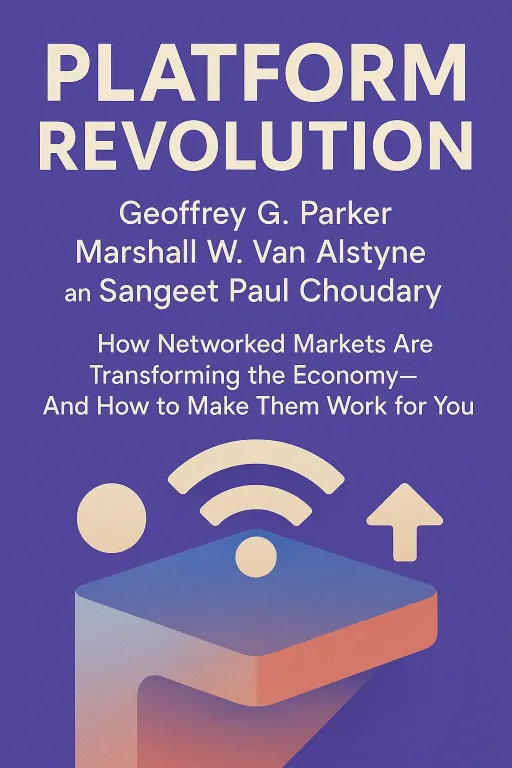
Nova: Well, today, Atlas, we’re diving into two groundbreaking books that, when combined, offer a powerful blueprint for exactly that. We’re talking about "Platform Revolution" by Geoffrey G. Parker, Marshall W. Van Alstyne, and Sangeet Paul Choudary, and then "Blue Ocean Strategy" by W. Chan Kim and Renée Mauborgne.
Atlas: Two heavy hitters! I imagine a lot of our listeners, the pragmatic innovators and driven builders among us, are constantly seeking those frameworks to fuel their ventures and sharpen their professional edge.
Nova: Absolutely. And what's fascinating about "Platform Revolution" is that it emerged from extensive, deep-dive research into the fundamental shifts happening with digital businesses, dissecting how companies like Google and Amazon truly built their empires. It’s not just theory; it’s an observation of a new economic reality. And "Blue Ocean Strategy," on the other hand, became a global phenomenon, teaching executives worldwide how to literally redraw market boundaries.
Atlas: So, we’re looking at how to build the new playing field, and then how to ensure you're the only one playing on it. That’s a compelling combination.
Nova: Exactly. Because in today's digital landscape, the rules of competition have fundamentally changed. It’s no longer just about optimizing existing processes; it’s about understanding the invisible forces that create entirely new forms of value.
The Platform Playbook: Unlocking Network Effects
SECTION
Nova: And that brings us to our first core idea: the almost magical power of platforms and network effects. Most businesses focus on creating a product or service. Platforms do something different. They create an. Think of it like a stage, where different groups of users come to interact and create value for each other.
Atlas: So, it's not just an app or a website. It’s more like a digital town square, where people meet for various reasons?
Nova: Precisely. And the key to their immense success lies in something called "network effects." This is where the value of the platform increases with every new user who joins. Imagine the first person to join a social media site. Not much value there, right? But as more and more friends join, the value for everyone skyrockets. The platform becomes more useful, more engaging, more essential.
Atlas: That makes perfect sense. I mean, who wants to be on a social network if none of their friends are there? But how does that translate into a competitive advantage? It sounds like a chicken-and-egg problem: you need users to attract users.
Nova: That's the million-dollar question, Atlas, and it’s where "Platform Revolution" offers profound insights. They call it the "bootstrapping problem." One classic example is how a particular online auction site, in its early days, focused on attracting sellers first. They understood that if you have unique items for sale, buyers will follow. They created a vibrant marketplace by making it incredibly easy for sellers to list, and then buyers flocked to find those unique treasures. The more sellers, the more buyers; the more buyers, the more sellers. A virtuous cycle.
Atlas: That sounds almost like magic. But how do you even building that initial critical mass? For our driven builders out there, trying to launch a new venture, that first step feels daunting.
Nova: It is. The book details several strategies. One is the "single-user utility," where the platform offers value to one set of users even if the other side isn't there yet. Think of a document creation tool that later adds collaboration features. Another is the "piggyback strategy," leveraging an existing platform's users. Or the "seed and grow" approach, where you manually recruit one side of the market. The core insight is that you have to solve the chicken-and-egg by focusing on creating initial value for side, knowing the other will follow.
Atlas: And for someone trying to sharpen their professional edge, how does thinking in "platform terms" help them? It seems very business-oriented.
Nova: That’s a great question. It's about shifting your mindset from being a "product" to being a "platform" for others. How can you connect people? How can you facilitate interactions? Maybe you become the go-to person in your team who connects disparate projects, or the expert who creates a knowledge-sharing hub. It’s about building a network around yourself where your value grows as more people interact through you or with the resources you provide. It's about becoming indispensable by enabling others.
Beyond the Red Ocean: Creating Uncontested Market Space
SECTION
Nova: Now, once you have a platform, how do you ensure you're not just creating a new, crowded "red ocean" of competition, full of sharks battling over shrinking profits? This is where "Blue Ocean Strategy" by Kim and Mauborgne comes in.
Atlas: So, instead of beating the competition, we just... make them irrelevant? That sounds like a dream for any pragmatic innovator out there who's tired of the constant grind.
Nova: Exactly. The core idea is "value innovation." Most companies compete in "red oceans," which are existing market spaces where the boundaries are defined and companies try to outperform rivals to grab a larger share of existing demand. "Blue oceans," on the other hand, are untapped market spaces, ripe for growth, where competition is irrelevant. It’s about creating new demand, not fighting over existing demand.
Atlas: But usually, differentiation comes at a higher cost, and low cost means less differentiation. How do you achieve both simultaneously? That sounds like a fundamental contradiction.
Nova: That’s the brilliance of "Blue Ocean Strategy." They argue that you achieve both by focusing on what they call the "Four Actions Framework": Eliminate, Reduce, Raise, and Create. Let me give you a classic example that really brings this to life, a company that redefined the entertainment industry.
Atlas: I'm all ears for a good story, especially one that shows how to break those perceived trade-offs.
Nova: Imagine a traditional circus. What does it have? Animal acts, star performers, multiple rings, concession stands, maybe some dated tents. Now, this particular company looked at that model and asked, "What can we eliminate or reduce that the industry takes for granted but adds little value to the customer experience, or is even a high cost?" They eliminated animal acts, which were expensive and increasingly controversial. They reduced the reliance on star performers, which also cut costs significantly.
Atlas: Okay, so they cut out a lot of the traditional circus elements. That makes sense for cost, but what about the "differentiation" part? What did they or?
Nova: This is where the magic happens. Instead of competing with Ringling Bros. on traditional circus elements, they started to the artistic quality, the storytelling, the live music, and the overall theatrical experience. They a sophisticated, high-end production that appealed to adults and corporate clients, blending circus skills with theatrical narrative and artistic expression. They offered the thrill of the circus with the intellectual and aesthetic richness of theater.
Atlas: That's a brilliant example of reframing the problem. They didn't just make a better circus; they made something entirely new that drew from both the circus and theater worlds. It’s like they designed a new game with new rules.
Nova: Precisely. They created a blue ocean, an uncontested market space, where they were the sole occupants for a long time. They offered premium entertainment at a price point that was lower than a Broadway show but higher than a traditional circus, capturing new demand.
Atlas: How can our listeners apply this to finding their own "blue ocean" in their careers or ventures? It's easy to see for a big company, but for an individual or a small team?
Nova: It's about looking at your existing industry, your role, or even your personal skill set, and applying those four questions: What can you that’s considered standard but adds little value? What can you below industry standards? What can you well above industry standards? And what can you that the industry has never offered? For a career, maybe it’s eliminating busy work, reducing time spent on low-impact tasks, raising your expertise in a niche area, and creating a unique service offering that combines seemingly disparate skills.
Connecting the Dots & Synthesis
SECTION
Nova: So, when you bring these two ideas together – the power of platforms and the art of creating blue oceans – you get an incredibly potent strategy for competitive advantage. A blue ocean can be a platform, or a platform can enable blue oceans.
Atlas: So, it's about building a new game, and then making sure you're the only one playing it, or at least setting the rules. It’s a complete shift from a competitive mindset to a creative one.
Nova: Exactly. It's moving beyond simply trying to out-compete to actively redefining the playing field. Platforms thrive on network effects, creating value by connecting diverse groups. Blue oceans thrive on value innovation, creating new market space by simultaneously pursuing differentiation and low cost. Both require a fundamental shift in perspective.
Atlas: It sounds like a journey, not a sprint. Small steps build great things, right? Our listeners who are driven by impact and seeking growth will find this incredibly empowering. It’s about not just working harder, but working smarter by truly innovating.
Nova: That's the profound insight here. The true competitive advantage in the digital age isn't about having more resources or just optimizing existing processes; it's about vision, the courage to redefine market boundaries, and the strategic foresight to build ecosystems where value multiplies. It’s about understanding that the biggest gains often come from not joining the fray, but from creating an entirely new one.
Atlas: This isn't just theory; it's a blueprint for impact, for making a lasting mark. It’s about finding that unique space where your contribution is undeniable because you built the space itself.
Nova: It’s about becoming the architect of your own success, whether that's for a company, a team, or your own professional trajectory. I encourage all our listeners to think about where their "red ocean" is, and how they might begin to chart a course for a "blue ocean," perhaps even one powered by a platform model.
Atlas: That's powerful. Thank you, Nova, for shedding light on these transformative ideas.
Nova: My pleasure, Atlas.
Atlas: This is Aibrary. Congratulations on your growth!