

Beyond Centralization: Designing Distribute Governance for a Complex World
Golden Hook & Introduction
SECTION
Nova: For centuries, we've organized ourselves around the idea of a central authority, a singular power structure, whether it's a government, a corporation, or even a community leader. But what if that core assumption is not just outdated, but actively holding us back from navigating the complexities of our hyper-connected digital age?
Atlas: Whoa. That's a bold claim, Nova. Are you suggesting the very bedrock of our societal organization is... crumbling? Or that we've just been looking at it all wrong? I'm intrigued, but also a little skeptical.
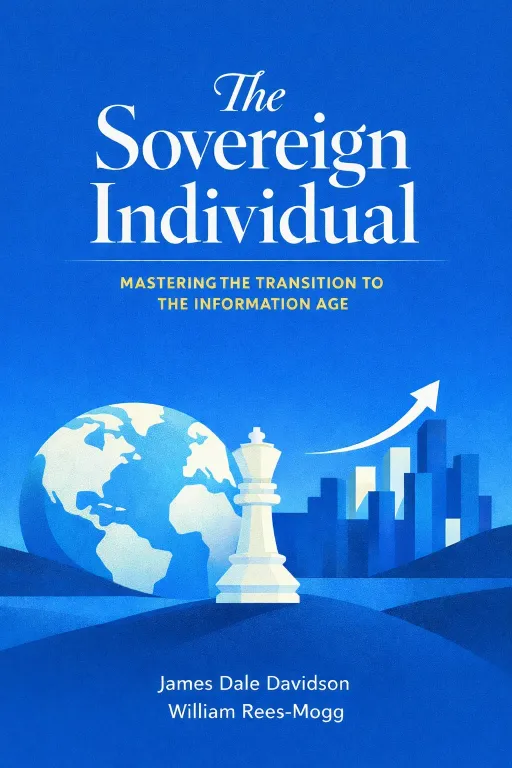
Nova: Exactly the reaction I'm looking for, Atlas! Because the truth is, while it might feel like a radical idea today, some thinkers were predicting this tectonic shift decades ago. Today, we're diving into that very prophecy with a look at "The Sovereign Individual" by James Dale Davidson and Lord William Rees-Mogg. These guys, an investment advisor and a former editor of The Times, had this uncanny knack for spotting massive cultural and economic shifts long before anyone else.
Atlas: Right, I've heard that book is like a crystal ball for the digital age. And we're pairing that with the more contemporary insights from "Blockchain and the New Architecture of Trust" by Don and Alex Tapscott, who are really at the forefront of digital transformation.
Nova: Absolutely. It's about bridging that visionary foresight with the practical, technological blueprints for how we actually build this new future.
The Inevitable Shift: From Centralized Control to Digital Sovereignty
SECTION
Atlas: So, you're saying our traditional governance models, these big, slow, centralized hierarchies, are just too clunky for the speed of digital transformation? That's going to resonate with anyone who's ever tried to get a large organization to pivot quickly.
Nova: Precisely. We're clinging to these top-down structures, and in doing so, we're missing the immense power of distributed decision-making and this concept of emergent order. Davidson and Rees-Mogg, in "The Sovereign Individual," foresaw a future where nation-state power would wane significantly, and individuals, connected through decentralized networks, would gain unprecedented sway. They called it digital sovereignty.
Atlas: Digital sovereignty. That sounds incredibly empowering, but also potentially chaotic. What does that actually mean for everyday people? Isn't a completely sovereign individual a recipe for, well, a lack of cohesive governance? For those of us trying to architect resilient systems, that sounds a bit like throwing out the blueprint entirely.
Nova: It's not about chaos, Atlas, but rather a different of order. Think of it like this: traditionally, if you wanted to do something significant, you had to operate within the rigid boundaries and rules of your nation-state. But with digital tools, individuals can now connect, transact, and even form communities globally, often bypassing traditional gatekeepers. For example, a developer in Mumbai can collaborate on a project with someone in Buenos Aires, funding it with cryptocurrency, totally outside the purview of their national banks or even traditional legal systems. That's digital sovereignty in action – the ability to operate and self-govern within these emergent digital networks.
Atlas: I see. So it's less about the nation-state disappearing entirely, and more about its influence being diluted as individuals gain more options and leverage through these digital pathways. It's like the internet made us all global citizens, but now blockchain might give us global and outside traditional borders.
Nova: Exactly. It's an emergent order, where rules and norms aren't dictated from the top, but arise from the interactions and agreements within these distributed networks. The challenge, and the opportunity, is to design these new systems to be more resilient and equitable than what came before. Which naturally leads us to the second key idea we need to talk about.
Building Trustless Futures: Blockchain, DAOs, and Ethical Distributed Governance
SECTION
Atlas: So, how exactly do we this new, resilient, equitable system? How does this digital sovereignty manifest in a practical, governed way, rather than just individual freedom? Because freedom without structure can still lead to problems.
Nova: That's where the Tapscotts come in with "Blockchain and the New Architecture of Trust." They detail how blockchain technology can create these transparent, immutable, and decentralized systems. And the most compelling manifestation of this in governance today is the rise of Decentralized Autonomous Organizations, or DAOs.
Atlas: DAOs. That term gets thrown around a lot. For our listeners who are trying to build ethical frameworks and ensure integrity, what does a blockchain that makes it so revolutionary for governance? How does it prevent the pitfalls of traditional systems, like corruption or centralized power grabs?
Nova: It comes down to two core properties: transparency and immutability. Imagine a traditional organization where decisions are made behind closed doors, and financial ledgers can be altered. A DAO, built on blockchain, operates with rules encoded in smart contracts – these are self-executing agreements. Every transaction, every vote, every decision is recorded on a public, unchangeable ledger. So, when we talk about "trustless coordination," it doesn't mean no trust at all. It means you don't have to trust a central authority because the rules are transparent, the execution is automatic, and the record is immutable. The trust is in the code, not in a person or a single institution.
Atlas: So basically you're saying, instead of trusting a CEO or a government official, you're trusting a set of transparent, pre-agreed rules that everyone can see and verify? That's a huge shift from how we normally operate. But what about the 'ethical' part of DAOs? The deep question we’re grappling with is: how can we apply these principles to create more effective DAOs? Because even code can be designed to be unethical, right?
Nova: Absolutely, Atlas. The technology itself is neutral; its ethical outcome depends entirely on its design. For DAOs to be truly effective and ethical, architects need to bake in principles like fair distribution of power from the outset. This means avoiding situations where a few large token holders can dictate all decisions. It means designing robust dispute resolution mechanisms, so disagreements don't lead to gridlock. And it requires transparent communication channels, so members are informed and engaged. It's about designing for human nature within a decentralized framework, ensuring that the architecture fosters not just efficiency, but also equity and resilience.
Atlas: That's a critical point. It's not just about the tech, it's about the social contracts and human-centered design principles embedded within that tech. An ethical DAO isn't just a smart contract; it's a community built on shared values and transparent rules for interaction.
Synthesis & Takeaways
SECTION
Nova: Precisely. The future of governance, as Nova's Take suggests, lies in leveraging these decentralized architectures to build systems that are more resilient, more equitable, and more responsive to a complex, rapidly changing world. It's a journey from rigid hierarchies to fluid, adaptive networks.
Atlas: So, for anyone out there trying to architect the next generation of organizations, whether it's a DAO, a community initiative, or even just a better way to make decisions in their own team, what's one core principle they absolutely cannot ignore when thinking about distributed governance?
Nova: It's the principle of designing for. You can't impose integrity from the top down in a distributed system; it has to emerge from the transparent, immutable interactions of its participants. Focus on creating rules and incentives that align individual actions with collective well-being, and then let the system evolve. The beauty is that when the foundation is sound, the collective intelligence of the network can achieve far more than any centralized authority ever could.
Atlas: That’s a powerful idea. It’s about building the garden, not just planting a single tree, and trusting the ecosystem to flourish. For our listeners, I encourage you to reflect: where in your own life or work could you shift from centralized control to a more distributed, transparent, and ethically designed approach? Where can you foster emergent integrity?
Nova: A fantastic question to leave our listeners with. The future isn't just happening to us; we're actively designing it, one distributed system at a time. This is Aibrary. Congratulations on your growth!