

Disrupting the Classroom
Content
Content
Narrator: Introduction
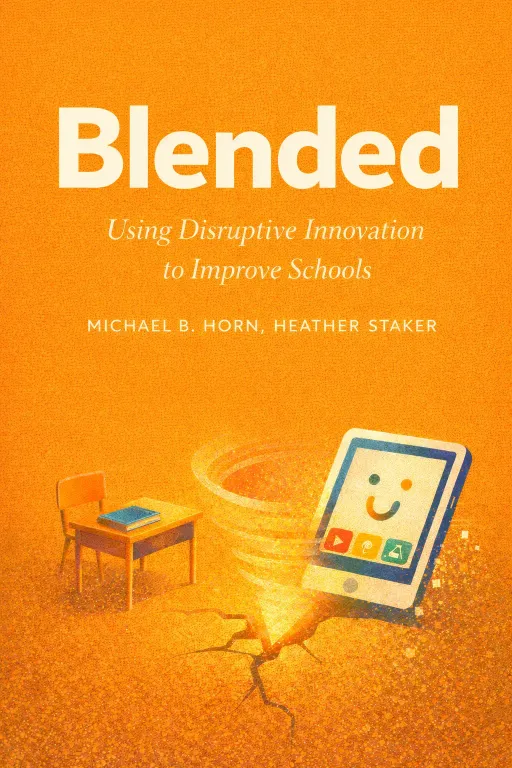
Imagine a kindergarten in South Los Angeles, where over 90 percent of students qualify for free lunch. The state has just slashed funding, forcing class sizes to jump from 20 to 28. By all accounts, this should be a story of decline. Yet, within a year, the students go from 61 percent "below basic" in reading to 91 percent "proficient or advanced," and the school achieves an academic performance score of 991 out of 1000, one of the highest in California. How is this possible? The answer lies not in more money or a longer school day, but in a fundamental redesign of the classroom itself. This transformation is the central focus of the book "Blended: Using Disruptive Innovation to Improve Schools" by Michael B. Horn and Heather Staker. They argue that this isn't an isolated miracle, but a repeatable blueprint for the future of education.
Key Insights
Key Insight 1: The Factory Model of Schooling Is Obsolete
For over a century, our schools have operated on a factory-based model. It was designed for a different era, with a different purpose: to efficiently process large numbers of students for an industrial economy. This system batches students by age, moves them along at a uniform pace, and sorts them based on performance. The authors acknowledge this model was spectacularly successful for its time, lifting millions into the middle class. The problem is that the world has changed, but the model hasn't. Today’s economy demands knowledge workers, and society expects schools to educate every child to their fullest potential. The factory model, with its one-size-fits-all approach, is structurally incapable of meeting this goal. It inherently creates gaps in learning, as some students are left behind while others are held back. The book argues that in a world where we can personalize everything from our news feeds to our shopping, it’s time to demand the same for our children's education. The core challenge is that the very design of the traditional classroom makes it nearly impossible to customize learning for each student’s distinct needs.
Key Insight 2: Blended Learning Is a Disruptive Innovation
The book frames its argument using the theory of disruptive innovation, developed by co-author Michael Horn’s mentor, Clayton Christensen. A disruptive innovation is not necessarily a better product, but one that is simpler, more affordable, and more accessible. It typically starts by serving customers at the bottom of a market or by creating new markets where there was "nonconsumption"—people who had no access to the existing solution. The authors use the example of TurboTax. It didn't start by competing with high-end accounting firms; it started by serving people who couldn't afford an accountant at all. Over time, it improved and moved "upmarket."
In education, online learning is the disruptive force. It began in the niches of the K-12 system: offering Advanced Placement courses to rural students whose schools couldn't afford a physics teacher, providing credit recovery for students at risk of dropping out, and serving homeschooled students. For these students, a basic online course was far better than their alternative, which was often nothing. As technology improves, online learning is moving upmarket, integrating with traditional instruction to create blended learning. This hybrid approach is now challenging the very foundation of the monolithic factory model by offering a new definition of quality centered on personalization, access, and cost-effectiveness.
Key Insight 3: Blended Learning Is the Engine for Personalized Learning
For decades, educators have known the power of one-on-one tutoring. A famous 1984 study by Benjamin Bloom found that the average tutored student performed better than 98 percent of students in a traditional classroom. The problem has always been scale. Providing a personal tutor for every child is financially impossible. Horn and Staker argue that blended learning is the engine that finally makes personalized, competency-based learning possible for every student. It uses technology to do what a single teacher cannot: allow each student to learn at their own pace.
The book shares the powerful story of a fifth-grade student named Jack. At the beginning of the year, Jack was at the bottom of his class in math and believed he just wasn't a "math person." His school, Santa Rita Elementary, transformed his class into a blended-learning environment using Khan Academy's online platform. For a portion of his math block, Jack worked through online tutorials and exercises that adapted to his level. He could pause, rewind, and practice a concept until he mastered it. After just seventy days, Jack was no longer in the bottom group. He had become one of the top four students in his class, working on material well above his grade level. Blended learning gave him the customized pathway he needed to unlock his potential.
Key Insight 4: A Practical Blueprint with Diverse Models
"Blended" is not just a theoretical book; it is a practical guide. The authors make it clear that there is no single "blended learning" model. Instead, they provide a taxonomy of different approaches that schools can adapt to their specific needs. These models range from the Station Rotation, where students cycle through online learning, small-group instruction, and independent work, to the Flex model, where online learning is the backbone and teachers provide support as needed.
To illustrate this, the book tells the story of KIPP Empower Academy, the school mentioned in the introduction. Faced with budget cuts that forced an increase in class size from 20 to 28, the school's leaders adopted a Station Rotation model for their kindergarteners. By having one group of students work independently on computers, they could maintain a low adult-to-student ratio of 1-to-14 during small-group instruction, even with larger overall classes. This not only solved their budget crisis but also led to extraordinary academic gains. This example shows how blended learning can be a strategic tool to solve real-world problems, from budget constraints to the need for differentiated instruction.
Key Insight 5: Success Requires More Than Technology
Perhaps the most crucial insight from the book is that technology is not a silver bullet. A successful blended learning implementation is about fundamental changes in strategy, motivation, and culture. The authors introduce the "Jobs-to-Be-Done" theory, asking a critical question: what "job" are students hiring a school to do? They argue students are primarily motivated to feel successful and have fun with friends. The traditional school model often fails at both. Blended learning, by allowing for mastery and personalized success, can be designed to do this job far better.
Furthermore, the book stresses that "culture eats strategy for breakfast." A school can have the best technology and the most innovative model, but it will fail without a culture that supports student agency, collaboration, and continuous improvement. The authors advocate for a "discovery-driven planning" approach, where implementation is not a rigid, top-down mandate but an iterative process of testing assumptions and learning along the way. The ultimate goal is to build a student-centered system, and that requires a holistic approach that elevates the role of the teacher, redesigns physical spaces, and, most importantly, creates a culture where every student can thrive.
Conclusion
The single most important takeaway from "Blended" is that technology is not the end goal of educational reform; it is the means to an end. Blended learning is the enabling engine that can finally power a systemic shift away from the outdated factory model toward a truly student-centered system, one that delivers on the promise of personalized, competency-based learning for every child. It breaks the old trade-offs between quality, cost, and access, allowing schools to achieve more, period.
The book leaves us with a profound challenge, captured in a quote from Eric Hoffer: "In a time of drastic change it is the learners who inherit the future. The learned usually find themselves beautifully equipped to live in a world that no longer exists." For educators, parents, and policymakers, the question is not whether our schools will change, but whether we will be the architects of that change. Will we cling to the familiar structures of a world that is gone, or will we become learners ourselves, using the tools of disruptive innovation to build the schools our children deserve?