

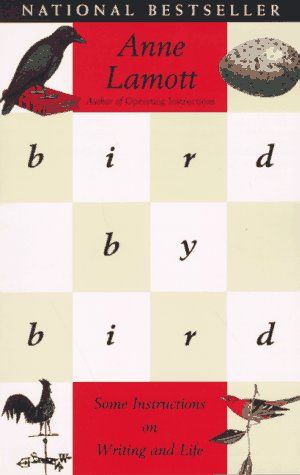
Bird by Bird
Some Instructions on Writing and Life
Introduction
Nova: Picture this: a ten-year-old boy sits at a kitchen table, surrounded by unopened books about birds, binder paper scattered everywhere, and he's crying. He has a school report due the next morning. He's had three months to do it. And now he's completely paralyzed by the enormity of the task. Then his father sits down beside him, puts an arm around his shoulder, and says, "Bird by bird, buddy. Just take it bird by bird."
Nova: : That story... that is just devastatingly relatable. I've been that kid so many times. Staring at a blank page, totally overwhelmed. But who is the father in that story?
Nova: That father was Kenneth Lamott, a writer himself. And the little boy's older sister, watching this unfold at their family cabin in Bolinas, California, grew up to become Anne Lamott. She took that moment, that simple piece of fatherly advice, and turned it into the title and the beating heart of one of the most beloved books about writing ever published: Bird by Bird: Some Instructions on Writing and Life.
Nova: : So this is more than just a writing manual, I'm guessing. It sounds deeply personal.
Nova: Exactly. Published in 1994, it's now sold over a million copies and become a perennial New York Times bestseller. It's been called "a warm, generous, and hilarious guide through the writer's world and its treacherous swamps" by the Los Angeles Times. But what makes it so enduring is that Lamott writes not from some ivory tower but from a place of radical vulnerability. She talks about her own fears, her jealousy, her procrastination, her terrible first drafts.
Nova: : Okay, I'm hooked. Let's get into it. What are the ideas from this book that have made it such a touchstone for writers for nearly three decades?
Nova: Let's find out. Bird by bird.
Why Bad Writing Is Your Best Friend
The Shitty First Draft
Nova: If there's one idea from Bird by Bird that has entered the cultural bloodstream, it's the concept of the "shitty first draft." Lamott says that all good writers write them. There's no way around it. And this is actually, she says, "even better news" than the idea of short assignments.
Nova: : I have to admit, I find that genuinely liberating. But what does she actually mean by it?
Nova: She describes the first draft as "the child's draft." You let it all pour out. You let it romp all over the place. Nobody is going to see it. If a character wants to say something ridiculous, you let them. You're not judging. You're not editing. You're just getting it down. She writes: "Almost all good writing begins with terrible first efforts. You need to start somewhere."
Nova: : But isn't there a voice in your head screaming that it's garbage the whole time?
Nova: Absolutely. Lamott is hilariously honest about this. She talks about all the other voices in your head when you sit down to write — what she calls "banshees and drunken monkeys." The voices of anxiety, judgment, doom, guilt. There might be "a Nurse Ratched-like listing of things that must be done right this moment." Foods that must come out of the freezer, appointments to make, hairs to tweeze.
Nova: : So how do you push past that noise?
Nova: She says you hold an imaginary gun to your head and make yourself stay at the desk. You clear a space for the writing voice, "hacking away at the others with machetes." Then you begin to compose sentences. You string words together like beads. And here's the key insight: the first draft isn't supposed to be good. It's supposed to exist.
Nova: : So the magic happens in revision?
Nova: Exactly. Lamott says the first draft is where you find out what you're writing about. In the second draft, you fix it up — you take what's there and make it more accurate, more alive. And in the third draft, you go after it with a dental tool, checking every metaphor, every rhythm. But you cannot revise what doesn't exist. The shitty first draft is the essential raw material.
Nova: : This reminds me of something else she's famous for — the Polaroid analogy.
Nova: Yes! She says writing a first draft is like watching a Polaroid develop. You can't know exactly what the picture is going to be. You just have to wait and watch as details emerge. She tells this story about being assigned to write about the Special Olympics. She had no idea what her angle was until a tall man handed her a Polaroid of himself with two friends who had Down syndrome. He pointed to his own image and said, "That is one cool man." That was the moment the story started coalescing. You have to trust the process.
How to Start When You Can't Start
The One-Inch Picture Frame
Nova: The second core insight in Bird by Bird is about how to begin when the task feels impossible. This is where her father's advice really comes to life. Lamott introduces what she calls "short assignments."
Nova: : I think I know where this is going. Instead of thinking about writing an entire novel...
Nova: You think about writing just one small thing. Lamott says: "It reminds me that all I have to do is to write down as much as I can see through a one-inch picture frame." That's your assignment for now. Just that one paragraph. Just that one description of the river at sunrise. Just the first time the man sees the woman he will marry.
Nova: : That's such a vivid image — the one-inch picture frame. It makes the terrifying manageable.
Nova: It really does. She says tackling a novel or a memoir is like trying to scale a glacier. Your mind freezes. But writing just what you can see through a one-inch frame? That you can do. She also quotes E. L. Doctorow, who said: "Writing a novel is like driving a car at night. You can see only as far as your headlights, but you can make the whole trip that way."
Nova: : So you don't need to know the destination. You just need to see two or three feet ahead.
Nova: Exactly. And Lamott extends this to beginnings. She tells her students that good writing is about telling the truth. If you don't know where to start, start with your childhood. Write down all your memories as truthfully as you can. What happened at your birthday parties. What people ate. What they wore. Write about your first few years in school. Just get it down.
Nova: : That feels almost like a therapy exercise.
Nova: In a way, it is. Lamott believes writing and reading decrease our sense of isolation. They deepen and widen our sense of life. She has this beautiful line: "It's like singing on a boat during a terrible storm at sea. You can't stop the raging storm, but singing can change the hearts and spirits of the people who are together on that ship."
Nova: : Wow. So the act of writing itself, the process, is the point — not just the finished product.
Nova: That's one of her most radical arguments. She tells her students that publication is probably not going to bring them financial security, peace of mind, or joy. What it might bring is "ruin, hysteria, bad skin, unsightly tics, ugly financial problems." But writing? Writing is the reward. She compares it to discovering that while you thought you needed the tea ceremony for the caffeine, what you really needed was the tea ceremony.
Perfectionism, Jealousy, and Radio Station KFKD
The Enemies of Writing
Nova: One of Lamott's most quoted lines is: "Perfectionism is the voice of the oppressor, the enemy of the people." She means this literally. She says perfectionism will keep you "cramped and insane your whole life" and is the main obstacle between you and a shitty first draft.
Nova: : Why does she see perfectionism as so destructive? I mean, isn't wanting to do good work a good thing?
Nova: The distinction she makes is crucial. Perfectionism isn't the desire for excellence. Perfectionism is the obsessive belief that if you run carefully enough, hitting each stepping-stone just right, you won't have to die. But the truth, she says, is that you will die anyway, and a lot of people who aren't even looking at their feet are going to do better than you and have more fun doing it.
Nova: : That's almost a spiritual observation, not just a writing tip.
Nova: It absolutely is. And she connects it to clutter and mess. She has this wonderful line: "Clutter and mess show us that life is being lived. Tidiness makes me think of held breath, of suspended animation." She says what people forgot to tell us as children is that we need to make messes in order to find out who we are and why we are here.
Nova: : So the messy first draft, the messy life — that's the raw material.
Nova: Exactly. And then there's another enemy she identifies: what she calls Radio Station KFKD. K-F-K-D. She describes it as the radio station playing in your head, broadcasting on two channels. On one channel, it's telling you how brilliant and amazing you are. On the other, it's telling you how worthless and talentless you are. Both channels, she says, are equally destructive.
Nova: : Oh, I know that station. I'm a loyal listener. So what do you do about it?
Nova: She says you have to recognize it and try to turn down the volume. And closely related to KFKD is jealousy. Lamott is brutally honest about how jealousy can consume writers — seeing someone else get a great review, a big advance, a prize. She says the only real antidote is to remember what dying people teach us: to pay attention, to forgive, and not to sweat the small things.
Nova: : She talks about death quite a bit for a writing book, doesn't she?
Nova: She does. Lamott lost her father to brain cancer, and she lost her best friend Pammy to cancer as well. She wrote books about both of them. Those experiences gave her a profound sense of perspective. In the chapter on jealousy, she essentially says: look, we're all going to die, so maybe stop obsessing over who got a better review and just do your work.
Nova: : And she has another metaphor — broccoli, right?
Nova: Yes! The broccoli chapter is one of the most unusual in the book. Lamott uses broccoli as a metaphor for intuition. She says that when she's stuck, she tries to tune into what her intuition is telling her, the same way you might try to hear what your body is telling you about what it needs. Sometimes the answer is unexpected. Sometimes your intuition says something as mundane as "broccoli" — but you learn to listen. It's about quieting the noise and trusting that small, still voice.
Routine, Character, Community, and Why We Write Anyway
The Craft and the Life
Nova: Lamott is very practical about the day-to-day of writing. She believes in routine. She tells her students: "You try to sit down at approximately the same time every day. This is how you train your unconscious to kick in for you creatively."
Nova: : So you can't just wait for inspiration to strike.
Nova: Right. She describes the process with painful honesty: you sit there. You stare at the page for an hour. You begin rocking, just a little at first. You look at the ceiling, at the clock. Then, eventually, you begin to compose sentences. It's not glamorous. But it's how it works.
Nova: : What about the actual craft elements? Plot, character, dialogue?
Nova: She has strong opinions on all of them. On plot, she says it grows out of character. If you focus on who the people in your story are, the plot will emerge naturally. She also offers a formula from her friend Alice Adams: ABDCE — Action, Background, Development, Climax, Ending. You start with action that draws readers in. Then you give background. Then you develop the characters so we learn what they care about. The drama builds to a climax, and then there's the ending where things are genuinely different.
Nova: : And character? She seems to spend a lot of time on that.
Nova: She says getting to know your characters is like watching a Polaroid develop — it takes time. She suggests looking within yourself to find your characters. Inside you, she says, there's a con man, an orphan, a nurse, a king, a hooker, a preacher, a loser, a child, a crone. Go into each of these people and capture how they feel and talk. She also quotes Ethan Canin: "Nothing is as important as a likable narrator. Nothing holds a story together better."
Nova: : What about the practical tools? Index cards, I think I read somewhere?
Nova: Yes! Lamott is a big believer in index cards. She carries them everywhere. She says that Henry James might have said "A writer is someone on whom nothing is lost" while looking for his glasses, which were on top of his head. The point is, you have to capture ideas when they come. You can't trust your memory. She jots down snippets of conversation, observations, anything that strikes her, and keeps the cards organized.
Nova: : And she also talks about writing groups, doesn't she?
Nova: She does, and she's very candid about the dangers. A bad writing group can crush your spirit. She says you need to find people who can give feedback without being merciless. But a good group is invaluable. They help you see what you can't see yourself. They remind you that writing doesn't have to be a lonely endeavor.
Nova: : So after all of this — the shitty first drafts, the one-inch frames, the battle against perfectionism — what's her ultimate answer to the question of why we write?
Nova: She says: "Because this business of becoming conscious, of being a writer, is ultimately about asking yourself, How alive am I willing to be?" Writing is about paying attention. It's about telling the truth. It's about reaching across the void of human isolation and saying: you are not alone. She sees it as almost a sacred act. Not because writers are special, but because paying attention and telling the truth is how we make sense of being alive.
Conclusion
Nova: So here's what I think makes Bird by Bird endure, nearly three decades after it was published. It's not a book of writing techniques. It's a book about the writer's soul. Lamott gives you permission to be messy, to be afraid, to be jealous, to procrastinate, to write terrible first drafts — and to do it all anyway.
Nova: : The core ideas are so simple in the best way. Take it bird by bird. Write shitty first drafts. Look through a one-inch picture frame. Perfectionism is the enemy. Pay attention. Tell the truth. But the way she delivers them — with vulnerability and humor and that self-deprecating honesty — that's what makes it stick.
Nova: Exactly. She never pretends she has it figured out. She's in the trenches with you. She tells you that her writer friends "do not go around beaming with quiet feelings of contentment" but walk around with "haunted, abused, surprised looks on their faces." And yet, when they're working, they feel more alive than at any other time.
Nova: : And that's the paradox at the heart of the book, isn't it? Writing is hard. It might not make you rich or famous or happy. But it's still worth doing.
Nova: Because writing has so much to give, so much to teach, so many surprises. The act of writing turns out to be its own reward. And if you can learn to approach not just writing but life itself bird by bird — one small, manageable piece at a time, with patience and attention and a willingness to make a mess — you might just find yourself more alive than you ever expected to be.
Nova: : I love that. So the final question, the one Lamott asks her readers: How alive am I willing to be?
Nova: And if you want to find out? Sit down. Pick up the one-inch picture frame. And start writing. Bird by bird.
Nova: : This is Aibrary. Congratulations on your growth!