

The AI-Driven Edge: How to Leverage Machine Learning for Smarter Real Estate Investments
Golden Hook & Introduction
SECTION
Nova: What if the biggest risk in real estate isn't market volatility, or interest rates, but simply relying on intuition when powerful AI can now predict market shifts with astounding accuracy? We're talking about transforming real estate from a gut feeling to a data-driven science.
Atlas: Wow, Nova, that's a bold claim right out of the gate. "Gut feeling" has been the bedrock for so many seasoned investors. Are you saying that era is... over? For our listeners who are looking for strategic foresight and to build value, this sounds like a paradigm shift.
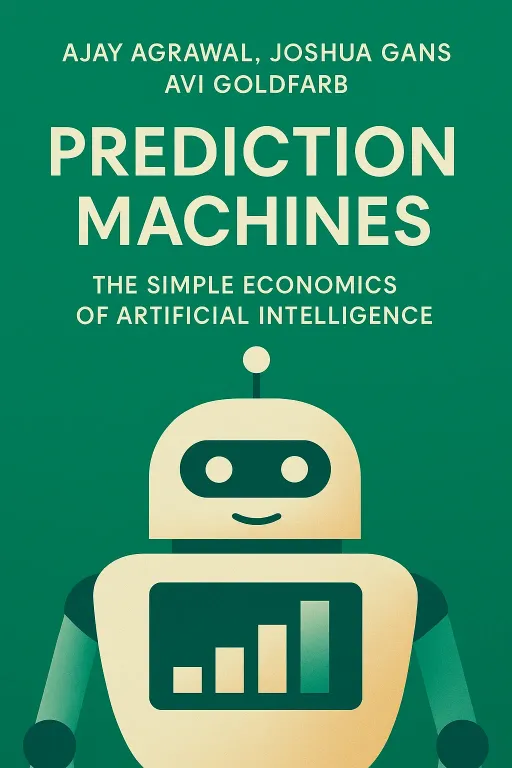
Nova: Absolutely, Atlas. And it’s precisely what we're exploring today, drawing heavily from the groundbreaking insights in "The AI-Driven Edge: How to Leverage Machine Learning for Smarter Real Estate Investments." This book really crystallizes how artificial intelligence and big data are not just buzzwords, but powerful tools fundamentally reshaping the landscape of real estate investment, transforming intuition into precise, profitable strategy. We’re particularly looking at the foundational ideas from "Prediction Machines" by Ajay Agrawal, Joshua Gans, and Avi Goldfarb, who essentially argue that AI makes prediction cheaper and more abundant, much like electricity did for power. And we're also pulling from "Big Data" by Viktor Mayer-Schönberger and Kenneth Cukier, a seminal work that showed us the sheer power of analyzing vast datasets.
Atlas: Okay, so we're talking about moving beyond the crystal ball and into something more… scientific. I'm curious how this cheap prediction actually plays out in the messy, human world of real estate.
AI as a Prediction Machine: Lowering the Cost of Uncertainty
SECTION
Nova: That’s the perfect question, because the core insight from "Prediction Machines" is revolutionary. They argue that AI is fundamentally a prediction technology, and it lowers the cost of prediction. Think about it like this: For decades, real estate investment was like driving without GPS. You had maps, you had experience, you had a good sense of direction, but you were still guessing about traffic, road closures, or the fastest route.
Atlas: Right, you relied on your own knowledge, maybe a co-pilot, and a lot of intuition.
Nova: Exactly. Now, imagine AI is the ultimate, real-time GPS for real estate. It’s constantly analyzing countless variables – economic indicators, demographic shifts, even hyper-local development plans – to predict property values, demand, and risk. It takes the cost of "knowing what's next" and drives it down dramatically. Let me paint a picture.
Atlas: Oh, I love a good picture.
Nova: Consider a seasoned real estate broker, let's call her Sarah, who's been working in a city for thirty years. She has an incredible intuition about neighborhoods, knows all the local players, and can "feel" when an area is about to boom. She advises her client, a developer, to invest heavily in a particular commercial district, confident in her gut feeling. Her advice is based on years of experience, recent sales she's seen, and conversations with her network.
Atlas: That sounds like a solid, traditional strategy. The kind of person you want on your team.
Nova: Absolutely. But simultaneously, an AI model is at work, analyzing data Sarah couldn't possibly process. It's looking at anonymized mobile phone data showing a subtle but consistent increase in foot traffic from young professionals to a, adjacent district, not Sarah's pick. It's correlating this with online search trends for specific types of cafes and co-working spaces, new business registrations, and even micro-changes in public transport routes that are months away from physical implementation. The model predicts a significant upward trend in property values in this adjacent district, while Sarah's chosen area is showing signs of plateauing, despite her intuition.
Atlas: Hold on, so Sarah, with all her experience, is potentially missing a huge opportunity because she's limited by human processing power and the data she can personally observe? That sounds like a harsh reality check for anyone who trusts their gut in high-stakes environments.
Nova: Precisely. The cause here isn't Sarah's lack of skill, but the inherent limitations of human cognitive bias and the sheer volume of data she access or synthesize quickly. The AI's process involves continuously crunching these subtle, often disparate indicators. The outcome is that the developer, if they listen to the AI, invests in the emerging micro-market, securing properties at current prices before the general market catches on, leading to significantly higher returns than Sarah's perfectly logical, but ultimately less informed, recommendation.
Atlas: That's incredible. It's like the AI isn't just predicting, it's seeing the future before it even has a name. But for our listeners who are building for the future and creating lasting value, isn't there still an 'art' to real estate? Can a machine truly understand the 'feel' of a neighborhood or the human element of negotiation and community building?
Nova: That's a critical point, Atlas, and it brings us beautifully to the second key idea. AI isn't replacing the art; it's refining the canvas. It's augmenting human strategists.
Big Data: Unlocking Real Estate's Hidden Patterns
SECTION
Nova: Think about it: if AI makes prediction cheaper, what's the raw material it needs? Data, and lots of it. This is where "Big Data" by Mayer-Schönberger and Cukier comes in. They emphasize the power of analyzing vast datasets to uncover patterns and correlations invisible to traditional methods. Real estate data, from zoning changes to foot traffic, becomes a predictive goldmine.
Atlas: So you're saying every piece of information, no matter how small or seemingly unrelated, could hold a clue? I can see how that would appeal to an innovator, but what kind of data are we even talking about? And how do we ethically harness this 'predictive goldmine' without crossing lines or creating unfair advantages?
Nova: That's a valid concern, and ethical data use is paramount. But let's look at the sheer potential first. Imagine an investor, Liam, who wants to find an undervalued multi-family property. Traditionally, he'd look at comps, neighborhood demographics, maybe local school ratings and crime statistics. All good, solid data.
Atlas: Standard due diligence.
Nova: Right. Now, an AI-driven system is layered on top. It’s analyzing anonymized cell phone location data to track actual pedestrian flow patterns at different times of day, identifying areas with increasing evening activity. It's scraping social media for sentiment analysis within specific zip codes, looking for discussions about new community initiatives or local business growth. It’s even cross-referencing public permit applications for unexpected renovations or upcoming infrastructure projects that haven't hit mainstream news yet.
Atlas: Wow. So it's not just the of data, it's the and the. That makes me wonder, how does this actually play out in finding something truly hidden?
Nova: Here’s the illuminating case. Liam, relying on his traditional reports, might identify Unit A in a generally stable neighborhood. The AI system, however, notices a subtle but significant uptick in a specific type of creative professional moving into a, slightly older and seemingly less desirable neighborhood – let's call it District B. This isn't visible in broad demographic reports. The AI correlates this with an increase in small, independent art galleries and niche coffee shops, and a slight but consistent rise in local event attendance.
Atlas: So, the AI is detecting the early tremors of gentrification or a cultural shift that's not yet reflected in property prices.
Nova: Exactly. The cause is the limitations of aggregated, broad data that misses these micro-trends. The process is the AI's ability to connect seemingly disparate data points – cell phone pings, social media chatter, local business permits – to paint a granular, real-time picture of an emerging micro-market. The outcome for Liam, if he leverages this insight, is identifying an undervalued property in District B, purchasing it before the wider market realizes its potential, and seeing significant appreciation as the area transforms. This isn't just about making money; it's about being ahead of the curve, spotting disruptive trends, and investing in what will become sustainable value.
Atlas: That's a great way to put it. It sounds like it's not just about prediction, but about understanding the behind the market movements, which is crucial for building for the future. But for listeners who are not data scientists, how accessible is this? What’s the barrier to entry for someone looking to apply these insights?
Nova: That's a very practical question, Atlas. And the exciting part is that the tools are becoming increasingly user-friendly. While the underlying algorithms are complex, the interfaces are being designed for strategists and innovators like our listeners. The key is understanding and then seeking out the platforms or partnerships that provide these capabilities.
Synthesis & Takeaways
SECTION
Nova: So, what we've really been talking about today is a profound shift. It’s moving from a world where real estate investment was heavily reliant on experience and intuition, to one where AI and big data provide an unparalleled edge. It's not about replacing the strategic thinker, but empowering them with tools to make decisions with a level of precision and foresight previously unimaginable.
Atlas: Absolutely. It’s about cultivating that executive presence, as our listener profile suggests, by trusting a vision that's backed by far more than just a hunch. It's about leading with empathy for the market, understanding its true dynamics, not just its surface.
Nova: And for anyone listening who wants to take a tiny, concrete step towards leveraging this AI-driven edge, here it is: Identify one specific data set you currently use for investment analysis – maybe it's local housing prices, maybe it's demographic reports. Now, brainstorm how a simple predictive algorithm could enhance its value. Could it forecast trends? Identify outliers? Predict demand?
Atlas: That’s a fantastic exercise. It moves us beyond just observing the market to actively anticipating and shaping our role within it. It's about embracing disruptive technologies not just for profit, but to build for the future, to create lasting value in a more informed, more sustainable way.
Nova: It truly is. This is about transforming your investment strategy from reactive to proactively visionary.
Atlas: That's a powerful thought to leave our listeners with.
Nova: This is Aibrary. Congratulations on your growth!