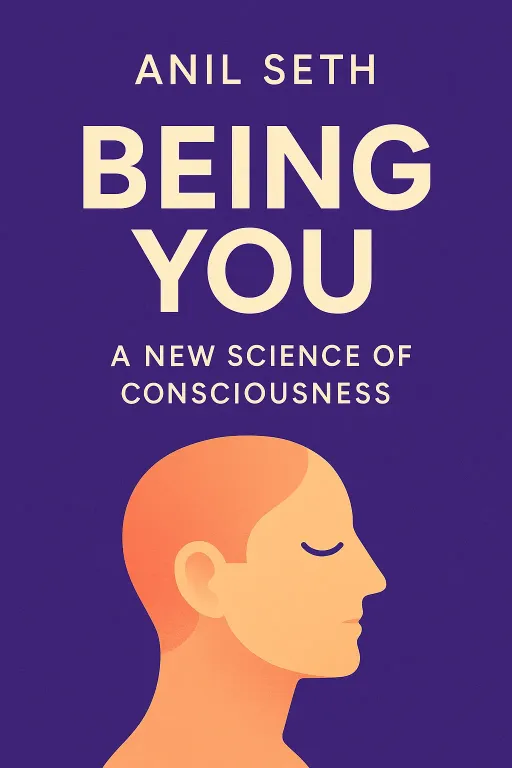
The Self, Unmade: A Neuroscientist's Guide to Rebuilding Your Identity
Golden Hook & Introduction
SECTION
Dr. Celeste Vega: Imagine you're at the top of the world, in the penthouse of a skyscraper that you helped build. Your identity is your title, your success, your power. Now, imagine that in a matter of weeks, it all vanishes. You're in the basement, with nothing. The question that hits you isn't 'What do I do now?' but a far more terrifying one: 'Who I now?'
CESAR NADER: That’s a question that cuts right to the bone, Celeste. It’s not hypothetical for me. It was my reality.
Dr. Celeste Vega: And that’s why I’m so thrilled to have you here, Cesar. Our guest today, Cesar Nader, lived that exact experience. And his journey provides a stunning real-world map to the scientific territory we're exploring in Anil Seth's groundbreaking book, 'Being You'. Today we'll dive deep into this from two powerful perspectives. First, we'll explore the shocking idea that the self you think you are is actually a perception, a kind of 'controlled hallucination' built by your brain.
CESAR NADER: An idea that I think will resonate with anyone who's ever felt their world shift beneath their feet.
Dr. Celeste Vega: Absolutely. Then, we'll go deeper to discuss the 'beast machine'—and how reconnecting with our fundamental, animal biology is the key to discovering who we truly are when everything else is stripped away. Cesar, welcome.
CESAR NADER: Thank you for having me, Celeste. I’m ready to dive in.
Deep Dive into Core Topic 1: The Self as a Perception
SECTION
Dr. Celeste Vega: Cesar, that question you faced—'Who am I now?'—is at the very heart of what neuroscientist Anil Seth tackles. He argues that we've been thinking about the 'self' all wrong. It's not a little entity or a soul that we, it's a perception that our brain. It's a constant, active process of inference.
CESAR NADER: So, not a noun, but a verb. The self is something the brain.
Dr. Celeste Vega: Precisely. And to understand this, let's look at how our brain constructs even simple reality. Think of a famous visual illusion called Adelson's Checkerboard. Imagine a checkerboard pattern, and a green cylinder is sitting on it, casting a shadow. There's a square in the bright light, let's call it square A, and a square in the shadow, square B.
CESAR NADER: Okay, I can picture it.
Dr. Celeste Vega: To your eyes, square A looks like a dark gray, and square B looks like a very light, almost white, gray. It's an obvious difference. But here's the twist: if you were to digitally isolate those two squares, you'd find they are the.
CESAR NADER: That’s hard to believe. So why do we see them so differently?
Dr. Celeste Vega: Because your brain is not a passive camera. It's a prediction machine. It has a lifetime of experience with shadows. It knows that a surface in shadow is actually lighter than it appears. So, your brain makes a 'best guess.' It predicts, "This square is in shadow, so I'll correct for it," and it actively changes your perception to show you a 'lighter' square. What you see is a useful construction, not objective reality. Seth's argument is that your sense of self is just like that—a 'controlled hallucination.'
CESAR NADER: That is a perfect, and frankly, unsettling analogy, Celeste. Because the 'Cesar' in the penthouse, the executive with the titles and the influence, felt absolutely real. It wasn't a story I was telling myself; it was my reality. My brain was taking all this external data—the job title, the respect from others, the financial success—and constructing a 'self' that was stable, valuable, and powerful.
Dr. Celeste Vega: It was your brain's best guess about who you were, based on all available evidence.
CESAR NADER: Exactly. And when that evidence, that external data, was violently stripped away, the perception shattered. It was exactly like you said—it was like someone removed the shadow from the checkerboard, and suddenly I saw that the square I was convinced was 'white' was actually just gray. The profound pain of that moment was realizing my identity was a 'best guess' based on data that was no longer there.
Dr. Celeste Vega: In Seth's terms, you experienced a massive 'prediction error.' The brain predicts one reality—'I am a successful CEO'—and the world returns a completely different signal—'You have nothing.' That mismatch, that error, is what the brain registers. And you felt that error as suffering.
CESAR NADER: It was an existential prediction error. The system crashed. And in the reboot, the old operating system, the old 'self,' was gone. I was left with a blank screen, asking, "What program is supposed to be running now?"
Dr. Celeste Vega: Which is the most terrifying and fundamental question of all. And it leads directly to where Seth goes next. If that narrative self, the 'CEO self,' is a fragile perception, what's left? What is the hardware that's still running?
Deep Dive into Core Topic 2: The 'Beast Machine'
SECTION
Dr. Celeste Vega: This brings us to Seth's most radical and, I think, most profound idea: the 'beast machine.' He argues our most fundamental, rock-bottom sense of self isn't our story, our memories, or our social roles. It's our living, breathing, feeling body.
CESAR NADER: The beast machine. I like that. It’s provocative. It strips away the romance of selfhood.
Dr. Celeste Vega: It does. The theory is that consciousness is more about being alive than it is about being intelligent. Our brain's primary job isn't to think deep thoughts; it's to keep the body in a state that's compatible with life. It does this through something called 'interoception'—which is just a fancy word for the brain's perception of the body's internal state. It’s constantly getting these noisy, ambiguous signals from inside: your heart rate, your gut, your temperature, your inflammation levels.
CESAR NADER: The things we're usually trying to ignore.
Dr. Celeste Vega: Exactly. And Seth argues that emotions are simply the brain's 'best guess' about what those internal signals mean, all in service of one goal: keeping the beast machine running. A feeling of anxiety might be the brain's prediction that your resources are low and you need to be careful. A feeling of calm is a prediction that all is well. Our entire emotional life is a controlled hallucination about our own biology.
CESAR NADER: So it’s not that we feel sad and then we cry. It’s that the brain perceives the physiological state that includes crying, and the perception of that whole-body state the feeling of sadness.
Dr. Celeste Vega: You've got it. And when this system breaks down, the self can completely fragment. Seth tells the deeply moving story of his own mother, who developed hospital-induced delirium. She was in an unfamiliar environment, her body was under stress, and her brain's ability to predict and regulate her internal state went haywire. She started having intense hallucinations and became paranoid, convinced she was part of a cruel experiment. She looked at her own son, at Anil, and didn't recognize him. She said, "This is not my mother." The person she was, her very self, had disintegrated because that fundamental, biological perception was broken.
CESAR NADER: That story… it resonates so powerfully with what I learned in that 'basement' phase of my life. For my entire career, society—and my own training as an executive—taught me to suppress those internal signals. Fear, anxiety, sadness, pain… those were weaknesses. They were noise that got in the way of rational decision-making. You quiet the beast. You numb it. You push through.
Dr. Celeste Vega: You down-regulate the prediction errors from the body.
CESAR NADER: Yes. But when I had nothing else, when the narrative self was gone, those raw, physical feelings were all that was left. And I had to learn to stop running and just… feel. To feel the grief as a physical weight in my chest, to feel the despair as a knot in my gut. It was terrifying, but it was also the first time I felt something that was undeniably and undeniably. It wasn't a social construct. It wasn't dependent on my bank account. It was the raw, unfiltered feeling of being a living organism in pain. It was me, the beast machine.
Dr. Celeste Vega: So you found your foundation not by thinking your way out of the crisis, but by your way through it. By finally paying attention to the interoceptive predictions your brain was making about your body.
CESAR NADER: Precisely. I had to become acquainted with the beast to find the man again. The path to a new self wasn't paved with positive affirmations; it was paved with the conscious acceptance of suffering. It was the most difficult and most important work I've ever done.
Synthesis & Takeaways
SECTION
Dr. Celeste Vega: It’s such a powerful reframing. So, through the lens of Anil Seth's work, we have these two layers of self. There's the self as a story, a perception built from the outside-in, based on our roles and achievements. And as you experienced, Cesar, that can be incredibly fragile.
CESAR NADER: It’s a house of cards built on external validation.
Dr. Celeste Vega: And then there's the self as a feeling. A perception built from the inside-out, rooted in the biological imperative to stay alive. The beast machine. And that, it seems, is the bedrock.
CESAR NADER: It is. And the lesson for me, and I think for anyone listening, is that we spend so much time and energy polishing the story of who we are—our resume, our social media, our titles. We build and defend that 'controlled hallucination.' But true resilience, true self-knowledge, comes from having the courage to connect with our fundamental nature as a 'beast machine.'
Dr. Celeste Vega: To not be afraid of the signals it's sending us.
CESAR NADER: Exactly. When a crisis hits—and it will, for everyone, in some form—it's not your resume that will save you. It's not your past glories. It's your ability to sit with the raw, physical reality of your own existence, in pain or in joy, and know that even there, especially there, you are still you. The question isn't just "Who am I?" but "What is it like to be this living, feeling organism, right now?" Finding the answer to that is where the real work, and the real peace, begins.
Dr. Celeste Vega: A profound and essential insight. Cesar Nader, thank you so much for sharing your story and your wisdom with us today.
CESAR NADER: The pleasure was all mine, Celeste. Thank you.