Unlocking the Mind: The Science of Thought & Behavior
Golden Hook & Introduction
SECTION
Nova: Atlas, rapid-fire word association for you. Ready?
Atlas: Oh boy, sounds like trouble. Hit me.
Nova: Decision.
Atlas: Regret!
Nova: Impulse.
Atlas: Snack! Always a snack.
Nova: Logic.
Atlas: ... Nap. My brain needs a nap after logic.
Nova: And finally, why.
Atlas: That’s the big one, isn’t it? The question of everything. And often, the answer is way more complicated than we think. Which, conveniently, brings us to today’s episode on Unlocking the Mind: The Science of Thought & Behavior.
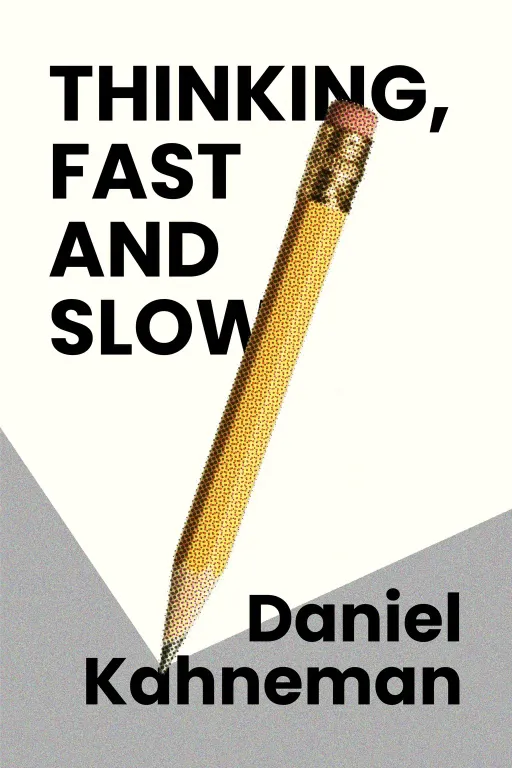
Nova: Absolutely! Today, we’re diving into two monumental works that completely redefine how we understand ourselves and our actions. First up, the absolute masterpiece, "Thinking, Fast and Slow" by Daniel Kahneman. It's truly remarkable because Kahneman, a psychologist, won the Nobel Memorial Prize in Economic Sciences for his work on how our minds actually make decisions, challenging decades of economic theory.
Atlas: Right? That's what fascinates me – a psychologist rocking the economics world. And then we pair that with Robert M. Sapolsky’s "Behave: The Biology of Humans at Our Best and Worst," which is just this sprawling, interdisciplinary epic. Sapolsky is this incredible blend of neuroscientist, primatologist, and endocrinologist. He looks at human behavior from milliseconds before an action to millions of years of evolution. It’s a wild ride.
Nova: It’s the ultimate double-header for understanding the 'why' behind everything we do, from our snap judgments to our deepest biological impulses.
The Dual Engines of Decision Making
SECTION
Nova: So, let’s start with Kahneman and his revolutionary idea of the two systems that drive our thinking. He essentially says we have two main engines in our minds. Let’s call them System 1 and System 2.
Atlas: Okay, so System 1, System 2. Sounds a bit like a computer. Is one better than the other?
Nova: Not necessarily better, just different. Think of System 1 as your gut reaction, your intuition. It’s fast, automatic, emotional, and requires almost no effort. It’s what makes you instantly pull your hand away from a hot stove or recognize a familiar face. It’s brilliant for quick survival decisions.
Atlas: Oh, I see. So it’s like when I’m driving and suddenly hit the brakes without even really thinking about it. That’s System 1.
Nova: Exactly! Now, System 2 is the complete opposite. It’s slow, deliberate, effortful, logical, and requires conscious attention. It’s what you use to solve a complex math problem, fill out a tax form, or carefully weigh the pros and cons of a major life decision.
Atlas: So basically, System 1 is Homer Simpson, and System 2 is Lisa Simpson.
Nova: That’s a pretty good analogy! The challenge is, System 1, for all its speed, is also prone to systematic errors, or what Kahneman calls cognitive biases.
Atlas: Okay, but how does that play out in real life? Give me an example where my Homer Simpson brain leads me astray.
Nova: Let’s talk about anchoring bias. Imagine you’re at a car dealership. The salesperson tells you the original price of a car is $40,000, but they're offering it to you for $35,000. Even if you know that car is only worth $30,000, that initial, high anchor of $40,000 subtly influences your perception of what a good deal is. Your System 1 latches onto that first number, making $35,000 feel like a bargain.
Atlas: That’s actually really inspiring. So, are you saying we're not as rational as we think? That our quick, intuitive judgments are constantly being manipulated without us even realizing it?
Nova: Precisely. System 1 is a storyteller. It tries to create a coherent narrative from limited information, often ignoring crucial details. And System 2, our more rational self, is often quite lazy. It prefers to go with System 1’s story unless it encounters a significant red flag or is explicitly prompted to intervene.
Atlas: So, if System 1 is so prone to error, how do we even function? How does System 2 kick in, or does it always lose? I mean, for a lot of our listeners, especially those in high-pressure environments, making quick decisions is part of the job.
Nova: That’s where the effort comes in. System 2 is capable of overriding System 1, but it takes mental energy. It’s why you feel drained after a day of intense focus. Kahneman’s work highlights that we improve our decision-making, not by eliminating System 1, but by learning to recognize its cues and knowing when to engage our more deliberate System 2. It's about being aware of the mental traps.
Atlas: Oh, I like that. It sounds like it's not about being perfect, but about being aware. What’s one tiny step we can take today to just this in ourselves? Like, how do I spot my Homer Simpson brain in action?
Nova: A great tiny step is simply to observe your own reactions. When you have a strong emotional response or an instant judgment about something or someone, pause. Ask yourself, "What information am I basing this on? Is there another way to look at this?" That pause is System 2 trying to wake up.
The Deep Biological Roots of Behavior
SECTION
Nova: Now, while Kahneman gives us these incredible insights into the of our thinking, Sapolsky asks an even more fundamental question: do we behave the way we do, down to our very cells? He peels back layer after layer of influence.
Atlas: Whoa, that’s kind of heartbreaking. So, are you saying free will is just an illusion? If everything is predetermined by biology, what's even the point of trying to change? I imagine a lot of our listeners, especially those focused on personal growth and self-discipline, might find that a bit disheartening.
Nova: That’s a crucial question, and it’s where Sapolsky really shines. He doesn't say free will doesn't exist, but he meticulously shows how incredibly complex and interwoven the causes of our behavior are. He says, to understand any behavior, you need to look at what happened a second before, minutes before, hours before, days before, and even centuries and millennia before.
Atlas: Can you give us an example of those layers? That sounds incredibly abstract. Like, how does a second before an action matter, let alone a million years?
Nova: Absolutely. Let's take an example like aggression. Sapolsky would say, a second before an aggressive act, certain neurons are firing in the amygdala, signaling fear or anger. Minutes before, specific neurotransmitters like dopamine might be fluctuating. Hours before, hormones like testosterone or cortisol could be influencing mood and reactivity.
Atlas: So, it’s not just one thing, it’s a cascade.
Nova: Exactly. Then you zoom out further. Days or months before, perhaps the person experienced chronic stress, which rewired parts of their brain. Years before, their childhood environment shaped their neural development. And then, we go even broader: their culture, their genetics, and finally, the evolutionary pressures that shaped our species to have these capacities for aggression or cooperation in the first place.
Atlas: That makes me wonder, so it's not just "bad people do bad things." It's "this person, with this biology, in this environment, with this history, did this thing." It’s like understanding the rules of the game allows you to play it better, rather than just being a pawn.
Nova: That’s a perfect way to put it. Sapolsky’s work isn't about excusing behavior, but about understanding it with profound empathy and scientific rigor. It's about seeing the river: you can’t change where the water came from, but understanding its currents and forces gives you the power to build a dam, or redirect its flow.
Atlas: I can see that. It changes the game entirely. And how does this biological 'why' connect back to our System 1 and System 2? Are our biases rooted in our biology too?
Nova: Absolutely. Our System 1, that fast, intuitive part, is deeply rooted in our evolutionary past. It developed to help us survive in a dangerous world – quickly recognizing threats, forming social bonds, making snap judgments about edible vs. poisonous. Our brains are wired for shortcuts because deliberation takes time and energy, which wasn't always available on the savannah. So, many of our cognitive biases, those System 1 errors, are actually vestiges of biologically adaptive mechanisms that are sometimes maladaptive in our complex modern world.
Synthesis & Takeaways
SECTION
Nova: So, what we have from Kahneman and Sapolsky is this incredible tapestry. Kahneman shows us the immediate cognitive architecture, the 'how' of our thoughts and decisions, while Sapolsky provides the deep, multi-layered biological 'why' behind our behaviors.
Atlas: It really is a powerful combination. It sounds like the first step to unlocking our minds and making better choices is simply to be aware of these incredibly complex forces at play. It's not about being perfect, but about being aware of the incredible machinery running the show.
Nova: Exactly. And that awareness gives us agency. It means we’re not just passive recipients of our thoughts or our biology. We can learn to notice our System 1 biases, to slow down and engage System 2. We can understand the biological underpinnings of why we might react a certain way, and then choose to intervene.
Atlas: That’s actually really inspiring. So, for our listeners who are trying to cultivate self-discipline, improve their mental well-being, or just understand themselves better, what’s one actionable insight you’d give them today from these two incredible thinkers?
Nova: I'd say this: When you feel a strong, immediate impulse or judgment, especially one that feels emotionally charged, take a deliberate breath. That’s your System 2 signaling it wants to engage. And remember, your biology isn't your destiny; it's your starting point. Understanding it gives you power to consciously shape your path.
Atlas: That’s profound. It gives you this sense of control, or at least understanding, over things that often feel completely out of our hands. Thanks for unlocking so much for us today, Nova.
Nova: My pleasure, Atlas. Always a journey into the mind with you.
Nova: This is Aibrary. Congratulations on your growth!