

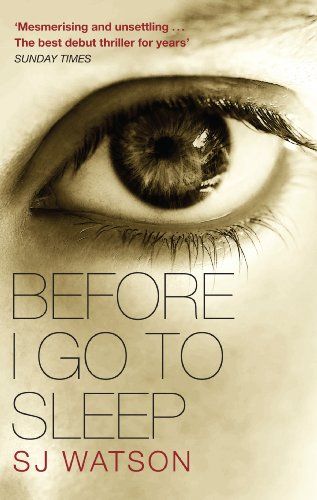
Before I Go to Sleep
Introduction
Nova: Imagine waking up tomorrow morning and having absolutely no idea who you are, where you are, or who the person sleeping beside you might be. Then imagine discovering that this has been every single morning of your life for the past twenty years. That is the devastating premise of S. J. Watson's 2011 debut novel, Before I Go to Sleep — a psychological thriller that sold over six million copies, was translated into more than forty languages, and became the highest-charting debut by a British author on the New York Times bestseller list since a little-known writer named J. K. Rowling.
Nova: : That comparison alone tells me this isn't just any thriller. Six million copies? That is staggering. And I love that you started with that question, Nova, because it immediately puts me in the protagonist's shoes. Walk me through what this book is actually about.
Nova: At the center of the story is Christine Lucas, a forty-seven-year-old woman living in the suburbs of London. Every night when she falls asleep, her brain essentially resets. She wakes up each morning believing she is still in her twenties, utterly bewildered by the middle-aged face staring back at her in the bathroom mirror. The man beside her introduces himself as Ben, her husband, and every day he patiently explains her condition: a severe form of anterograde amnesia caused by a traumatic accident nearly two decades ago.
Nova: : So every day she has to rebuild her entire identity from scratch. That sounds emotionally exhausting just to think about. How does she cope?
Nova: Here is where it gets fascinating. With the help of a neuropsychologist named Dr. Nash — who contacts her in secret, without her husband's knowledge — Christine begins keeping a journal. Each day Dr. Nash calls her, reminds her where the journal is hidden, and she reads it to catch up on her own life. But on the very first page of that journal, she has written three words in bold: "DON'T TRUST BEN." That is the moment the thriller truly ignites. Today, we are going to unpack this remarkable novel — its ingenious structure, its exploration of memory and identity, the surprising real-life inspiration behind it, and the incredible staying power that has a sequel and a stage play arriving more than fifteen years after its original publication.
Plot and Narrative Structure Deep Dive
The Story That Traps the Reader Inside a Fractured Mind
Nova: Let us really dig into the plot, because the way Watson structures this novel is arguably its greatest achievement. The book is divided into three parts. Part one is brief — it is Christine waking up, meeting Ben, receiving the call from Dr. Nash, and receiving her journal. The narration is in first-person present tense. Then part two, the longest section of the book, is the journal itself. We, the readers, are literally reading Christine's diary alongside her, day by day, entry by entry, watching her piece together the fragments of her life.
Nova: : That is such a clever structural choice because it makes the reader experience the exact same confusion and gradual discovery that Christine herself goes through. We know only what she knows when she knows it. And since she resets every morning, there is this constant tension — she might not even read the journal the next day.
Nova: Exactly. And the journal entries reveal a steady drip of disturbing inconsistencies. Ben told her she worked as a secretary, but she discovers she was actually a published author before the amnesia. Ben said they never had children, but she learns she had a son named Adam — who Ben claims died serving in Afghanistan. The hit-and-run accident Ben described? Not what actually happened. Her amnesia was caused by a violent assault in a hotel room.
Nova: : So throughout the journal, the reader is trying to figure out: is Ben a loving husband protecting Christine from traumatic truths she would have to relive every single day, or is he something far more sinister?
Nova: That question drives the entire novel. And here is where Watson plays an absolutely masterful game of misdirection. In the final act, Christine and Ben — or rather, the man she believes is Ben — go away for a weekend to the coast. She realizes with dawning horror that their hotel room is the very room where she was attacked years ago. She finds missing pages from her journal in his luggage. And then the truth crashes down: the man she has been living with is not Ben at all. He is a man named Mike, a former lover whom Christine had an affair with. When she tried to end the affair, Mike attacked her in that hotel room, causing her amnesia. After the real Ben divorced her, Mike posed as her husband and brought her home.
Nova: : That twist is genuinely chilling because it means every single day for years, Christine has been waking up next to the man who destroyed her life, and she has had no way of knowing it. She has been completely dependent on her attacker. The real Ben and her son Adam are actually still alive. Mike stole her entire existence.
Nova: The final confrontation in the hotel room is devastating. Mike attacks Christine again, tries to burn her journal, but the fire spreads. Mike dies in the blaze. Christine survives. She reunites with the real Ben and their son Adam, and there is the faintest glimmer of hope — she realizes some of her memories have returned. But the novel closes with the haunting uncertainty of whether she will remember any of this when she wakes up tomorrow.
The Real-Life Inspiration Behind the Novel
The Man Who Could Not Remember
Nova: Here is something I find absolutely remarkable about this book: it was written by a man who had never published a novel before, in his spare time between shifts working as an audiologist for the National Health Service. S. J. Watson — his full first name is Steve, by the way, he used initials to keep a certain ambiguity — was not a full-time writer. He was an NHS clinician with a creative dream.
Nova: : That alone is inspiring — writing a six-million-copy bestseller between hospital shifts? But what actually sparked the idea?
Nova: Watson has spoken about this in interviews, including a wonderful Q&A with The Guardian. He was reading about a real person named Henry Molaison, known to medical history as Patient H. M. In 1953, when Molaison was twenty-seven years old, he underwent brain surgery to treat severe epilepsy. The surgery removed parts of his medial temporal lobe, including much of his hippocampus. The epilepsy improved, but Molaison was left with profound anterograde amnesia — he could no longer form new memories. He lived for another fifty-five years, until the age of eighty-two, and for all that time could not create a single new lasting memory.
Nova: : Fifty-five years of waking up and not remembering yesterday. That is almost incomprehensible.
Nova: Watson said he was haunted by a single image: this elderly man, looking in the mirror, fully expecting to see a twenty-seven-year-old looking back. The disconnect between the self he remembered and the self he actually was — that became the seed for Christine Lucas. Watson realized just how deeply memory is tied to identity. Without memory, who are we? What anchors us to our own existence? That philosophical question pulses through every page of the novel.
Nova: : And H. M. became the most studied patient in the history of neuroscience. His case essentially taught us that the hippocampus is essential for forming new memories but not for storing old ones. There is a heartbreaking scientific legacy behind this fictional thriller.
Nova: Watson also said that choosing to write the book in first person from Christine's perspective was the single hardest technical decision he made. He had to track, at all times, exactly what Christine knew and what she did not know at any given moment. One slip in continuity and the entire illusion would shatter. He described the editing process as a constant battle to ensure consistency. His writing advice, published in that same Guardian interview, is almost legendary: "A novel is made in the editing stage; books aren't written, they're rewritten."
Themes and Psychological Depth
Memory, Identity, and the Terror of the Ordinary
Nova: Let us step back and talk about what this novel is really about beneath the thriller plot. The central theme, of course, is memory and how it defines identity. Christine's journal is literally the only thread connecting her to herself. Without it, she is adrift, a different person each morning, utterly dependent on what others tell her about her own life.
Nova: : That is the deeply unsettling part, isn't it? It is not just that she cannot remember — it is that someone else gets to write her history for her. Whoever reaches her first each morning controls her entire reality. The novel asks: if you cannot verify your own past, how do you know who you are? How do you know who to trust?
Nova: Exactly. And Watson explores this not through grand philosophical monologues but through the texture of Christine's daily life. Multiple reviewers noted the way the novel is rooted in the domestic, the suburban, the ordinary. John O'Connell wrote in The Guardian that "the most unnerving aspect of Before I Go to Sleep is the way it is rooted in the domestic, the suburban, the trivial. Forget whizz-bang futurism: it proceeds from ordinary life in tiny, terrifying steps, and is all the better for it. The Escher staircase has an oatmeal carpet."
Nova: : An oatmeal carpet — I love that line. Because the horror is not in some sci-fi laboratory; it is in a modest house in the London suburbs, with photographs taped around the bathroom mirror and a husband who makes her tea every morning. The banality makes it far more frightening.
Nova: There is also a profound meditation on the female body and aging. Christine looks in the mirror and sees a middle-aged woman's body — lines, grey hair, changes she has no memory of acquiring. She examines her own hands, her own face, as if they belong to a stranger. This is one of the aspects of the book that has been discussed extensively in reader communities. The alienation from her own physical self adds another layer to the identity crisis.
Nova: : The claustrophobia is another key element. Christine's world for most of the novel consists of her house, the park, and her sessions with Dr. Nash. She has no friends except the ones she cannot remember, no job, no independent life. The reader feels that confinement viscerally. It is almost hard to breathe inside this book at times.
Nova: Several reviewers, including one from Dear Author, mentioned that reading this book produced genuine dread — not just suspense about what might happen next, but a bone-deep unease about what had already happened to Christine. It is not a comfortable read. But that discomfort is precisely what makes it effective as a psychological thriller. It does not rely on gore or cheap shocks. It relies on the slow, creeping horror of realizing nothing you believe about your own life is true.
The Book's Cultural Impact and Legacy
From Overnight Sensation to Enduring Phenomenon
Nova: When Before I Go to Sleep was published in the spring of 2011, it did not just sell well — it became a genuine literary phenomenon. The New York Times called Watson an "out-of-nowhere literary sensation." It hit number seven on the New York Times bestseller list, the highest position for a debut novel by a British author since — and I want to pause on this — since J. K. Rowling.
Nova: : That is not a comparison you hear thrown around casually. And the awards started piling up almost immediately: the Crime Writers' Association John Creasey New Blood Dagger, the Galaxy National Book Award for Thriller and Crime Novel of the Year, the Dutch Crimezone Debut of the Year, the French SNCF du Polar Prize for best crime novel. This debut cleaned up across multiple countries and languages.
Nova: Ridley Scott acquired the film rights. The 2014 adaptation starred Nicole Kidman as Christine, Colin Firth as Ben — or rather, Mike — and Mark Strong as Dr. Nash. The film received mixed reviews from critics, partly because translating Christine's internal, journal-based experience to the screen is incredibly difficult. But the performances were widely praised. Roger Ebert's site called Kidman and Firth's work "very good," noting they brought "complexity and realism to difficult roles."
Nova: : And the novel essentially helped invent a genre. Karen Sullivan, the publisher of Orenda Books, has said that Before I Go to Sleep "was instrumental in defining the modern psychological thriller" and that it created a blueprint that countless novels would follow. Long before "domestic noir" became a recognized genre, this book set the standard: the unreliable narrator, the claustrophobic domestic setting, the twist that reframes everything you thought you knew.
Nova: And here is the most exciting development: more than fifteen years after the original publication, Christine Lucas is coming back. Orenda Books has announced Before I Sleep Forever, the long-awaited sequel, scheduled for May 2027. In the sequel, Christine is living under an assumed name, in hiding, terrified the past will find her. Mike Lynford — who apparently survived? — has reinvented himself as a public figure with millions of followers, rewriting history and presenting himself as the victim. Strange things start happening around Christine, and she becomes convinced her amnesia is returning. But if her memory is not failing, then someone is trying to make her believe that it is.
Nova: : That premise sounds just as twisted and psychologically layered as the original. And there is also a world premiere stage adaptation on the way, starring Giovanna Fletcher, touring UK theatres starting in 2027. So this book, which began as a debut novelist's dream written between NHS shifts, has now become a multi-platform, multi-generational phenomenon.
Nova: S. J. Watson himself said something really interesting about the sequel: he never wanted to return to Christine's story unless he could take it somewhere new, surprising, and worthy of the first book. The fact that it took over fifteen years for that moment to arrive tells you how seriously he takes this character and this world.
Conclusion
Nova: So what makes Before I Go to Sleep such an enduring work of psychological suspense? Let us tie together the threads. First, the premise is both high-concept and deeply human. The idea of waking up every day with no memory is immediately graspable and terrifying. Watson takes that concept and grounds it in the utterly mundane — a suburban house, a daily routine, a marriage — which makes the horror feel uncomfortably close to home.
Nova: : Second, the structure. By placing the reader inside Christine's journal, Watson makes us complicit in her investigation. We discover alongside her. We doubt alongside her. The unreliable narrator is not a gimmick here — it is the entire engine of the narrative because Christine herself does not know what is reliable. Third, the twist lands so hard because Watson plays fair. Clues are seeded throughout, but they hide in plain sight, and the revelation that the man she trusts most is actually the man who destroyed her recontextualizes every single interaction in the book.
Nova: And beneath all of that, the novel is asking genuinely profound questions. What defines a person if not their memories? How do we know who to trust when we cannot even trust our own minds? The book is a thriller, yes, but it is also a meditation on the fragility of identity and the terrifying power that comes with controlling someone else's access to the truth.
Nova: : For listeners who have not yet picked up this book, it is a swift, propulsive read — around three hundred sixty pages — but the emotional and psychological weight lingers long after the final page. The ending offers hope, but it also refuses to tie everything up neatly. Christine falls asleep unsure if she will remember anything in the morning. That final note of uncertainty is, in many ways, the novel's most honest moment.
Nova: And if you have already read it? Mark your calendars for May 2027, when Before I Sleep Forever hits shelves, and keep an eye out for the stage production touring the UK. Christine Lucas's story, it turns out, is far from over.
Nova: : This is Aibrary. Congratulations on your growth!