

The Schwarzenegger Strategy: Marketing Your Vision, Selling Your Career
Golden Hook & Introduction
SECTION
Orion: Imagine you're a marketing manager. Your star product is Arnold Schwarzenegger. He's the king of action movies, a global brand synonymous with explosions and one-liners. Now, he comes to you and says, "I want to star in a comedy with Danny DeVito as my long-lost twin." Your investors, your team, everyone says it's brand suicide. What do you do?
Naomi: You probably start looking for a new job.
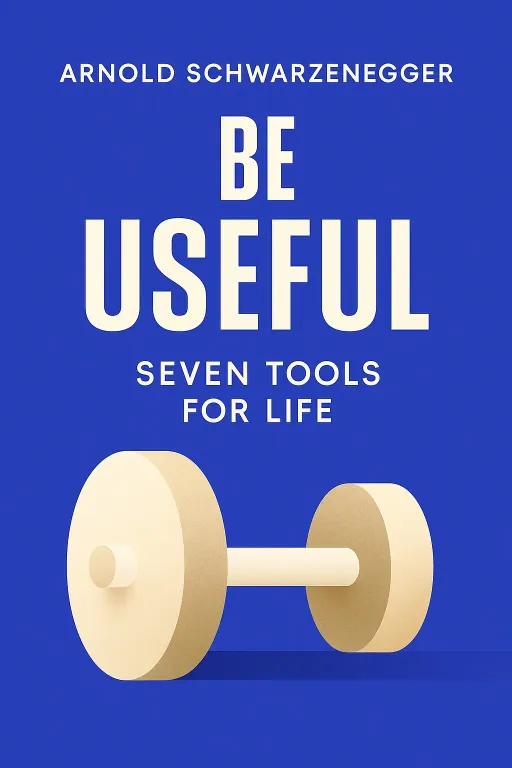
Orion: Right? But this isn't a hypothetical. It's a real-life marketing masterclass from Arnold's own playbook, and it reveals everything about how to sell a truly audacious vision. And that's what we're diving into today, using his book, "Be Useful: Seven Tools for Life." I’m your host, Orion, and I'm thrilled to have Naomi with us. Naomi is a project manager in the marketing world, so she lives and breathes this stuff every single day. Welcome, Naomi.
Naomi: Thanks for having me, Orion. That opening scenario is my nightmare and my dream all at once. A huge creative risk with a massive potential payoff.
Orion: Exactly. In his book, Arnold lays out seven tools for life, but today we're focusing on two that are pure marketing gold. First, we'll explore how to craft a 'brand strategy' for your life by having a clear and audacious vision. Then, we'll break down the 'go-to-market' plan: the art of selling that vision to a skeptical world.
Deep Dive into Core Topic 1: Vision as Brand Strategy
SECTION
Orion: So, Naomi, before you can even think about selling an idea as wild as the movie 'Twins,' you need a powerful, unwavering vision. Arnold's first and most important tool is exactly that: Have a Clear Vision. He argues that without it, you're just drifting.
Naomi: Which, in project management, is called "scope creep." You're just reacting to things instead of driving toward a defined outcome. It's inefficient and demoralizing.
Orion: Perfectly put. And Arnold’s own story is the best example. He describes growing up in post-war Austria, a place that felt small and gray. But in his mind, he had this incredibly vivid picture of America. He didn't know what he would do there, he didn't have a plan, but he could see the skyscrapers, the big cars, the sense of unlimited possibility. It was this huge, technicolor vision.
Naomi: That's fascinating. In marketing, we'd call that 'top-of-funnel' thinking. He had this powerful brand affinity for 'Team America' before he even had a product or a strategy to get there. He just knew, on an emotional level, that he wanted to be part of that brand.
Orion: Exactly! The vision came first. The 'how' came later. For him, the 'how' appeared on the cover of a muscle magazine. He saw a picture of Reg Park, a bodybuilder who became Mr. Universe and then starred in Hercules movies. Suddenly, the abstract vision had a concrete path. He thought, "Wait a minute. I can become a bodybuilding champion. That will be my ticket to America. Then I can get into movies." Bodybuilding wasn't the end goal; it was the tactic to serve the larger vision.
Naomi: That’s a perfect analogy for a marketing funnel. The grand 'vision' of America was his top-of-funnel brand awareness. The 'tactic' of bodybuilding was his mid-funnel consideration and conversion strategy. As a project manager, if my team doesn't have that crystal-clear 'America'—that ultimate end-state for the project—every tactical decision about ad spend or social media posts becomes a pointless debate. The vision is the north star that justifies all the smaller moves.
Orion: And to protect that vision, he has a pretty radical piece of advice from his second chapter, "Never Think Small." He says you should have no Plan B.
Naomi: Oof. That's a tough one for a project manager. My job is basically to have a Plan B, C, and D. We call it contingency planning and risk mitigation.
Orion: I get it. But hear him out. He tells a story about running for governor and wanting to pass redistricting reform to stop politicians from drawing their own districts. His first attempt in 2005 failed miserably. Everyone told him to drop it, to move on. But he refused. For him, there was no Plan B. He just kept pushing, and in 2008, he got an even more aggressive version of the reform passed. His point is that having a safety net makes it too easy to give up on your primary goal.
Naomi: You know, it's terrifying, but I see the logic. It's about resource allocation. If you spend time and energy building a fallback plan, that's time and energy you're not spending on making Plan A successful. It forces 100% commitment. In a project, if the team knows there's an easy out, they might not push through the toughest problems. It's a high-risk, high-reward leadership strategy, for sure.
Deep Dive into Core Topic 2: The Art of the Sale
SECTION
Orion: And that total commitment is exactly what you need when you get to the hardest part: selling your vision. This brings us to Arnold's next tool, and my personal favorite for you, Naomi: 'Sell, Sell, Sell.' He says, and I quote, "You can have the most amazing idea... but if nobody knows that it exists or knows what it is, then it’s a waste of time and effort."
Naomi: That should be tattooed on the arm of every innovator and marketer. A brilliant product with bad marketing is just a hobby.
Orion: Precisely. And the first rule of selling, he learned as a teenager working in a hardware store. He tells this great little story about a couple who came in to buy tile. His boss, Herr Matscher, started by talking to the husband, who was gruff and just wanted to know the price. But he noticed the wife was the one touching the tiles, imagining them in her kitchen. So, Herr Matscher completely ignored the husband and focused all his attention on the wife, asking about her vision, her colors. She made the decision, and the husband just paid the bill.
Naomi: That is Marketing 101. Know your audience's true decision-maker. It's not always the person who holds the purse strings. In B2B marketing, we might sell a software to a whole team, but it's the one project manager who will use it every day whose pain points you really need to solve. The boss will sign the check if their team member is convinced. Arnold's boss understood that the wife was the end-user with the emotional investment.
Orion: Exactly. But it gets even more advanced. Let's go back to 'Twins.' So Arnold has this vision to break into comedy. He and director Ivan Reitman pitch the idea. And every studio says no. They see it as a huge financial risk. Arnold, the action star, in a comedy? It's off-brand. The project is dead in the water.
Naomi: This is the classic roadblock. The idea is too new, the data doesn't support it, the risk is too high. I've had campaigns shot down for less.
Orion: So what do they do? They go back to the studio head, Tom Pollock, and they change the pitch. Arnold, Ivan Reitman, and Danny DeVito make a new offer. They say, "We will do this movie for zero dollars in salary. Not a penny upfront. We believe in it so much, you can pay us a percentage of the profits on the back end."
Naomi: Wow. Okay, that's a power move. They didn't just pitch the 'what'—the creative idea for the movie. They completely changed the 'how'—the financial deal structure.
Orion: And the studio immediately said yes! Because the pitch was no longer about creative vision; it was about financial risk. And they had just eliminated it. 'Twins' went on to be a massive hit, and because of their profit-sharing deal, it was the most money Arnold ever made on a single film.
Naomi: That is brilliant. It's a masterclass in stakeholder management. They correctly identified the customer's—the studio's—biggest pain point. It wasn't creative doubt; it was financial exposure. So they tailored the entire sales pitch to solve that one problem. This is something we face in marketing all the time. You present a groundbreaking, creative campaign, and the first question from the finance department is, 'What's the guaranteed ROI?'
Orion: And what does this story tell you about how to answer that?
Naomi: It shows that sometimes the most persuasive argument isn't about hyping up the potential reward, but about systematically minimizing the perceived risk for the decision-maker. Instead of saying 'This will be a huge success!', they said 'This cannot be a failure for you.' That's a much more powerful and compelling sales proposition for anyone with a budget to protect.
Synthesis & Takeaways
SECTION
Orion: So, when you put it all together, it’s a powerful one-two punch for any project, or even your career. First, as we discussed, you build an unshakable, ambitious vision—that's your brand strategy. Second, you become a master salesperson for that vision, not by being loud, but by deeply understanding your audience's real needs and re-engineering your proposal to de-risk the 'yes' for them.
Naomi: Absolutely. The vision provides the 'why,' and the sales strategy provides the 'how.' One without the other is useless. You need both the dream and the deal.
Orion: So, as we wrap up, what’s a final, practical takeaway from Arnold's playbook that our listeners, especially those in roles like yours, can apply this week?
Naomi: I think it comes from a simple exercise Arnold mentions. He talks about doing a '24-hour countdown' where you track your day to find wasted time. My challenge to our listeners is this: Find one hour this week. Just one. And in that hour, don't the work. Don't write the code, don't design the graphic, don't manage the tasks. Instead, use that hour to think exclusively about how you're going to the work.
Orion: I love that. Shift from production to promotion.
Naomi: Exactly. Ask yourself: Who is my 'Herr Matscher's wife'? Who is the real decision-maker I need to convince? And more importantly, what is my 'no-salary deal'? What is the biggest risk for them, and how can I reframe my proposal to eliminate it? That single hour of shifting your focus from 'doing' to 'selling' is the real game-changer. It's the difference between having a great idea and leading a successful project.
Orion: That's a fantastic, actionable piece of advice. Want to be useful? First, have a vision. Then, learn how to sell it. Naomi, thank you so much for bringing your marketing expertise to this.
Naomi: It was my pleasure, Orion. It's amazing how a bodybuilder from Austria can teach us so much about corporate strategy.









