The Blueprint for Audacious Growth
Golden Hook & Introduction
SECTION
Nova: If you are running at full speed in the wrong direction, you are just getting lost faster. That is the fundamental problem with the modern obsession with productivity. We are all so good at being busy, but we are terrible at being intentional.
Atlas: That hits a little too close to home. Most of us treat our careers like a high-speed chase where we forgot to check the map. We are just burning fuel.
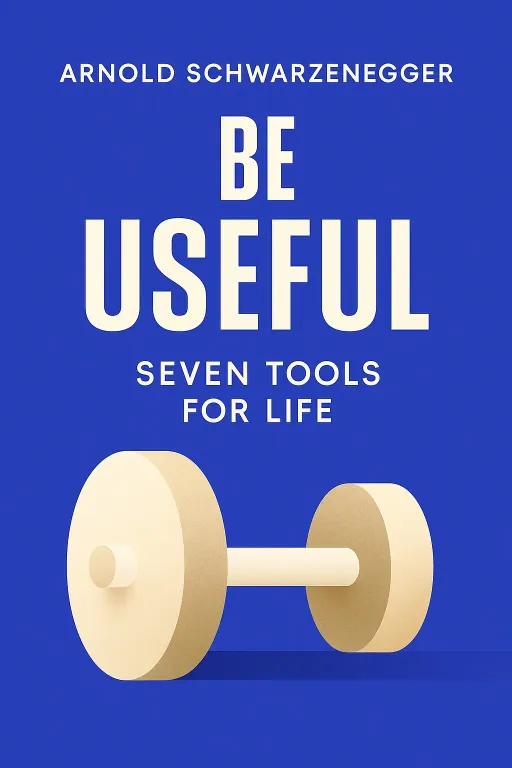
Nova: Exactly. And that is why we are looking at two very different, yet perfectly complementary books today to fix that. We are diving into Be Useful by Arnold Schwarzenegger and Kaizen by Sarah Harvey.
Atlas: Arnold Schwarzenegger. I feel like most people hear that name and think of the movie star or the bodybuilder, but his book is actually a masterclass in this exact problem of direction.
Nova: It really is. What makes Be Useful so compelling is that Schwarzenegger isn't just giving generic advice. He is documenting how he managed to dominate in three completely different fields—bodybuilding, acting, and politics—by applying a singular, unwavering vision. He argues that you have to define exactly what you want before you even pick up a weight or learn a line of dialogue.
Atlas: And then you have Sarah Harvey’s book, Kaizen. I’ve read a bit about this philosophy before. It’s the Japanese concept of continuous, microscopic improvement. It feels like the perfect antidote to the "go big or go home" culture that burns everyone out.
Nova: It is the perfect counter-weight to Schwarzenegger’s high-octane ambition. While Arnold gives you the destination, Harvey gives you the vehicle to get there without your brain hitting the panic button. Today, we are going to explore how to combine that massive, audacious vision with the tiny, invisible steps that actually make it happen.
The Power of Singular Vision
SECTION
Atlas: Let’s start with the vision part. I talk to a lot of people who are trying to level up their careers—say, someone who wants to stop being a generalist and become a high-earning, independent PCB designer. They have the ambition. They have the drive. But they are scattered. They are trying to learn five different software packages and reading three different blogs at once. How does Schwarzenegger’s philosophy actually help someone like that?
Nova: It helps by forcing a brutal, necessary narrowing. When you look at Schwarzenegger’s life, he didn't wake up and decide to be a bodybuilder, an actor, and a governor all at once. He had a singular vision for each phase. He treated his life like a project. For our listener who wants to master PCB design, the trap is thinking that doing everything at once is the same thing as making progress.
Atlas: That is the trap, isn't it? The belief that if I am busy, I am moving forward. But you are saying that without a singular vision, that busyness is just noise.
Nova: That is the core of it. Schwarzenegger talks about the necessity of having a clear, singular vision to guide all your decisions. If your vision is to become a high-earning independent PCB designer, then every single decision you make—what you study, who you network with, how you spend your Saturday mornings—has to pass through that filter. If it doesn't serve the vision, it is a distraction.
Atlas: I can see how that feels restrictive, though. People fear that by picking one path, they are closing off all the other doors.
Nova: The funny thing is, the opposite happens. When you have a singular vision, you actually find more freedom. You stop wasting energy on things that don't matter. You stop comparing yourself to the person who is learning Python, or the person who is getting into marketing, because you know exactly what your mountain looks like. You aren't climbing three mountains at once. You are climbing one.
Atlas: So, for the aspiring PCB designer, it is not about being the best engineer in the world. It is about becoming the specific person who can solve the specific problems that high-paying clients are willing to pay for.
Nova: Precisely. That is the difference between a hobbyist and a specialist. The hobbyist learns everything. The specialist solves the problem. And that is what Arnold is getting at. He didn't just want to be strong; he wanted to be the best bodybuilder in the world. That goal dictated his diet, his sleep, his training, and his social life. It was the filter for his entire existence.
Atlas: I have to play devil’s advocate for a second. That level of focus sounds exhausting. It sounds like you have to be a machine. What happens to the human element? What happens when you are tired, or you have a bad week, or life just gets in the way of that singular vision?
Nova: That is where the tension lies. If you only have the vision, you break. If you only have the micro-steps, you drift. You need both. You need the vision to tell you where to go, but you need the Kaizen philosophy to tell you how to survive the journey without quitting.
The Micro-Step Revolution
SECTION
Atlas: Okay, let’s bridge that gap. We have the vision—the high-earning PCB design career. Now, how do we handle the fact that my brain, like most people’s, is wired to resist big changes? I look at a complex PCB design project, and my brain says, "That’s too hard, let’s go watch a video on social media instead."
Nova: That is a classic amygdala hijack. Your brain is literally designed to protect you from the unknown. When you look at a massive task, your brain perceives it as a threat, a danger to your comfort. It triggers a fight-or-flight response, and you choose flight—which, in our case, is procrastination.
Atlas: So, how does the Kaizen approach bypass that?
Nova: It bypasses it by being so small that the brain doesn't even register it as a threat. Sarah Harvey’s point in Kaizen is that we fail because we try to make giant, sweeping changes. We decide to study PCB design for three hours every single night. That is a threat. That is a huge, painful change. Your brain hates it.
Atlas: So instead of three hours, what? Two minutes?
Nova: Exactly. The magic of Kaizen is in the microscopic improvement. If you want to become a master PCB designer, your Kaizen goal isn't "design a motherboard today." Your goal is to open your design software for two minutes. That is it.
Atlas: Two minutes? That feels almost insulting. It feels like I am not doing enough.
Nova: That is the point. You are hacking your own psychology. By making the goal so small, you remove the friction of starting. Most of the energy goes into the "start." Once you have opened the software, you are already inside the room. Often, you will stay for ten minutes, or thirty. But even if you only stay for two minutes, you have kept the promise to yourself. You have reinforced the identity of someone who shows up.
Atlas: I like that framing. It is not about the output of those two minutes; it is about the consistency of the action. It is about proving to yourself that you are the kind of person who does this.
Nova: You hit the nail on the head. Momentum follows completion. When you finish a tiny task, you get a hit of dopamine, which makes you want to do it again. If you set a massive goal and fail to hit it, you get a hit of cortisol—stress. You start to associate your work with failure. Kaizen flips that. It associates your work with success.
Atlas: This reminds me of the "Skyscraper" analogy. You don't build a skyscraper by putting up a finished floor every day. You build it by laying one brick perfectly, then another, then another. The skyscraper is the vision—that is the Arnold part. The brick is the Kaizen—that is the Sarah Harvey part.
Nova: That is a perfect analogy. The vision keeps you from building a shed when you meant to build a skyscraper. The Kaizen keeps you from stopping when the work gets heavy.
Practical Application for the Specialist
SECTION
Atlas: Let’s get really practical for our listener. They want to be a high-earning PCB designer. They have a full-time job, they are tired, and they have limited time. How do they actually apply this on a random Tuesday?
Nova: They start by defining the vision. Not "I want to be rich." That is too vague. The vision is "I want to be an independent consultant who can design a four-layer board from scratch by the end of the year." That is specific. Now, the Kaizen action. What is the smallest, most ridiculous step they can take that is impossible to fail?
Atlas: Maybe it is not "study PCB design." Maybe it is "watch one tutorial video while I eat lunch."
Nova: That is it. Or even smaller. "Put the PCB design software icon on my desktop so I see it." Or "Read one paragraph of a technical manual."
Atlas: Wait, surely reading one paragraph doesn't actually make you a better engineer. Isn't that just playing games with yourself?
Nova: It is playing games with yourself, but it is a game that leads to mastery. Think about it. If you read one paragraph a day, at the end of a year, you have read a whole book. If you try to read a whole book in a week and give up on day three, you have read nothing. The "game" is to ensure you never break the chain.
Atlas: That makes sense. It is the compound interest of effort. And regarding the "Focused Architect" profile we are talking to, they value utility. They want to know that this works.
Nova: They will appreciate this: it is a systems-based approach. We are building a system that is robust against bad days. On a good day, you might do two hours of design work. On a terrible day, when you are exhausted and the kids are screaming, you do your two minutes. You open the software, you look at a trace, you close it. You have maintained the system. You haven't broken the streak.
Atlas: I can see how that would actually reduce anxiety. The anxiety of "I need to become an expert" is paralyzing. The task of "just look at one trace for two minutes" is manageable.
Nova: It is incredibly liberating. And when you combine that with Arnold’s principle of the singular vision, you have a powerhouse strategy. The vision keeps you focused on the right target, and the Kaizen keeps you moving forward, even when the wind is blowing against you.
Atlas: It sounds like we are talking about building a new version of yourself. You are not just learning a skill; you are changing your operating system.
Nova: That is exactly what growth is. It is not just acquiring new information. It is shifting your identity. You move from being the person who "wants to learn" to the person who "does the work." And you do that through the repetition of these tiny, intentional actions.
Synthesis & Takeaways
SECTION
Atlas: This has been a really grounding conversation. I think people get so caught up in the "how" that they forget the "why," and they get so caught up in the "why" that they never start the "how."
Nova: It is a delicate balance. You need the grandiosity of the vision to pull you forward, and the humility of the micro-step to keep you grounded. Without the vision, you are just busy. Without the micro-step, you are just dreaming.
Atlas: If I am listening to this and I want to walk away with something I can actually use today, what is the single, most important thing I should do?
Nova: The takeaway is this: define your singular vision for your career, and then identify the most microscopic, two-minute action that proves you are committed to it. Don't worry about the scale of the action. Worry about the consistency of it.
Atlas: And for our listener aiming for that independent PCB design career, the vision is "I am a specialist who delivers high-quality boards." The two-minute action is something like "open the design software" or "read one technical forum thread."
Nova: Exactly. Momentum follows completion. You finish that two-minute task, you feel the win, and you are one step closer to the skyscraper.
Atlas: I love that. It’s not about doing more; it’s about doing the right thing, repeatedly.
Nova: And that is the only way to build anything that lasts. You are building a skyscraper, not a tent. It takes time, it takes a clear blueprint, and it takes one brick at a time.
Atlas: That is a great place to leave it. Whether you are building a career, a project, or a new version of yourself, keep the vision clear and the steps small.
Nova: Congratulations on your growth.
Atlas: This is Aibrary. Congratulations on your growth!