

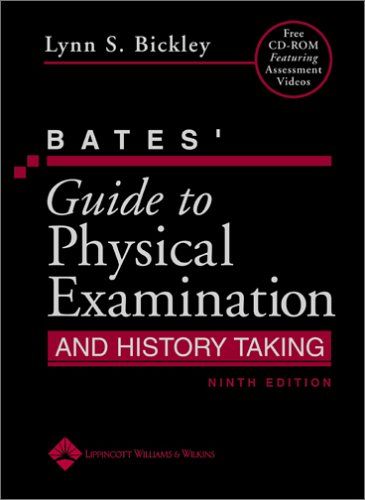
Bates' Guide to Physical Examination and History Taking
Introduction
Nova: If you walk into any medical school library or the office of a seasoned physician, there is one book you are almost guaranteed to find. It is thick, it is heavy, and for over fifty years, it has been the literal foundation of how we train people to become healers. We are talking about Bates' Guide to Physical Examination and History Taking.
Nova: Because it is not just about poking and prodding. It is about the art of the human connection and the science of observation. Written primarily by Lynn S. Bickley today, but founded by the late Barbara Bates, this guide is the gold standard for learning how to talk to patients and how to use your own senses—your eyes, your hands, your ears—to figure out what is wrong before you ever even order a lab test.
Key Insight 1
The Legacy of the Gold Standard
Nova: To understand why Bates is so important, we have to go back to 1974. That is when Dr. Barbara Bates first published the guide. At the time, medical education was becoming increasingly focused on high-tech diagnostics, but she wanted to bring the focus back to the patient.
Nova: Exactly. Barbara Bates was a pioneer. she was a physician, but she also had a deep respect for nursing and the collaborative nature of healthcare. She realized that the most important data point in any medical encounter is the patient's story. She wanted to create a systematic way to capture that story and verify it through a physical exam.
Nova: Yes, Dr. Lynn Bickley has been the lead author for many editions now, and she has kept that spirit alive while modernizing it. What makes it the gold standard is its reliability. It is evidence-based. If Bates tells you to move a patient's leg a certain way to check for a hip issue, it is because there is clinical data showing that specific maneuver actually works.
Nova: It has evolved tremendously. We are now on the fourteenth edition. It has gone from a black-and-white textbook to a full-color, multi-media ecosystem with a massive video library called the Bates' Visual Guide. But the core philosophy remains: the patient is the center of the universe.
Key Insight 2
The Art of the Interview
Nova: Most people think the physical exam is the most important part, but Bates actually spends a huge amount of time on the history taking—the interview. In fact, it is often said that seventy to eighty percent of a diagnosis comes from the history alone.
Nova: Often, yes. But only if they ask the right questions. Bates teaches a very specific framework for this. One of the most famous concepts in the book is the Seven Attributes of a Symptom. Whenever a patient mentions a problem, like a cough or a pain, the student is taught to run through these seven things.
Nova: They are looking for Location, Quality, Quantity or Severity, Timing, Setting, Remitting or Exacerbating factors, and Associated Manifestations.
Nova: Spot on. Timing is when it started and how long it lasts. Setting is what you were doing when it happened. Remitting or exacerbating factors are what makes it better or worse. And associated manifestations are other symptoms, like if your headache also makes you feel nauseous.
Nova: That is a huge part of the Bickley editions. The book emphasizes 'patient-centered communication.' It teaches students how to use open-ended questions, how to show empathy, and how to handle difficult conversations. It even covers how to talk to a patient who is angry, or silent, or even someone who is grieving. It recognizes that if the patient doesn't trust you, they won't give you the information you need to help them.
Key Insight 3
The Science of the Exam
Nova: Once you have the story, then you move to the physical exam. And this is where the book's famous layout comes into play. If you open Bates, you will see a two-column format on many pages.
Nova: On the left side, it describes the normal technique—exactly how to place your hands or where to put the stethoscope. On the right side, in red text, it lists the abnormalities you might find and what they could mean.
Nova: Exactly. And it follows a very specific order: Inspection, Palpation, Percussion, and Auscultation. We call it IPPA.
Nova: Right. Inspection is just looking—really looking—at the patient's skin, their posture, their breathing. Palpation is feeling with your hands for things like tenderness or masses. Percussion is my favorite—it is when the doctor taps on your body with their fingers.
Nova: That is actually a perfect analogy! They are listening for the sound. A hollow sound over the lungs is normal because they are full of air. But if it sounds dull, like tapping on a piece of wood, it might mean there is fluid in there. Bates teaches you how to distinguish those subtle sounds.
Nova: It really is. And Bates covers everything from the top of the head to the tips of the toes. There are entire chapters dedicated just to the eye, or the heart, or the neurological system. It is incredibly granular.
Key Insight 4
Clinical Reasoning and the Aha! Moment
Nova: That is the 'Clinical Reasoning' aspect, and it is one of the most challenging parts of medical training. Bates uses the findings to help students build a 'Differential Diagnosis.' That is basically a list of all the possible things that could be causing the patient's symptoms.
Nova: Precisely. The book teaches you to look for 'red flags.' If a patient has back pain, Bates will tell you the common causes, but it will also highlight the red flags that suggest something serious, like a spinal infection or a tumor. It teaches students to prioritize their thinking.
Nova: It is. And Bates helps by teaching the 'Assessment and Plan' part of the SOAP note. SOAP stands for Subjective, Objective, Assessment, and Plan. The history is subjective, the exam is objective, the assessment is your reasoning, and the plan is what you are going to do about it.
Nova: And it emphasizes that this is a skill that takes a lifetime to master. You don't just read Bates once and become an expert. You carry it with you. You refer back to it when you hear a heart murmur you can't quite identify or when a patient presents with a symptom you haven't seen before.
Key Insight 5
Modern Medicine and Cultural Humility
Nova: This is where the recent editions, especially the thirteenth and fourteenth, really shine. Lynn Bickley and her team have integrated a huge focus on health equity and cultural humility. It is no longer just about the biological body; it is about the social determinants of health.
Nova: Yes. There is expanded content on caring for LGBTQ+ patients, understanding the impact of racism in healthcare, and how to perform a respectful exam on patients from different cultural backgrounds. It moves away from the idea of a 'standard' patient and recognizes the diversity of the human experience.
Nova: Absolutely. And it also addresses the digital age. There is content on telehealth—how do you do a physical exam over a video call? What are the limitations? It even covers how to use point-of-care ultrasound, which is a newer technology where doctors use small handheld devices to see inside the body right at the bedside.
Nova: Exactly. It is teaching students that while the tools might change, the fundamental goal—understanding the patient's story and their physical reality—remains exactly the same.
Conclusion
Nova: We have covered a lot today, from the seven attributes of a symptom to the two-column layout that has helped millions of students. Bates' Guide to Physical Examination and History Taking is more than just a textbook; it is a rite of passage. It represents the moment a student stops just reading about science and starts practicing the art of medicine.
Nova: Well said. Whether you are a student carrying that heavy 'brick' in your backpack or a patient sitting on the exam table, the principles in Bates are what ensure that healthcare remains human. It reminds us that the most powerful tools a healer has are their own senses and their ability to connect.
Nova: It really is. Thank you for diving into this with me. This is Aibrary. Congratulations on your growth!