

** Beyond the Data: Awakening Your Inner Strategist
Golden Hook & Introduction
SECTION
Atlas: Imagine the world is a giant jigsaw puzzle. Society tells you the best way to fit in is to be a corner piece—stable, predictable, easy to place. But what if the world doesn't need another billion corner pieces? What if your true genius lies in being that one, weirdly-shaped piece that completes the picture in a way no one else can? The problem is, most of us are so busy trying to sand down our edges to fit that we forget our unique shape entirely.
Kehinde Olayiwola: That’s a powerful image. It’s the tension between fitting in and standing out, which is something you feel every day in the corporate world.
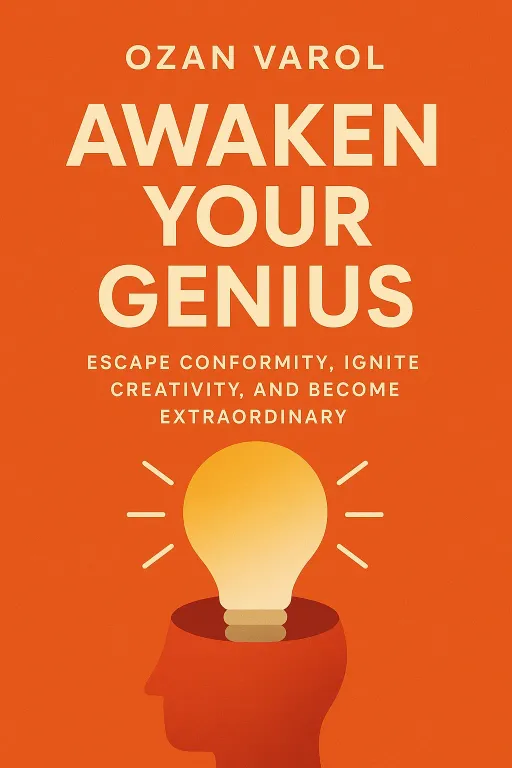
Atlas: Exactly. And in his book 'Awaken Your Genius,' Ozan Varol argues that waking up from this conformity is the first step to an extraordinary life. Today, with our guest Kehinde Olayiwola, a data analyst and strategist whose work lives at the intersection of business growth and personal development, we're going to tackle this from two powerful perspectives.
Kehinde Olayiwola: I'm excited to be here. This book really speaks to the core of what it means to build not just a career, but a meaningful life.
Atlas: Perfect. So first, we'll explore the art of 'unlearning'—how to strategically deconstruct the beliefs holding you back. Then, we'll discuss how to architect your true mission, moving from simply following a path to designing your own. So, Kehinde, let's start with that first, almost counterintuitive step. Varol calls the first part of his book 'The Death.' It's about eliminating who you are. How does that land with you, as someone focused on growth and building?
Kehinde Olayiwola: It sounds destructive, but it’s actually deeply strategic. You can't build something new and robust on a faulty foundation. It’s like trying to run a sophisticated AI model on a 20-year-old computer. Before you can build, you have to clear out the old hardware and outdated software.
Deep Dive into Core Topic 1: Strategic Deconstruction: The Art of Unlearning
SECTION
Atlas: I love that framing. Outdated software. Varol uses a beautiful story to illustrate this. He calls it 'The Snake's Lesson on Living on Your Own Terms.' Imagine a snake in a lush, vibrant jungle. It's born into a world with a set of rules, expectations from the other animals about how a snake should behave. For a while, it tries to conform. It moves how they say it should, hunts when they say it should. But inside, there's this growing turmoil, a sense of deep dissatisfaction.
Kehinde Olayiwola: It’s running on someone else’s code. The system is functioning, but the output feels wrong.
Atlas: Precisely. The snake starts to question everything. It ventures into parts of the jungle it was told to avoid. It faces resistance. But eventually, it comes to a crucial moment. It has to shed its skin. This isn't just a biological process in the story; it's symbolic. It's shedding the old identity, the old beliefs, the expectations that have become too tight and are now restricting its growth. And in that act of shedding, it finds freedom and its own authentic way of being.
Kehinde Olayiwola: That is such a powerful metaphor. In the tech world, we call this 'unlearning' a legacy system. You can't build a fast, new application on top of slow, outdated code. You have to be willing to discard what once worked to make room for what will work. It’s a strategic decision, not just a feeling. It’s about recognizing that the skin that protected you when you were small is now the very thing holding you back.
Atlas: So it’s a conscious choice. You have to decide to shed the skin.
Kehinde Olayiwola: Absolutely. But that raises a critical question. How do you identify to discard? It’s not always obvious. In data analysis, we look for anomalies, for outliers, for patterns that don't fit the model. What are the 'anomalies' in our own thinking we should be looking for? Where do we find the data that tells us a belief is outdated?
Atlas: Varol suggests it’s in those moments of friction, of dissatisfaction, just like the snake felt. It’s the feeling that you’re playing a role rather than living a life. It’s when the advice everyone gives you—the 'common wisdom'—feels hollow. He says we need to 'uneducate' ourselves from the idea that there's one right path and 'discard' the identities that no longer serve us. Are you a 'Data Analyst,' or is that just one skin you're wearing right now?
Kehinde Olayiwola: That’s a fantastic point. The job title is a label, a snapshot in time. It describes a function, but it doesn't define my potential or my purpose. The danger is when we confuse the label with our identity. Discarding it doesn't mean quitting your job; it means detaching your sense of self-worth from the title, so you have the freedom to evolve.
Atlas: You're free to become the next thing.
Kehinde Olayiwola: Right. You create space for growth. The snake doesn't become nothing when it sheds its skin; it becomes a bigger, stronger snake.
Deep Dive into Core Topic 2: Authentic Reconstruction: Architecting Your Mission
SECTION
Atlas: That's the perfect transition, because it leads directly to the second phase in the book: 'The Birth.' Once you've cleared the land, once you've shed the skin, what do you build? And here, Varol argues against the cliché advice to just 'follow your passion.' He says that can be a trap. Instead, he talks about discovering your mission through action.
Kehinde Olayiwola: This is where my analytical brain gets really excited. 'Follow your passion' is a poorly defined instruction. It's like telling a business to 'make a profit' without a strategy. The 'how' is everything.
Atlas: Exactly. And he tells this great story to illustrate the 'how.' It’s about a man in the 1950s working as an appliance salesman. It's a mundane, unfulfilling job, but it pays the bills. Deep down, though, he has this hidden talent, a love for music. He feels a total disconnect between his daily work and his inner world.
Kehinde Olayiwola: A classic case of a misaligned life. The data points of his daily actions don't match his core values.
Atlas: You got it. So, instead of just dreaming, he starts a process. He spends his evenings and weekends writing songs and practicing. He starts performing at small, local bars, just to see what happens. He's collecting data. He faces tons of rejections from record labels, which is more data. But the feedback from the live audiences is positive. So he keeps going. He saves up his own money to record a demo tape.
Kehinde Olayiwola: He’s self-funding his own pilot program. A minimum viable product, essentially.
Atlas: That's it! He's not waiting for permission. He's running an experiment. Eventually, he gets that demo into the hands of a small, independent record label. They see the potential, and they sign him. He quits the appliance store, and he goes on to become a best-selling musician. The point of the story isn't just 'he made it.' It's that he found his mission not by thinking about it, but by doing.
Kehinde Olayiwola: This completely debunks the 'overnight success' myth. It wasn't about passion alone; it was about a process. He was testing a hypothesis: 'Can I make a life from music?' He collected data—the applause, the rejections—and he iterated. This is exactly how a startup finds its product-market fit, or how we refine a predictive model. You don't just launch the final product on day one. You test, you learn, you adapt.
Atlas: So your 'mission' isn't a destination you find on a map...
Kehinde Olayiwola: Exactly. It's a product you develop through experimentation. You have an idea, you build a small version of it, you put it out into the world, and you see how the world responds. Maybe your 'mission' is to be a leader. You don't just declare yourself a leader. You test it by volunteering to lead a small project at work. You see if you enjoy it, if you're good at it, if it creates value. That's how you find your way.
Synthesis & Takeaways
SECTION
Atlas: So, when you put it all together, it’s a clear, two-part process. It’s not mystical at all. First, the courage to deconstruct—to be the snake and shed the skin of conformity and old identities.
Kehinde Olayiwola: The strategic demolition. You have to be willing to let go of what feels safe but is ultimately limiting.
Atlas: And second, the discipline to reconstruct—to be the musician, running small, smart experiments to test your hypotheses about where you can create the most value and find the most fulfillment.
Kehinde Olayiwola: The authentic construction. It’s an iterative, data-driven approach to building a life of purpose. It’s far more empowering than just waiting for an epiphany.
Atlas: I couldn't agree more. It’s about being both the demolition expert and the architect of your own life. So, as we wrap up, what’s the one question or takeaway you’d leave with our listeners?
Kehinde Olayiwola: I think it comes back to that experimental mindset. The question for everyone listening is this: What's one 'legacy belief' you're running on—one piece of outdated software about who you should be or what you should do? And following that, what's one small, low-risk experiment you can run this week to test a new way of being? Don't try to change your whole life. Just run one test. Collect one data point. That’s how the journey begins.
Atlas: That is the perfect, actionable takeaway. Kehinde, thank you so much for bringing your strategic and analytical lens to this. It’s been fantastic.
Kehinde Olayiwola: Thank you for having me, Atlas. It was a pleasure.









